


Building a Compliant Web Scraping Stack for SEO and Pricing Data
-
Last Updated:

23 Jun 2026
-
Read Time:

5 Min Read
-
Written By:
 Isha Choksi
-
734
Table of Contents
Build a reliable and compliant web scraping stack for SEO and pricing intelligence. Learn how to choose the right proxies, improve data quality, ensure legal compliance, secure scraped data, and evaluate vendors for scalable data collection.
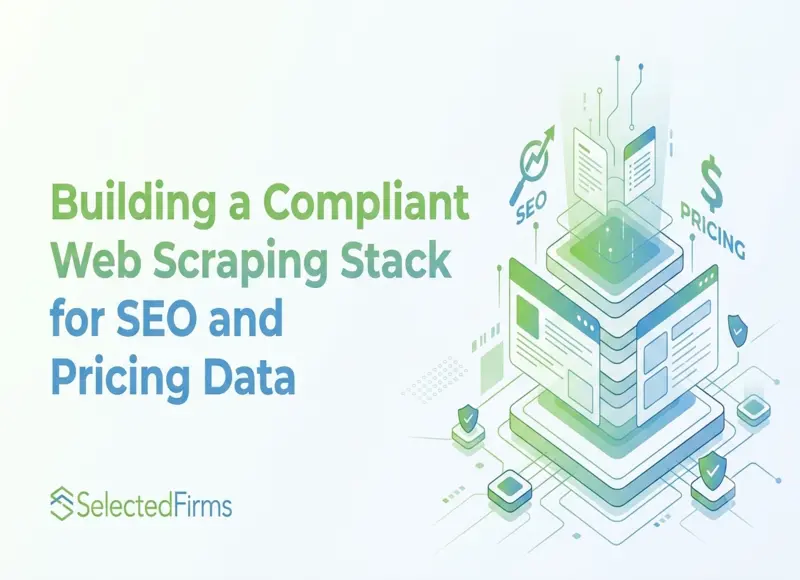
Teams use scraping to track rank, check prices, and spot stock shifts. The hard part rarely sits in the code. The hard part sits in repeat runs without blocks, legal risk, or bad data.
Many businesses use SelectedFirms to compare web scraping and data extraction companies. Whether you build an in-house solution or hire an agency, understanding the fundamentals of a compliant scraping stack helps you evaluate vendors more effectively.
Start with a data spec, not a scraper
Write a short spec before you pick tools or vendors. It keeps costs down and cuts rework. It also helps you compare agencies and data shops on the same scope.
Define the exact pages, fields, and update rate you need. Add rules for locale, device, and logged-in views. Set a hard bar for data checks, like missing fields, dupes, and outliers.
Pick an ID plan early. Use a stable key like SKU, GTIN, or a URL hash. Without it, your team will fight joins and trend lines later.
Match the proxy type to the site and the risk
Most block pain comes from one mismatch. Teams hit a high-risk site with a low-trust IP pool, or they scrape like a bot. Choose the lightest option that still meets uptime and reach.
Datacenter, residential, and mobile IPs
Datacenter IPs run fast and cost less. They work well for low-risk pages, public docs, and wide crawl tests. Many retail and search pages flag them fast, so plan for retries and swap-outs.
Residential IPs map to home networks. They fit geo checks and sites that tie trust to user-like traffic. They cost more, so focus on pages that block hard or need true geo.
Some teams also test mobile proxies. They can help on flows that key trust to mobile carrier IPs. Use them with tight rate caps and clean session rules.
Session design beats raw IP volume
Model a real visit. Reuse cookies per session, keep headers stable, and avoid odd jumps in locale. Rotate IPs based on page risk, not on every request.
Handle 403 and 429 with clear backoff. Add jitter and cap retries per host. You protect your pool and you cut noisy traffic that triggers more blocks.
Use a browser only when you must
Headless browsers solve script heavy pages, but they raise cost and risk. A plain HTTP client runs faster and fails less. Decide per page template, not per site.
Use a browser for pages that render key fields in script. Price widgets, stock labels, and variant lists often load late. Keep the browser path strict and short, and block heavy assets you do not need.
Keep a fallback plan. If the browser path fails, log the raw HTML, a screen shot, and the key events. Those logs speed up fixes when a site ships a new build.
Build compliance into the pipeline
Compliance starts with what you collect. Avoid personal data unless you have a clear legal basis and a real need. If you scrape user posts or reviews, you may pull names and IDs by default.
Set a clear data retention rule. Delete raw pages once you parse and check them. Keep only what you need for audit, fixes, and trend work.
Know the penalty range when you handle personal data. GDPR allows fines up to 20 million euros or 4% of global annual revenue, whichever is higher. CCPA allows statutory damages from $100 to $750 per consumer per incident in some cases.
Track consent and access rules in your logs. Store the time, URL, user agent, and run ID for each fetch. If a site asks you to stop, you can prove what you did and when.
Secure Your Scraped Data
Compliance also includes protecting the information after collection. Even when scraping only public data, access controls help reduce operational risks.
Good practices include:
- Encrypting stored datasets
- Restricting database permissions
- Using audit logs for access history
- Rotating API credentials regularly
- Backing up critical datasets securely
Security measures become increasingly important when multiple teams or external vendors access the same data warehouse.
Questions to ask an agency or data vendor
Many firms hire an agency when scraping grows past one use case. That shift can make sense when you need scale, SLAs, or wide geo. It also helps when legal and IT want one owner.
Ask how the vendor handles blocks and site changes. Ask how they test parsers and stop bad runs fast. Ask how they store data, who can access it, and how they delete it on request.
Ask for a sample run report. It should show fetch rate, error codes, data fill rate, and a change log. If the vendor cannot share those basics, you will not control cost or risk.
Finally, align on output format and handoff. Many teams want a clean feed into BigQuery, Snowflake, or a warehouse in AWS. Put that in scope, along with run time, alert rules, and support hours.
Future-Proof Your Scraping Stack
Websites constantly change their layouts, JavaScript frameworks, and anti-bot systems. Designing your scraping pipeline with flexibility makes adapting to these changes much easier.
Keep parsers modular, version extraction rules, monitor template changes automatically, and document update procedures. A modular architecture reduces downtime when websites introduce redesigns or new anti-automation measures.
What “good” looks like in daily ops
A good scraping stack runs on a schedule and alerts on drift. It ties each data row to a run ID and a page template. It keeps a thin, clear audit trail without storing more than you need.
Teams that treat scraping like a product ship faster insights. They spend less time on one off fixes. They also find it easier to compare tools and vendors on real results, not claims.
FAQs
Rank tracking often runs daily, while pricing and inventory monitoring may require multiple updates per day depending on business needs.
Scraping publicly available information can be lawful in many jurisdictions, but businesses should comply with applicable laws, website terms, intellectual property rights, and privacy regulations.
Residential proxies are generally useful for geo-specific content, retailer pricing, and websites with stricter anti-bot detection.
AI can assist with parser maintenance, anomaly detection, template identification, and data validation, reducing manual effort when websites change.

Head of SEO Operations
Recent Blogs


Elia Martell
5 Virtual Recruiting Support Operations for Tech and Healthcare Teams
-
09 Oct 2026
-
8 Min
-

462


Jane Hart
Why LinkedIn Campaign Optimization Requires More Than CPC and CTR
-
09 Oct 2026
-
8 Min
-
150

Jane Hart
How to Vet an Offshore SEO Partner: A Due-Diligence Checklist for Agencies and Brands
-
08 Oct 2026
-
8 Min
-
249
Jane Hart
Benchmarking GPU Providers: A Practical Guide to Comparing Cloud Compute Options
-
07 Oct 2026
-
6 Min
-
171
