Top Remote Device Recovery Providers Compared: Pricing, Speed, Security & Success Rates
-
Last Updated:

07 Aug 2026
-
Read Time:

10 Min Read
-
Written By:
 Elia Martell
-
41
Table of Contents
Lost laptops cost more than you think. Compare the top remote device recovery providers and find the fastest, safest, and most reliable way to recover company devices.
?Only about half of remote employees return their laptops after leaving, according to Gartner. That missing gear isn't just a line item headache, one unreturned laptop can trigger tens of thousands of dollars in breach forensics, IP exposure, and emergency replacements.
A growing set of specialist vendors now handles the chasing, boxing, tracking, wiping, and recycling for you. This guide ranks the ten best, explains how we scored them, and helps you match each service to your churn rate, geography, and compliance risk.
How We Ranked the Providers
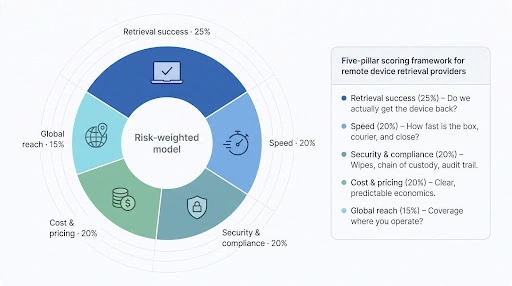
Choosing a device retrieval partner is a risk management decision. Our scoring reflects that, not popularity.
- Retrieval success (25%): Does the service actually get the device back? Industry reports put the average return rate near 50 percent, so we looked for vendors reaching 85 to 90 percent or higher.
- Speed (20%): How quickly a provider ships kits, schedules couriers, and closes the ticket.
- Security and compliance (20%): NIST-level wipes, tamper-evident packaging, and audit-ready certificates that satisfy SOC 2 (a security audit standard) reviewers and regulators.
- Pricing clarity (20%): How transparent per-device fees and seat-based subscriptions are, and whether hidden surcharges (like international duties) show up later.
- Geographic reach (15%): Whether a provider can support a global team, or scale during hiring bursts and layoffs.
A Quick, At-a-Glance Comparison
|
Provider |
Retrieval success |
Speed & convenience |
Security creds |
Pricing approach |
Global reach |
|
Allwhere |
91 % on-time pickups |
Kit ships next-day in 50 countries |
Tamper-evident box, NIST wipe option |
Pay-per-use |
North America, Europe |
|
GroWrk |
≈90 % |
Same-day courier in major cities |
SOC 2, auto wipe certs |
Per-seat subscription |
150+ countries |
|
Firstbase |
95–97 % (with full workflow) |
7-day average close |
SOC 2; MDM lock |
Flat monthly per user |
150+ countries |
|
Deel IT |
High-80 % range |
HRIS-triggered box, carbon-neutral shipping |
ISO / GDPR focus |
Add-on to Deel HR plan |
130+ countries |
|
Workwize |
High-80 % |
1–3-day kit worldwide |
EU R2 partners |
Flat global per-device fee |
120 countries |
|
Quipteams |
88 % |
Label in minutes, standard courier |
Basic chain-of-custody |
On-demand per pickup |
155 countries |
|
Retriever |
85 % |
FedEx foam kit, US/UK/Canada |
Standard wipe |
Lowest cost per device |
3 countries |
|
Iron Mountain |
90 % (SLA) |
Scheduled white-glove pickup |
ISO 27001, R2, SOC 2 |
Enterprise contract |
50+ countries |
|
Onepak |
80–85 % |
Depot program for bulk returns |
Full audit trail |
Volume-based |
Global via partners |
|
Loop Logistics |
75–85 % |
Regional courier |
Local compliance only |
Budget per device |
North America |
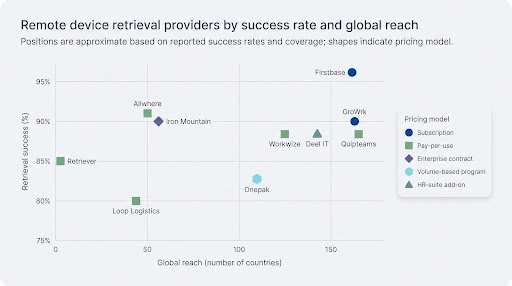
A few takeaways stand out from the table:
- Any retrieval rate above 85 percent beats the industry coin flip average, but only three providers regularly clear 90 percent.
- Subscription models (GroWrk, Firstbase) suit companies offboarding staff every week. Pay per use options (Allwhere, Quipteams) suit companies with light, sporadic turnover.
- Iron Mountain and Onepak are built for regulated enterprises or bulk refresh projects, likely more than a ten-person startup needs.
Top 10 Remote Device Recovery Providers
-
Allwhere
Best fit: mid-size and enterprise employers in North America or Europe with sporadic churn who want top-tier reliability without a monthly contract.
Allwhere leads our list for one reason: it gets the laptop back almost every time. In 2025, the New York-based startup logged a documented 91 percent on-time retrieval rate, nearly double the industry average.
Speed drives that result. The moment your HRIS (HR information system) flags a departure, Allwhere creates a pickup order, a padded, tamper-evident box arrives at the former employee's door with a prepaid label already attached.
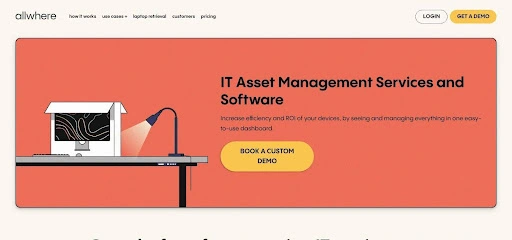
Tracking stays live from doorstep to depot, and you get a timestamped confirmation once the device is scanned in. The same dashboard maps every deployed, stored, or in-transit device, so IT can spot gaps before they turn into incidents.
Teams looking to strengthen asset visibility beyond employee offboarding can also benefit from a guide to IT asset management software, which explains how to track, manage, and optimize devices throughout their lifecycle.
Pricing is pure pay-per-use; cost mirrors actual offboarding volume rather than billing every active seat. Recovered hardware is inspected and routed for redeployment or resale when possible, often offsetting the service fee.
-
GroWrk
Best fit: companies with constant onboarding and offboarding across continents, where flat, unlimited use pricing keeps costs steady.
GroWrk covers 150+ countries, so a departing employee in São Paulo or Seoul goes through the same process as someone in Seattle.
The pricing model is predictable: a flat per-seat subscription covers unlimited pickups, swaps, and redeployments. There's no counting devices or absorbing surprise charges when turnover spikes.
Speed is GroWrk's edge. In more than sixty metro areas, a local courier can collect the laptop the same day; elsewhere, a return kit ships within 24 hours. Shorter shipping times reduce the window during which sensitive data sits outside company control.
Each device reaches a nearby GroWrk depot, where technicians run an on-site, NIST-compliant wipe and upload the certificate to your dashboard. Local disposal avoids cross-border data transfer complications under GDPR.
-
Firstbase
Best fit: teams that want one vendor covering the entire device lifecycle, from deployment through retrieval.
Firstbase started by shipping ready-to-work laptops to new hires and now closes the loop with an automated offboarding flow.
Everything runs on a single monthly per-user fee, so adding or removing a seat in the dashboard triggers every hardware task automatically, from onboarding kits to final pickup.
Firstbase connects to your HRIS and MDM (mobile device management) stack. Mark an employee as terminated, and three actions fire at once: the laptop locks, a prepaid return kit generates, and reminder emails start. The result is a reported 95 to 97 percent recovery rate with an average seven-day turnaround.
Every scan, doorstep pickup, depot arrival, wipe completion, writes to an audit log you can export as a PDF for SOC 2 review.
-
Deel IT
Best fit: teams already inside Deel for HR who want hardware retrieval handled with the same automation as contracts and payroll.
Deel IT (formerly Hofy, acquired by Deel in 2024) puts device retrieval on the same screen as final pay for companies already running payroll and compliance through Deel.
End an employee's contract in Deel, and a pickup order fires automatically. A carbon-neutral return kit arrives, the courier scans the box, and IT receives a real-time certificate confirming the laptop was wiped to NIST standards.
Success rates sit in the high 80s, slightly behind Allwhere's figures, but consistent across 130+ countries thanks to an established logistics network.
Sustainability reporting is built in: every shipment's carbon footprint is offset, and quarterly dashboards convert returned devices into CO? savings for ESG reporting.
-
Workwize
Best fit: mid-size companies with moderate global spread that want one predictable per-device price.
Workwize solves an awkward budgeting problem: a laptop return from Nairobi typically costs far more than one from New York. Workwize charges one flat global fee per device regardless of location.
Coverage spans 120 countries through regional depots on three continents. Keeping most returns inside the same customs zone trims delays, a French employee ships to an EU warehouse, a Singaporean employee to an Asia hub, and most kits arrive within two to three days.
The process is simple: log a retrieval in the portal, a branded box arrives, and the employee schedules pickup in one click. Technicians run a certified EU standard wipe on arrival and post the destruction or redeploy certificate to your account. Machines still in good condition are refurbished and stored for the next hire, or resold with proceeds credited back.
-
Quipteams
Best fit: startups with light turnover and tight budgets that want occasional retrieval without a long-term contract.
Quipteams is built for companies that don't need a subscription or enterprise contract, enter an address, get a kit, done.
Pricing is pay-as-you-go, typically $80 to $150 per pickup depending on location. For companies with attrition below ten percent a year, that often costs less than a monthly seat plan.
Through courier partnerships, Quipteams reaches 155 countries with roughly 88 percent retrieval success, solid, given there's no persistent employee tracking workflow. Each shipment is tracked end to end, devices are wiped on arrival, and a destruction or redeploy certificate posts to the dashboard.
-
Retriever
Best fit: cost-focused teams based in North America and the UK offboarding a handful of employees each month.
Retriever keeps things simple: order a pickup, and a foam-lined FedEx box lands at the former employee's address within two business days across the United States, the UK, and Canada, with some of the lowest per-device fees in this category.
Coverage is the trade-off; Retriever operates in just three countries, so teams with staff in Asia or Latin America will need a secondary provider. Within its home region, about 85 percent of devices return on schedule, well above the industry average.
Security is practical rather than premium: tamper seals, tracked shipping, and a drive wipe or forward-to-IT option on arrival. Certifications stop at standard vendor attestations rather than SOC 2.
-
Iron Mountain
Best fit: banks, hospitals, government contractors, and other organizations where an auditor or regulator will ask for proof of every wipe or destruction event.
Iron Mountain, a 75-year-old information management firm, treats each laptop like a piece of legal evidence, logged, sealed, tracked, and audit-ready throughout.
Uniformed couriers scan the serial number at pickup and secure the device in a GPS-tracked container. Every handoff appears in a tamper-proof chain of custody report that satisfies ISO 27001, SOC 2, HIPAA, and related standards.
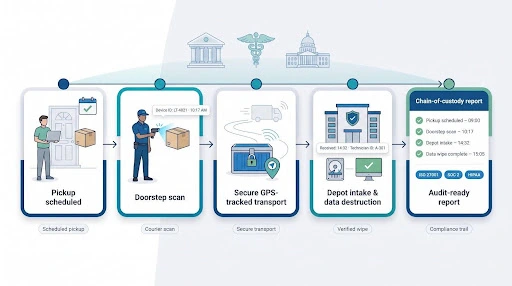
Success rates approach 90 percent under enterprise SLAs (service level agreements), and the depot network spans 50+ countries. Turnaround is slower than smaller providers, so pickups are planned days in advance, heavily regulated clients generally accept that trade-off for airtight paperwork.
Pricing is custom, scoped by asset volume, security tier, and destruction requirements.
-
Onepak
Best fit: companies facing bulk returns or cyclical tech refreshes that standard courier kits can't handle economically.
Onepak's ReturnCenter platform is built for offboarding events involving dozens or hundreds of devices at once, a store closure, a data center refresh, or a mass layoff.
Schedule pickups in the dashboard and track pallets, cartons, and single boxes moving toward regional depots on a live map. The platform connects to ServiceNow, so IT tickets can trigger shipments directly.
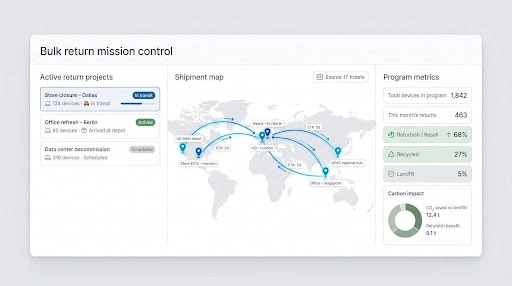
Success rates land in the low to mid 80s, solid at high volume, and tiered, program-based pricing lowers per-unit cost as volume increases. Onepak pairs with certified ITAD (IT asset disposition) vendors to wipe or shred drives, logging every event in an immutable audit trail, and tracks carbon impact for ESG reporting.
-
Loop Logistics
Best fit: North American teams with light compliance needs and a mandate to minimize cost per device.
Loop Logistics serves a narrow niche: US and Canada-based teams that need a low-cost way to retrieve gear quickly.
Orders trigger a regional courier pickup, often within 24 hours, using a sturdy but basic cardboard kit. Short routes and local depots keep per-device fees under $80 in most metro areas.
Retrieval success lands between 75 and 85 percent, behind the category leaders, but the savings may outweigh the gap for lower-risk fleets. IT still receives basic tracking and a signed data wipe confirmation, though Loop doesn't carry SOC or ISO certifications.
Picking the Right Partner for Your Reality
Match these four questions to your own risk, geography, and budget profile:
- Churn: Frequent offboarding favors a subscription platform (GroWrk, Firstbase). Low, sporadic turnover favors pay per use (Allwhere, Quipteams).
- Footprint: Teams spread across continents need 100+-country networks (GroWrk, Deel IT, Workwize). Teams anchored in a few cities can save with regional players (Retriever, Loop Logistics).
- Compliance: Regulated industries need airtight paperwork, Iron Mountain for strict chain of custody, Onepak for bulk return audit trails. Most other companies are covered by NIST-level wipes from mid-tier vendors.
- Resale appetite: Providers that refurbish, redeploy, or resell recovered gear (Allwhere, Workwize) can offset costs and turn a cost center into recovered budget.
Once you've answered those four questions, pilot your shortlist with five to ten devices and compare the real experience against the promises above before rolling out at scale.
Ready to stop chasing laptops over email? Request a quote from two or three providers on this list that match your churn and footprint, and compare their pilot terms side by side before committing to a contract.
FAQs
Set clear return terms in the offer letter. Where local law allows, tie final pay or severance to equipment return. If reminders fail, send a formal notice or pursue legal action.
No. A remote wipe secures company data, but many compliance standards also require certified destruction or physical device recovery with proper documentation.
The employer usually covers all shipping costs. Most retrieval services include prepaid labels or courier pickup, making the return process simple for employees.
Yes. Most providers can retrieve peripherals, though larger items may require an extra box and an additional fee. Low-value accessories are often not worth returning.
Use a data recovery specialist if you need lost files. Laptop retrieval providers focus on recovering hardware, securely wiping data, and maintaining compliance records.

Marketing Manager
Recent Blogs
Elia Martell
How to Select an Enterprise IT Agency for Active Directory Modernization & Disaster Recovery
-
07 Aug 2026
-
5 Min
-

85


Isha Choksi
How 3D Architectural Animation Is Transforming Digital Real Estate Marketing
-
06 Aug 2026
-
8 Min
-
84

Jane Hart
Best SaaS Tools Every Startup Needs to Streamline Operations
-
31 Jul 2026
-
6 Min
-
122