


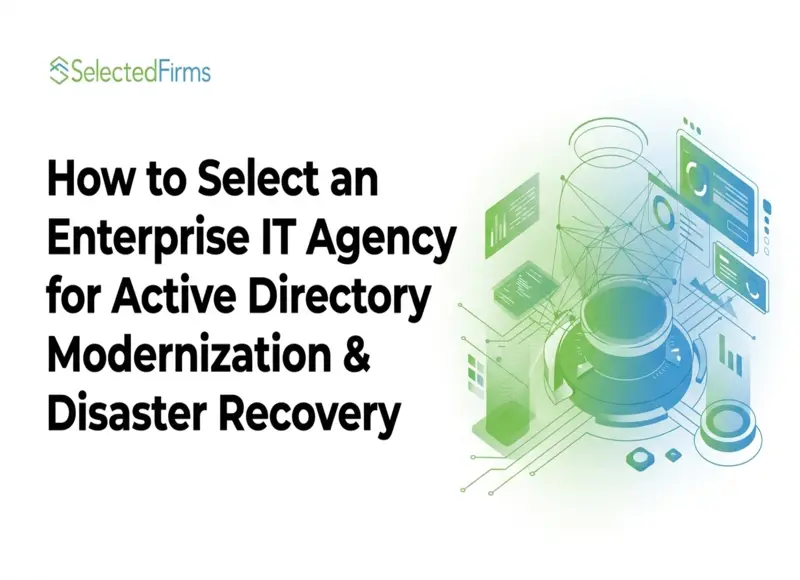
How to Select an Enterprise IT Agency for Active Directory Modernization & Disaster Recovery
-
Last Updated:

07 Aug 2026
-
Read Time:

5 Min Read
-
Written By:
 Elia Martell
-
1261
Table of Contents
Choosing the wrong IT agency can put your entire business at risk. Learn how to evaluate partners for Active Directory modernization and disaster recovery before an outage puts your operations on hold.
Most procurement conversations start in the wrong place. They begin with vendor shortlists and feature comparisons, before anyone defines what failure actually looks like.
With Active Directory (AD), that's a costly sequencing error. AD isn't just another workload. It's the authentication layer every other system depends on. So the first question isn't "what do they offer?"
It's: do they understand what happens when AD goes down, and how fast can they bring it back?
Choosing an enterprise IT Agency for Active Directory
There's a real difference between an agency that manages Active Directory and one that architects it for resilience.
Most managed service providers handle daily admin: account provisioning, group policy, replication monitoring. Far fewer have real depth in recovering AD when it's compromised or unavailable.
Ransomware increasingly targets domain controllers directly, because taking down AD takes down the whole organization at once. An agency without a tested, documented AD recovery runbook isn't ready for that scenario.
Ask directly: what recovery time have they actually achieved in a real AD forest recovery, not a theoretical one? If they're vague about restore sequencing or backup integrity, that's a signal.
Many agencies also split "modernization" and "disaster recovery" into separate teams. For AD, that's a structural problem, since decisions made during modernization directly shape how recoverable the environment is later. Both should sit with the same team.
If you're comparing IT service companies, look beyond their service list and verify they have proven experience handling both modernization and disaster recovery under one team.
5 Questions to Ask an Enterprise IT Agency
Skip the checklist. Present a real failure scenario instead:
Ransomware has encrypted three of five domain controllers. Backup files are corrupted. Your last clean backup is 36 hours old.
Ask the agency to walk through recovery step by step. A qualified team should be able to speak clearly to each of these:
|
Recovery Question |
What a Strong Answer Sounds Like |
|
Restore sequencing |
Explains why domain controllers get restored in a specific order, not just that they do |
|
Backup integrity risk |
Understands how virtual snapshots can silently corrupt directory data, and how to avoid it |
|
Residual attacker access |
Has a method for confirming attackers aren't still inside the recovered environment |
|
Replication after partial recovery |
Can explain how AD resyncs once some servers are back online |
|
Tooling |
Uses purpose-built AD recovery tools, not just the built-in Windows backup |
That last row matters more than it seems for active directory disaster recovery outcomes. Built-in backup tools have real limitations in complex environments with multiple domains. Agencies that rely on them exclusively are working with a narrower safety margin than they may let on.
Common Mistakes When Evaluating Enterprise IT Agencies
Reference calls are useful, but agencies pick their own references. These questions dig deeper.
- Ask for real documentation. Request a sample recovery runbook or a past disaster recovery test report. Agencies with genuine depth produce these routinely. Agencies that mostly resell software often can't.
- Ask how the agency secures its own environment. Strong agencies use dedicated, secured workstations and separate privileged accounts based on access levels. If they don't follow these practices internally, they're unlikely to provide the level of security your business needs.
- Ask if they can prove a clean recovery. Restoring access isn't the same as restoring a safe system. A strong agency can compare the recovered directory against a pre-attack backup to confirm no malicious changes were reintroduced. Most agencies won't volunteer whether they can actually do this.
How Active Directory Modernization Reduces Risk
Disaster recovery is the emergency. Modernization is where the slow-building risk lives.
Outdated AD setups quietly create the exact vulnerabilities that make a disaster scenario possible in the first place. Think flat permission structures, unused accounts, service accounts with too much privilege, and incomplete cloud identity sync.
A strong agency won't jump straight into modernization work. They'll start with a security assessment: mapping privilege exposure, auditing delegated permissions, and documenting what breaks if a given component changes.
That assessment becomes the baseline for setting realistic recovery targets, instead of setting them against an environment nobody fully understands.
Considering a modernization or disaster recovery partner? Before signing anything, ask for a sample runbook and a walkthrough of a real recovery scenario. It's the fastest way to separate agencies with real depth from those without it.
Conclusion
Choosing an enterprise IT agency isn't just about comparing services or certifications. It's about finding a partner that can modernize your Active Directory environment while keeping it secure and recoverable when the unexpected happens.
The right agency will have proven recovery experience, documented processes, and a clear understanding of how modernization decisions affect long-term resilience. Taking the time to ask the right questions today can help you avoid costly downtime and recover with confidence when it matters most.
FAQs
Active Directory controls user authentication and access across your organization. If it goes down, employees may lose access to critical systems. A solid recovery plan minimizes downtime and business disruption.
Ask about their experience with real AD recoveries, recovery runbooks, disaster recovery testing, and recovery timelines. Their answers should be specific and backed by real examples.
Look beyond certifications and references. Request documentation from past recovery tests and ask them to explain how they would recover your environment step by step.
Yes. Modernization removes outdated configurations, strengthens security, and makes recovery faster and more reliable. It also helps reduce risks before an incident occurs.
Watch for vague recovery plans, no documented testing, reliance only on built-in backup tools, and weak internal security practices. These can indicate limited real-world recovery experience.

Marketing Manager
Recent Blogs
Elia Martell
5 Virtual Recruiting Support Operations for Tech and Healthcare Teams
-
09 Oct 2026
-
8 Min
-

627

Jane Hart
Why LinkedIn Campaign Optimization Requires More Than CPC and CTR
-
09 Oct 2026
-
8 Min
-
189
Jane Hart
How to Vet an Offshore SEO Partner: A Due-Diligence Checklist for Agencies and Brands
-
08 Oct 2026
-
8 Min
-
323
Jane Hart
Benchmarking GPU Providers: A Practical Guide to Comparing Cloud Compute Options
-
07 Oct 2026
-
6 Min
-
187
