


Table of Contents
Stay ahead of the competition with the top web development trends in the USA. Discover how AI, headless CMS, edge computing, accessibility, and performance optimization are reshaping digital experiences and business outcomes.
Key Takeaways
- AI-native engineering workflows are transforming web development in the United States as of 2026, with AI-assisted development now embedded in daily delivery.
- Server-first rendering, edge computing, and Core Web Vitals are now tied directly to SEO visibility, ad efficiency, user experience, and conversion rates.
- ADA/WCAG compliance, DevSecOps, Zero Trust architecture, and privacy readiness are no longer optional for US-facing websites.
- Composable, API-first, headless CMS, and serverless architectures are replacing rigid monoliths in enterprise web development.
- Buyers should use verified reviews and transparent rankings on SelectedFirms to compare credible partners and reduce delivery risk.
The State of Web Development in the USA for 2026
The USA web development trends market in 2026 is defined by speed, compliance, AI automation for measurable business impact. Between 2023 and 2026, the web development landscape shifted from design-led redesigns to AI-assisted workflows, edge-first delivery, stricter accessibility mandates, and performance engineering.
According to Google DORA reporting cited by TechRepublic, roughly 90% of software development professionals use AI tools at work, while accessibility research shows thousands of ADA digital lawsuits annually in the US.
For CMOs, CTOs, and product leaders, these trends influence SEO, conversions, security, and growth. Modern websites use programming languages & frameworks like Next.js, headless CMSs, and API-first systems, with a focus on expertise and outcomes.

Top 10 Latest Web Development Trends Reshaping the USA in 2026
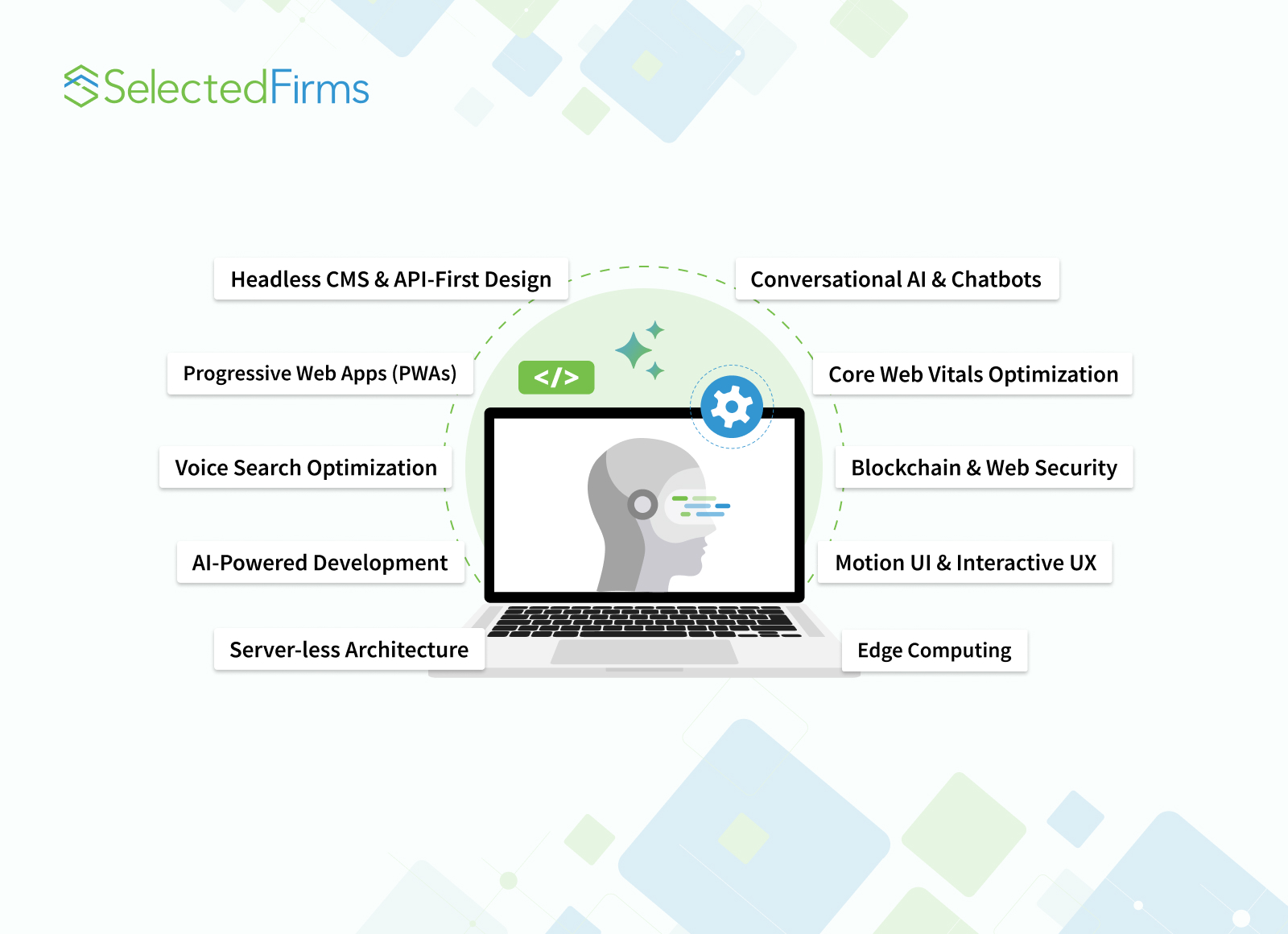
As we approach 2026, web development in the USA is changing fast. New technologies like AI-assisted development, flexible system designs, and faster website performance are reshaping how businesses create digital experiences. These trends help web developers build websites that are scalable, secure, and engaging. Business leaders need to understand these changes to improve their online presence, increase sales, and stay competitive in the market.
AI-Assisted and AI-First Web Development Workflows
By 2026, AI-assisted tools will streamline coding processes, enabling developers to focus on complex tasks. Over 65% of US developers use artificial intelligence daily, driving faster development & more efficient development workflows.
Key trends in AI-assisted web development include:
- Widespread adoption of AI coding assistants like GitHub Copilot and Tabnine to automate repetitive tasks and provide real-time suggestions.
- Integration of AI tools for code refactoring, testing, and documentation generation, improving development speed and accuracy.
- Use of design-to-code automation to generate UI components, reducing manual effort while maintaining agency oversight.
- Emphasis on governance frameworks to manage AI-generated code quality, security reviews, and licensing compliance.
- Growing reliance on artificial intelligence to enhance engineering capacity, enabling more experiments and faster feature delivery without sacrificing technical expertise.
Artificial Intelligence Inside the Product: Conversational Interfaces and Agentic UX
According to Gartner, over 40% of enterprises will deploy AI-powered chatbots or virtual assistants to enhance customer engagement and streamline workflows by the end of 2026. These AI-driven conversational systems improve user interaction by providing personalized, real-time responses that drive conversions and reduce operational costs.
Key factors driving this trend include:
- Integration of advanced AI models, such as OpenAI’s GPT series and Anthropic’s Claude, to enable natural language understanding and generation.
- Deployment of AI agents in ecommerce, SaaS dashboards, and enterprise portals to automate support, product discovery, and workflow management.
- Use of cloud-hosted machine learning models on platforms like AWS and Google Cloud for scalable, low-latency AI interactions.
- Business benefits such as lowered support costs, enhanced lead qualification, and increased user engagement through personalized content.
- The necessity for agencies to possess skills in prompt engineering, compliance monitoring, human escalation workflows, and AI safety guardrails to ensure effective implementation.
Server-First, Edge Computing, and Core Web Vitals as Revenue Drivers
Server-first architecture is increasingly preferred to improve website performance and SEO rankings. Studies show that websites loading in under 2.5 seconds experience a 15% increase in conversion rates, underscoring the business value of fast, efficient web delivery.
Key factors driving this trend include:
- Use of modern frameworks like Next.js, Remix, and Astro that leverage server-side rendering (SSR) and streaming to enhance first paint times and crawlability.
- Adoption of edge computing platforms such as Vercel Edge Network and Cloudflare Workers to reduce latency for real-time tasks like personalization and authentication.
- Emphasis on Google’s Core Web Vitals—loading speed, interactivity, and visual stability—as critical benchmarks impacting user satisfaction and search engine visibility.
- Demonstrated correlation between faster load times and higher ecommerce revenue, with US brands reporting double-digit uplifts when key performance metrics meet recommended thresholds.
Performance practices and business results:
|
Practice |
Business impact |
|
Server-side rendering and streaming |
Faster first load, stronger SEO, improved performance |
|
Edge functions |
Lower latency for US regions and better personalization |
|
Code splitting and lazy loading |
Smaller JavaScript payloads and smoother web applications |
|
Image optimization and CDNs |
Faster product pages and higher conversion rates |
|
Jamstack |
Jamstack (JavaScript, APIs, Markup) is one of the most influential architectures in web development, enabling instant loading through pre-rendered pages and global distribution via Content Delivery Networks (CDNs). |
Serverless architecture eliminates the need for developers to manage physical servers, leveraging cloud computing for scalability, efficiency, and security. Cloud platforms like AWS Lambda, Google Cloud Functions, and Azure Functions provide auto-scaling capabilities, improving performance during traffic surges without requiring manual intervention.
The adoption of serverless architecture is expected to continue to grow, as it allows developers to focus on writing and deploying applications faster while reducing infrastructure costs. In buyer checklists, Google Cloud Functions, AWS Lambda, and Azure Functions should be assessed for reliability, observability, and cost control.
Optimizing for Core Web Vitals and ADA/WCAG Compliance
Core Web Vitals and ADA/WCAG compliance have become essential for website success, impacting not only user experience but also legal standing and revenue. In 2025, Accessibility Build reported 3,117 federal digital-accessibility lawsuits, highlighting the urgent need for compliance. Professional web development teams now prioritize these standards to avoid legal risks and enhance usability.
Key practices include:
- Utilizing tools like Lighthouse, WebPageTest, axe, and WAVE for comprehensive accessibility and performance audits.
- Implementing performance optimizations such as critical CSS, HTTP/3, image CDNs, prefetching, and lazy loading to ensure fast load times.
- Adopting semantic HTML, ARIA best practices, keyboard navigation support, and captioned video to meet accessibility requirements.
- Embedding accessibility and performance checks into continuous integration (CI) pipelines to maintain standards throughout development.
- Ensuring legal and compliance mandates are integrated from project inception to minimize risk and improve user experience.
Composable, API-First Architectures and Headless CMS Adoption
Composable architecture has become a dominant trend in enterprise web development, offering enhanced flexibility and scalability. According to recent industry reports, over 60% of enterprises are adopting headless CMS and modular systems to better manage content and commerce across multiple digital platforms.
This approach separates content, commerce, search, payments, and personalization into distinct services, enabling seamless integration across websites, mobile apps, kiosks, connected TVs, and partner portals. By decoupling content creation from presentation, marketing teams can update campaigns without the need for front-end code redeployment, resulting in faster time-to-market and improved scalability during traffic surges.
Key benefits and considerations include:
- Support for multiple platforms, ensuring consistent user experiences across devices.
- Increased scalability and reduced risk during seasonal traffic spikes.
- Ability to deliver tailored solutions across different brands and channels.
- Necessity for strong API governance, security measures, and observability to manage complexity.
- Adoption of TypeScript for end-to-end type safety across front-end, APIs, and back-end services to enhance code quality and maintainability.
Full Stack Development in a Composable World
Full-stack development has changed. Full-stack teams now own front-end, server logic, edge functions, CI/CD, logs, traces, and performance monitoring. Common combinations include Next.js on Vercel, Remix on Fly.io, Astro with serverless functions, and TypeScript with tRPC, Prisma, or PlanetScale.
For business leaders, full-stack development means fewer handoffs, faster experiments, and better accountability for outcomes. Agencies should explain which web development technologies they standardize on, how they ship across cloud platforms, and how they monitor production issues.
This is especially important for site owners building dynamic websites, progressive web apps, and user-friendly websites with offline access and real-time interactions, who must also understand the differences between web design vs web development costs when choosing partners.
Progressive web apps combine the best features of web and mobile applications, providing fast, reliable, and engaging experiences directly through web browsers, and modern web design and UX trends that drive business growth further enhance engagement and competitiveness.
Content, Commerce, and Digital Marketing Integration
In the US market, website development, ecommerce, and digital marketing are converging into measurable web experiences. Modern builds connect Shopify, BigCommerce, headless CMSs, analytics, CDPs, search, experimentation tools, and personalization engines. SEO, paid media, email, and social performance all depend on fast, structured, crawlable web foundations.
AI now supports content creation through draft copy, automated product descriptions, localization, metadata, and schema suggestions. Human oversight remains essential because search engines reward originality, usefulness, and clear information architecture.
Over 80% of websites on the internet are inactive, presenting a unique opportunity for businesses to stand out by keeping their sites active, secure, and relevant, especially when partnering with top agentic AI development and services firms that can operationalize AI across web and product experiences.
From Static Sites to Intelligent, Personalized Experiences
Personalization helps make user experiences better and keeps people engaged on websites and apps. By using first-party data and advanced customer data platforms (CDPs) such as Segment and RudderStack, businesses can deliver content and offers that match what their audience wants. With more than half of all web traffic now coming from mobile devices, it’s essential to partner with experienced web design companies that prioritize a mobile-first approach, ensuring websites deliver a seamless experience across smartphones, tablets, and desktops.
Key trends supporting this include:
- Use of geo-specific US landing pages to tailor content based on visitor location.
- Implementation of account-based marketing pages for personalized B2B engagement.
- Behavior-based recommendations that adjust dynamically to user interactions.
- Mobile-first design ensures faster load times and improved usability on smaller screens.
- Voice search optimization, adapting content for conversational queries, with schema markup to enhance search engine understanding.
- Incorporation of Motion UI elements through frameworks like GSAP and Framer Motion to create interactive and engaging web experiences.

Security, Compliance, and DevSecOps in US Enterprise Web Development
Security maturity now separates credible agencies from risky vendors. According to recent studies, 20% of websites encounter security vulnerabilities during development, underscoring the critical need for robust security practices.
Key factors demonstrating the importance of security in enterprise web development include:
- Integration of cybersecurity best practices to protect sensitive user data and maintain business credibility.
- Adoption of DevSecOps, embedding security measures directly into development lifecycles to identify and mitigate vulnerabilities early.
- Utilization of advanced tools such as Snyk, Checkmarx, and OWASP ZAP for continuous threat detection and automated dependency scanning.
- Implementation of Zero Trust architecture within API designs to address expanding attack surfaces.
- Increasing reliance on blockchain technology to secure transactions, ensure data integrity, and support transparent record-keeping.
Regulatory and Accessibility Compliance for the US Market
US-focused web applications must account for ADA/WCAG, healthcare, finance, education, and privacy frameworks such as CCPA/CPRA. Many 2026 RFPs require WCAG 2.1 AA conformance statements, ongoing audits, and evidence of inclusive design.
Businesses should ask for accessibility reports, compliant case studies, keyboard testing results, color contrast documentation, and remediation histories, and global-facing teams should pair these with specialized translation and localization services to meet regional language and regulatory requirements. This proactive approach reduces legal exposure and improves user expectations for all customers.
Nearshore and Hybrid Web Development Models for US Companies
Nearshore web development is growing because US companies face talent shortages, rising salary expectations, and increasing demand for specialization in many programming languages. Many vendors listed on SelectedFirms blend US-based strategy leads with nearshore engineering teams in Canada, Latin America, and other close time zones.
The benefits include cost efficiency, overlapping working hours, English proficiency, cultural alignment, and access to new tools. For strategic planning, many buyers also hire consultants to validate architecture choices and delivery models. For cross-border shortlists, compare US web development companies and Canadian web developers.
Red Flags to Avoid in Nearshore Web Development: Governance and Communication Pitfalls
However, several red flags can indicate potential pitfalls in nearshore web development partnerships, such as a lack of relevant experience, unclear security policies, non-transparent pricing, and poor communication.
Red flags to watch for include:
- Lack of US-based client references or case studies signals possible gaps in relevant experience.
- Unclear or missing cross-border data privacy and security policies increase the risk of compliance issues and breaches.
- Vague, inconsistent, or non-transparent pricing and billing practices may cause budget issues.
- Poor or infrequent communication and status updates lead to reduced transparency and delayed problem-solving.
- Inadequate documentation of project progress, decisions, and deliverables risks misalignment and accountability.
These issues often reflect governance weaknesses and communication gaps that jeopardize project success. To mitigate risks, buyers should rely on verified client reviews and methodology-driven rankings on SelectedFirms, grounded in its SelectedFirms Agency Ranking Methodology (SARM), providing insights into agency delivery discipline, communication effectiveness, and compliance standards.
What to Look for in a US Web Development Agency in 2026
Hiring a web development partner worldwide is a strategic decision that impacts your project's success. Evaluate agencies based on their technical stack, AI-assisted development maturity, Core Web Vitals expertise, ADA/WCAG compliance, DevSecOps practices, industry specialization, and post-launch support.
- Strong agencies demonstrate expertise in React, Next.js, TypeScript, Node.js, Python, Shopify, WordPress, headless CMS, serverless architecture, app development, and cloud computing.
- They commit to continuous learning to stay ahead of emerging technologies such as virtual reality, mixed reality, AI agents, low-code/no-code platforms, edge computing, and machine learning to drive impactful business outcomes.
- Low-code/no-code platforms empower non-technical users to build applications visually, reducing reliance on traditional coding.
- Adoption of low-code/no-code solutions is growing, streamlining workflows and enabling teams with varied technical skills.
- By 2026, low-code/no-code tools will complement traditional development, automating routine tasks and speeding time-to-market without sacrificing quality.
Using SelectedFirms to Find and Compare Top Web Development Companies
SelectedFirms helps businesses compare top web development, ecommerce development, AI development, and digital marketing agencies using verified client feedback and the SARM™ methodology. Filters for location, hourly rate, industry, tech stack, and reviews help align agency capabilities with project scope and budget.
Buyers can start with SelectedFirms’ web development directory, review case studies, compare pricing models, and shortlist agencies that can deliver innovative solutions, outstanding performance, and long-term digital solutions. Agencies can also get listed on SelectedFirms to attract high-intent clients and verify profiles to improve marketplace trust.

Conclusion: Turning 2026 Web Development Trends into Competitive Advantage
The latest trends in modern web development are practical business levers. AI-assisted development accelerates delivery, composable architecture improves scalability, Core Web Vitals improve conversions, and DevSecOps reduces operational risk.
Companies that stay ahead will not chase every new technology; they will choose web technologies that support measurable growth, secure operations, and engaging websites. To compare proven partners, explore top web development companies in USA, or evaluate nearshore options through web development companies in Canada.
FAQs
Core Web Vitals, mobile-first UX, ADA/WCAG accessibility, structured data, server-first rendering, and edge computing matter most. These foundations improve crawlability, speed, usability, Quality Score, and conversion performance.
No. Headless CMS adoption is valuable for multi-brand, multi-channel, or content-heavy organizations. Smaller companies may still be better served by optimized WordPress or Shopify if they do not need a complex composable architecture.
AI will not remove the need for web app development providers. It will shift demand toward product-minded, full-stack, architecture-focused teams that can use AI safely, validate code, manage security, and ship reliable web applications.
Simple marketing sites often start in the low five figures. Mid-market commerce or composable builds usually fall in the mid- to high-five figures. Complex enterprise platforms commonly start in the low six figures and increase with integrations, compliance, and scale; a dedicated 2026 web development pricing guide by region and service can help refine these estimates.
Use modular architecture, strong performance baselines, accessibility from day one, clean content models, secure APIs, and platforms with large ecosystems such as React, Next.js, WordPress, Shopify, and major headless CMSs.


Head Of Digital Marketing
Recent Blogs

Elia Martell
5 Virtual Recruiting Support Operations for Tech and Healthcare Teams
-

09 Oct 2026
-

8 Min
-

477
Jane Hart
Why LinkedIn Campaign Optimization Requires More Than CPC and CTR
-
09 Oct 2026
-
8 Min
-
155
Jane Hart
How to Vet an Offshore SEO Partner: A Due-Diligence Checklist for Agencies and Brands
-
08 Oct 2026
-
8 Min
-
263
Jane Hart
Benchmarking GPU Providers: A Practical Guide to Comparing Cloud Compute Options
-
07 Oct 2026
-
6 Min
-
173
