


How to Select an AI-Augmented Retail BPO Provider
-
Last Updated:

28 Oct 2026
-
Read Time:

10 Min Read
-
Written By:
 Elia Martell
-
10
Table of Contents
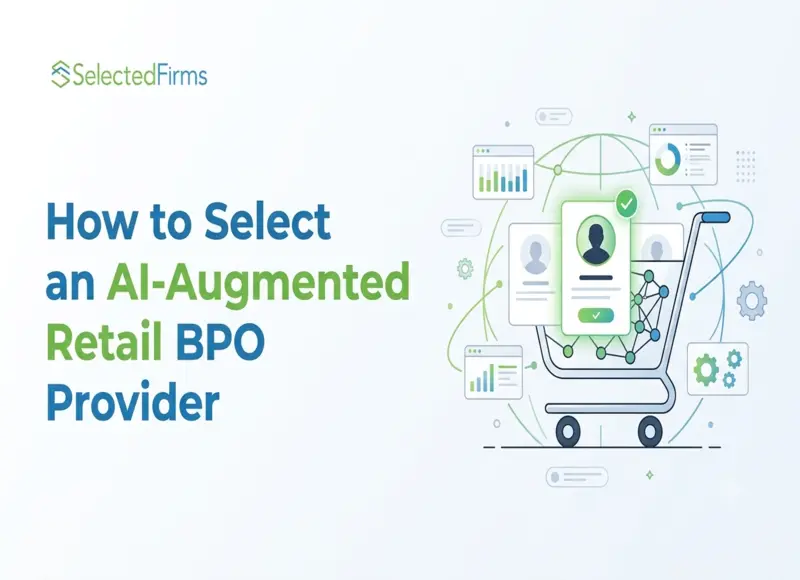
Can a retail BPO handle Black Friday demand without sacrificing customer experience? Compare six providers, examine their AI capabilities, and learn how to check their results before you commit.
Most retailers choose a BPO based on price per agent. That is the wrong place to start.
A flash sale can triple your ticket queue overnight. So can a carrier delay or one viral product. Your provider must handle that spike. Shoppers who wait too long will buy elsewhere.
To select an AI-augmented retail BPO provider, ask one question: how well does the vendor split work between AI and people? A long client list can hide a weak handoff. A smaller vendor can run a cleaner setup.
This guide gives you a scoring method. It compares six providers side by side. It also lists the contract checks you should run before you sign.
Quick Answer
Start with your ticket mix. Then score each vendor on five things: AI ownership, handoff design, retail experience, quality of proof, and fit.
Helpware, TP (formerly Teleperformance), Concentrix, TaskUs, Foundever, and TTEC all mix AI with human agents. They differ in size, in who owns the AI, and in how much retail proof they publish.
What Does an AI-Augmented Retail BPO Provider Do?
An AI-augmented retail BPO runs your customer support and back-office work. It uses AI and human agents together. AI takes the contacts where the data is clean and a wrong answer costs little. Agents take escalations and any chat where tone or judgment matters.
The work splits like this:
|
Retail task |
What AI handles |
What human agents handle |
|
“Where is my order?” |
Status checks and delivery updates |
Lost parcels, split shipments, and carrier disputes |
|
Returns and refunds |
Eligibility checks, return intake, and refunds within approved rules |
Policy exceptions, chargebacks, and disputed payments |
|
Product questions |
Catalog answers, sizing, and stock checks |
Comparisons and advice that need judgment |
|
Quality checks |
Scoring every chat for accuracy and tone |
Coaching and final review |
|
Fraud and abuse |
Flagging odd orders and accounts |
Final account decisions and customer replies |
Good providers of ecommerce and retail BPO services can show you where each task sits. Weak providers say “AI-powered support” and stop there.
That gap is your first filter.
Which Retail Support Tasks Can AI Automate?
Volume and repeat requests are a good start. They are not a rule. Four things decide the split: what data the AI can see, how sure it is, what your policies allow, and what a wrong answer costs you.
An order status request looks simple. It stops being simple when carrier data and your order system disagree. It also stops being simple when the order carries a fraud flag. Your provider needs clear rules for those cases.
Treat AI predictions as predictions
Gartner predicts that by 2029 AI will resolve 80 percent of common customer service issues without a person. It also expects operating costs to fall by 30 percent.
That is a forecast. No retail BPO can promise it.
Plan for customers who want a person
Gartner surveyed 5,728 customers in December 2023. 64 percent said they would prefer companies not use AI for customer service. 53 percent said they would consider switching to a competitor. The survey covers all sectors. It does not isolate retail shoppers.
Customers said their top worry was reaching a person. So the handoff matters most. A handoff is the moment AI passes a chat to an agent. Send each contact to the channel that solves it well and keeps risk low. A cheap contact that brings the customer back twice does not save money.
How to Evaluate an AI-Augmented Retail BPO Provider
Picture a DTC brand before Black Friday. Most tickets ask about order status and returns. A smaller share covers damaged goods and fraud. Your vendor should automate the first group and protect the second.
Score each provider on these five points:
|
Criterion |
What to check |
Strong answer |
Red flag |
|
AI ownership and connections |
Who builds and runs the AI, and who links it to your order system, helpdesk, CRM, and knowledge base |
A named platform or in-house AI with clear APIs and clear owners |
“Our AI” with no detail |
|
Handoff design |
The rules that pass a chat from AI to an agent |
The agent sees the full chat and customer details |
Customers repeat themselves |
|
Retail experience |
A retail team and named retail clients |
Peak-season results from similar retailers |
Averages from other industries |
|
Quality of proof |
Where each number comes from and what it covers |
A retail case study with clear scope |
Pilots or forecasts sold as results |
|
Fit |
Company size, your markets, and how often your catalog changes |
An account lead who matches your scale |
One standard program for every client |
Check AI ownership and connections
Ask who builds the links between the BPO platform and your tech stack. Ask who fixes them when your catalog or policies change. If the vendor owns none of this, your engineers will.
Check the handoff
Ask for the handoff rules in writing. Make sure the agent picks up where the bot stopped. Make sure the same rules apply during peak volume.
Check the quality of proof
Sort every number into one of three groups: measured results, pilot results, and forecasts. A retail case study from the vendor helps. A pilot from another industry helps less. A forecast from a launch announcement helps least.
How Do Six AI-Augmented Retail BPO Providers Compare?
The six providers below differ in their retail experience, AI capabilities, delivery scale, and published results.
Their figures are not directly comparable: some come from retail case studies, while others reflect client pilots or broader company capabilities.
Use this table to identify which providers fit your requirements, then verify each result and its relevance to your retail operation before making a decision.
|
Provider |
Best for |
Retail scale |
AI layer |
Published retail result and evidence type |
|
Helpware |
Mid-size retailers, DTC brands, and marketplaces |
19 locations and 45+ languages |
AI chat and voice, agent assist, AI quality checks, smart routing |
50 to 60% more inquiry capacity at peak with AI triage. 90% CSAT |
|
TP |
Global brands that need many countries |
329 retail, ecommerce, and B2B sales clients. 40,000 experts |
TP.ai Connect, TP.ai Assist, and TP.ai FAB |
7 to 9% CSAT gain at a packaged food client |
|
Concentrix |
Large firms that want one AI platform |
Retail client count not stated in the sources I reviewed |
iX Hero agent assist and ready-made order status and product support agents |
13.5% CSAT gain and 22% shorter handle time |
|
TaskUs |
Digital-first brands that want AI that acts on its own |
60,000+ specialists across 30 sites in 13 countries |
AI consulting with Decagon and Regal |
25 to 50% lower support cost |
|
Foundever |
Retailers with many languages and channels |
80+ retail clients. 20,000+ retail agents |
EverAssist agent tools, chatbots, and voicebots |
$10 million+ saved for one retailer |
|
TTEC |
Retailers that want AI quality checks and faster coaching |
50,000+ employees across six continents |
AI chat insights, Grammar Assist, and AI quality checks |
60% less time spent finding coaching moments at a luxury retailer |
What to check with each provider
- Helpware. Helpware reports 50–60% more inquiry-handling capacity during peak periods with AI triage and 90% CSAT. Ask how these figures were measured, which retail program they represent, and whether the results were achieved together. Confirm that Helpware can cover your required markets, languages, and seasonal demand.
- TP. TP offers several AI products, including TP.ai Connect, TP.ai Assist, and TP.ai FAB. Ask which tools are deployed in live retail programs, what tasks they handle, and how they connect with your order management system and customer support platform. Also, confirm which team will manage implementation and ongoing performance.
- Concentrix. Concentrix reports a 13.5% CSAT improvement and 22% shorter handle time through iX Hero client pilots. These figures should not be treated as retail-specific results without further evidence. Ask for retail case studies that show the baseline, measurement period, and impact on resolution rates and customer satisfaction.
- TaskUs. TaskUs has announced AI partnerships with Decagon and Regal, with a potential 25–50% reduction in support costs. This is an expected outcome, not a verified result across retail programs. Ask for live retail deployments, measured cost savings, and evidence that automation resolves customer issues without increasing repeat contacts or escalations.
- Foundever. Foundever reports more than $10 million in savings for one retailer through a broader customer experience transformation. The result should not be attributed to AI alone. Ask how much of the savings came from automation versus workforce changes and process improvements. Also, request retail-specific performance data for EverAssist, including its impact on handle time, resolution rates, and customer satisfaction.
- TTEC. TTEC reports a 60% reduction in the time spent identifying coaching opportunities in a luxury retail project. This demonstrates the potential of AI-assisted quality management, not autonomous customer support. If you want to automate customer conversations, ask for separate retail results showing resolution rates, escalation frequency, and customer satisfaction.
What Should You Verify Before Signing a Retail BPO Contract?
Published results can help you shortlist vendors, but you still need to verify they fit your business.
Compare each provider’s retail experience, AI capabilities, and verified client reviews. You can also explore BPO service providers to identify other potential partners before requesting proposals.
Then press each finalist on these points:
- Name the owner of every connection. Decide who builds and fixes the links between the BPO platform, order system, helpdesk, CRM, and knowledge base.
- List costs beyond the per-agent rate. Include AI usage fees, setup work, training, transition, and upkeep.
- Set service targets for normal weeks and peak weeks. Tie them to CSAT, first-contact resolution, and cost per solved contact. Skip raw deflection.
- Decide who controls the AI. Name who approves model changes. Name who reviews wrong answers. Name who can switch automation off.
- Lock in data and exit rights. Confirm who owns chat data, prompts, settings, and knowledge files. Confirm how you get them back when the contract ends.
- Match security proof to the work. PCI DSS covers any system that stores, handles, or sends card data. Outsourcing doesn't remove your duty to monitor the provider. Find out which rules apply and who owns each control. Ask for the SOC 2 report with its scope, dates, exceptions, and fixes.
- Ask for proof of scale. Request results from a similar peak. Do not accept “we can add agents” as an answer.
Deflection can hide failure. A bot that closes a ticket without solving it still counts as deflected.
What Should Retailers Prepare Before Implementation?
Many failed BPO programs share one cause. The retailer’s own inputs are messy. AI answers are only as good as your policies, your catalog data, and your access to order data.
Vague return rules produce mixed AI answers. Mixed answers cause refund leaks and repeat contacts. Both hurt your revenue and your shoppers’ trust.
Finish this prep before launch:
- Write down every policy exception. Your agents and your AI need the same playbook.
- Split last year’s tickets by type. Separate simple contacts from complex ones.
- Clean your catalog and order data. Fix gaps before you connect them to AI.
A strong provider will push you on this. A weak one will skip it and sell you the platform.
Conclusion
Selecting an AI-augmented retail BPO provider comes down to the handoff and the proof behind it. The right partner automates low-risk contacts. It also protects the chats that put revenue at risk.
Map your ticket mix. Score each vendor on AI ownership, handoffs, retail experience, proof, and fit. Then hold every vendor to retail results and written contract terms.
FAQs
Ask for the written handoff rules. They show how the vendor splits work. They also show whether agents see the full AI chat.
Dedicated teams usually charge a monthly fee per agent. AI work may cost a fee per solved contact. Ask for a quote that also lists setup, training, transition, and upkeep.
Start with high-volume tasks where the data is clean and a wrong answer costs little. Order status, delivery times, and return eligibility fit this group. Keep policy exceptions, damaged-goods claims, and fraud decisions with people until your AI proves itself.
Only your contract answers that. Define who owns chat data, prompts, settings, and knowledge files before you sign. Require a clear export process.
Global providers cover more countries and languages. They also give you backup capacity. Mid-size providers often give you closer attention and faster changes. Pick the one that matches your markets and how often your policies change.

Marketing Manager
Recent Blogs


Jane Hart
React vs. Angular vs. Vue: Which Stack Should You Ask Your Agency to Use?
-
27 Oct 2026
-
13 Min
-

45
Jane Hart
Best B2B Review Sites for Finding Trusted Digital Service Agencies
-
26 Oct 2026
-
14 Min
-
65
Elia Martell
5 Virtual Recruiting Support Operations for Tech and Healthcare Teams
-
09 Oct 2026
-
8 Min
-
1056
