


Table of Contents
AI agents are reshaping enterprise automation by moving beyond rule-based systems toward intelligent, autonomous workflows. This article explores how businesses are integrating AI agents as operational infrastructure to improve efficiency, scalability, an
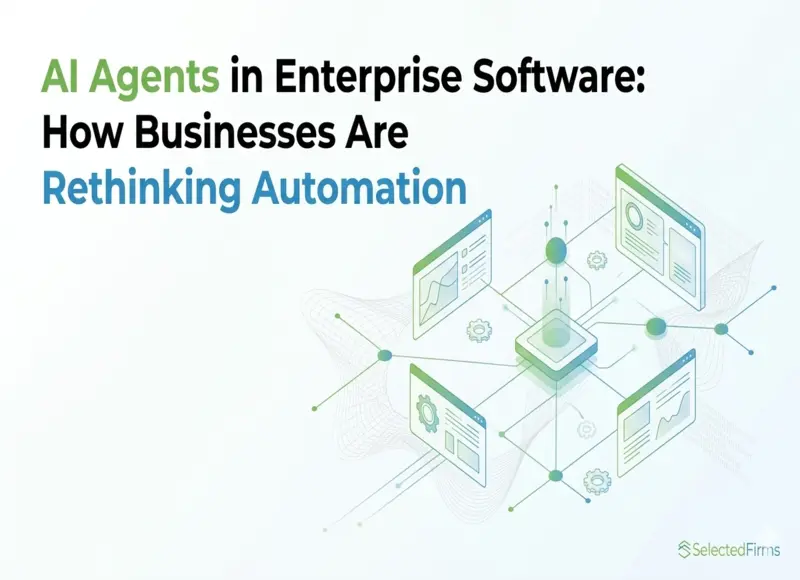
Artificial intelligence is moving beyond isolated tools and chatbot interfaces. Businesses today are increasingly focused on systems that can execute multi-step workflows, coordinate across software environments, and adapt decisions over time.
This change has pushed the idea of AI agents into the domain of enterprise. Now, AI agents are seen not as mere assistants awaiting inputs, rather as operational levels that can plan, reason, and execute actions within the business ecosystem.
For companies evaluating technology partners or digital transformation strategies, understanding this transition is becoming essential.
Why Traditional Automation Is No Longer Enough
This change has pushed the idea of AI agents into the domain of enterprise. Now, AI agents are seen not as mere assistants awaiting inputs, rather as operational levels that can plan, reason, and execute actions within the business ecosystem.
Common limitations include:
- Inability to adjust when data changes
- Heavy dependence on manual oversight
- Poor interoperability across multiple systems
- Difficulty scaling complex workflows
As businesses grow, these constraints increase operational friction and slow execution speed.
AI addresses this vacuum by combining all sorts of actions which will involve reasoning, memory and tool coordination. So, instead of blindly performing predefined rules, agents increasingly evaluate possibilities and decide on the next action within the permissible boundary.
What Makes AI Agents Different From Standard AI Tools
Many corporations frequently incorporate AI-enabled functionalities like content generation, analytics assistants, or recommendation engines. Nonetheless, these applications often do not communicate with each other.
AI agents introduce several new capabilities:
- Goal-driven execution rather than single-step responses
- Multi-tool coordination across APIs and enterprise software
- Continuous feedback loops that refine decisions over time
- Operational autonomy within defined governance frameworks
This allows organisations to automate not just tasks but complete workflows - from data gathering and analysis to execution and reporting.
Companies exploring this transition often look toward specialised AI agent development services to build systems that integrate securely with enterprise infrastructure and internal processes.
The Role of LLM Customization in Enterprise AI
A major challenge in enterprise adoption is that general-purpose AI models rarely understand domain-specific language, business logic, or compliance requirements.
Without adaptation, organisations face issues such as:
inconsistent outputs
hallucinated information
weak alignment with internal processes
low trust among operational teams
This is why customisation has become a core step in production AI deployments.
Customizing large language models (LLM) according to modality or retrieval-augmented generation (RAG) or instruction alignment allows the models to adapt to the company's specific data and lexicon. Models that are customized for language-based tasks often result in a greater level of reliability and better internal adoption because the results become closer to the actual operational context.
AI Agents as an Operational Layer
One of the most important trends for 2026 is the shift from “AI tools” to “AI-enabled operations.”
Instead of adding standalone AI features, companies increasingly integrate intelligence directly into workflows such as:
- customer service orchestration
- internal knowledge management
- compliance monitoring
- reporting and analytics automation
- cross-system process execution
This approach allows organisations to preserve existing software investments while improving efficiency through incremental automation.
Industry platforms focused on enterprise AI transformation are positioning AI agents as long-term operational infrastructure rather than experimental technology. Nextigent AI
What Businesses Should Consider Before Adoption
Before deploying AI agents, decision-makers should evaluate several factors:
- Governance and Security
Agents must operate within clearly defined permissions and monitoring systems. - Integration Strategy
Successful adoption depends on connecting agents to real business tools and data sources. - Performance Observability
Teams need visibility into agent decisions, actions, and outcomes. - Scalability
Pilot projects should be designed with enterprise expansion in mind.
Companies that treat AI agents as strategic infrastructure - rather than short-term experimentation - tend to achieve more sustainable results.
Additional Strategic Insights: Expanding the Enterprise AI Agent Conversation
Measuring the Real Business Impact
Beyond efficiency improvements, AI agents are beginning to influence broader strategic metrics. Enterprises deploying mature agent frameworks report improvements in:
- End-to-end process cycle time
- Cross-functional coordination speed
- Decision latency reduction
- Customer resolution effectiveness
- Operational cost predictability
Because workflows rather than tasks are being handled, the value one ends up getting is added over departments. This goes for long durations towards efficiency at the structural level instead of just relentless hikes in productivity.
AI Agents and Workforce Evolution
A common concern surrounding enterprise AI is workforce displacement. However, the practical reality in 2026 looks different.
AI agents are increasingly positioned as digital collaborators rather than replacements. They handle:
- Data-heavy analysis
- Process routing
- Status monitoring
- Repetitive cross-system updates
This allows human teams to focus on strategy, relationship-building, and exception management. In many organisations, AI agents are reducing burnout by removing administrative overload rather than eliminating roles.
Architectural Considerations for Enterprise Deployment
Successful AI agent systems typically operate within a layered architecture that includes:
- A customised language model layer
- Secure API orchestration
- Enterprise data connectors
- Memory and state management
- Audit logging and monitoring tools
This structure ensures agents operate within defined guardrails while still delivering meaningful autonomy.
Enterprises that skip architectural planning often struggle with scalability, performance bottlenecks, or compliance exposure.
The Competitive Implications of Autonomous Operations
As adoption increases, AI agents are becoming competitive differentiators.
Organisations capable of automating complex workflows with agentic automation can:
- Launch services faster
- Respond to market changes more rapidly
- Reduce operational bottlenecks
- Maintain consistency across global operations
In highly competitive industries, execution speed is often more valuable than strategy alone. AI agents enhance execution capacity at scale.
Looking Ahead: Multi-Agent Ecosystems
The next evolution in enterprise AI involves coordinated multi-agent systems.
Rather than deploying a single agent per workflow, organisations are beginning to experiment with:
- Specialised agents for finance, HR, and operations
- Agents that collaborate on shared objectives
- AI-managed dashboards that monitor workflow health
- Self-optimising automation systems
This represents a shift from intelligent features to intelligent infrastructure.
Closing Perspective
Enterprise automation is no longer about reducing repetitive work. It is about redesigning how operational systems function.
AI agents mark a turning point — moving organisations from rigid process automation to adaptive, goal-driven execution. As businesses continue navigating digital transformation in 2026 and beyond, the focus will shift toward building resilient, governed, and scalable AI ecosystems.
The companies that succeed will not simply deploy AI.
They will operationalise it.


Head Of Digital Marketing
Recent Blogs

Elia Martell
5 Virtual Recruiting Support Operations for Tech and Healthcare Teams
-

09 Oct 2026
-

8 Min
-

477
Jane Hart
Why LinkedIn Campaign Optimization Requires More Than CPC and CTR
-
09 Oct 2026
-
8 Min
-
155
Jane Hart
How to Vet an Offshore SEO Partner: A Due-Diligence Checklist for Agencies and Brands
-
08 Oct 2026
-
8 Min
-
263
Jane Hart
Benchmarking GPU Providers: A Practical Guide to Comparing Cloud Compute Options
-
07 Oct 2026
-
6 Min
-
173
