


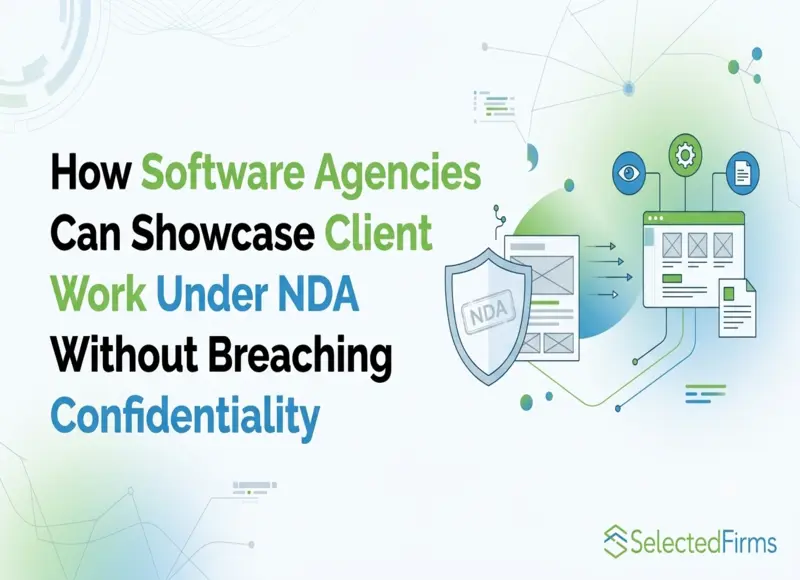
How Software Agencies Can Showcase Client Work Under NDA Without Breaching Confidentiality
-
Last Updated:

18 Sep 2026
-
Read Time:

6 Min Read
-
Written By:
 Isha Choksi
-
369
Table of Contents
NDAs can limit what agencies show, but they don't have to erase the proof of their expertise. From anonymized case studies to verified reviews, learn how software development agencies can showcase their expertise, build buyer trust, and demonstrate projec
Your agency just delivered a project you’re genuinely proud of. The client is happy, the results are strong, and your team finally has a project that could show prospects what you’re capable of.
Then comes the problem: you can’t show it to anyone.
The client has an NDA, the product is confidential, and suddenly your best work becomes the one project you can’t put in your portfolio, case studies, or sales deck. That matters because 73% of B2B decision-makers say case studies influence their vendor choices, according to the Content Marketing Institute.
So, how do you build credibility when your strongest work has to stay behind closed doors?
An NDA doesn’t mean you have to stay silent. It means you need a different playbook, one that helps software development agencies demonstrate their experience without exposing confidential client information.
Key Takeaways
- Reviews and social proof now carry more weight than named case studies. 90% of software buyers say social proof shaped their research stage (Gartner Digital Markets, 2025).
- You can showcase NDA-protected work through anonymization, sanctioned excerpts, process storytelling, and verified third-party reviews, without breaching your agreement.
- The strongest long-term fix is negotiating a case-study carve-out clause into the MSA/SOW before the project starts, not after it ends.
- Anonymizing a case study isn't automatically safe. Combining industry, team size, region, and timeline can still re-identify the client.
The NDA Trap: Why Agencies Lose Business They've Already Earned
Client confidentiality exists for good reason. Proprietary code, unreleased products, and competitive positioning all need protection. But that same protection quietly starves the agency's own marketing pipeline. While legal teams focus on shielding the client, sales and marketing teams are left without the proof buyers now expect by default.
Gartner Digital Markets' 2025 Tech Trends Survey of 3,500 software buyers found that 90% said some form of social proof, whether reviews, comparison sites, or testimonials, directly shaped their research stage. If your best work is invisible, buyers simply move to the agency whose work isn't.
What Your NDA Actually Blocks: A Quick Comparison
Not every NDA restricts the same things, and most agencies never check which tier they've actually signed. Before assuming you can't say anything, read your agreement against this breakdown:
|
NDA Type |
Can You Name the Client? |
Can You Describe the Project? |
Can You Share Metrics? |
|
Lockdown |
No |
No, not even generically |
No |
|
Standard |
No |
Yes, in general terms |
Only if anonymized |
|
Embargo |
Yes, after a set date |
Yes, once embargo lifts |
Yes, once embargo lifts |
Most agencies default to treating every NDA as a Lockdown NDA out of caution, and lose marketing material they were actually entitled to use.
Struggling to translate NDA-restricted results into something a prospect can actually see? SelectedFirms gives buyers a verified, third-party signal even when the case study itself has to stay confidential.
Build the Fix Into Your Contracts, Not After the Fact
The single biggest gap in how agencies handle this: they try to solve it after the project ends, when leverage is gone. The fix belongs in the MSA or SOW, negotiated at kickoff, alongside the rest of the terms. A simple carve-out clause, granting the agency rights to publish an anonymized summary, request written sign-off on a sanitized case study, or reference the engagement generically in sales conversations, costs nothing to ask for early and becomes nearly impossible to secure retroactively.
Five Ways to Showcase the Work Right Now
- Get written sign-off on a sanitized version. A short, specific request to the client's legal or procurement contact, not a vague "can we mention this?", gets faster approvals.
- Anonymize thoroughly, and flag the re-identification risk. Stripping the client's name isn't enough. Industry, team size, region, and timeline together can still make the client identifiable to a competitor. Vary or omit at least one of these.
- Password-gate a detailed version. Share specifics only with serious, vetted prospects rather than publishing them openly.
- Tell the process story, not the client story. Methodology, stack decisions, and problem-solving approach are rarely covered by an NDA, even when outcomes are. This is also where designing a clean, visual before-and-after narrative pays off: a well-designed process walkthrough, mocked up using video and image generation platforms like Higgsfield when designing Nano Banana for anonymized UI screens or workflow diagrams, can carry the story without a single confidential detail in frame.
- Let verified reviews do the talking. 84% of B2B buyers begin their purchasing process with a reference or recommendation (TrustRadius, 2025). A verified review on a platform like SelectedFirms validates outcomes without exposing confidential specifics.
Win the Pitch Without Naming the Client
Sales and BD teams need scripts, not just written policy. When a prospect asks "can you show us something similar?", the strongest response describes the problem category and outcome type: "we've solved this exact scaling issue for a mid-market fintech client," without naming names. Pair that with a verified review count and category ranking on a trusted directory, and the credibility gap closes without a single confidential detail changing hands.
Want your team's pitch decks to hold up in an RFP without naming restricted clients? Browse verified software development agency reviews to see how competitors frame anonymized proof points.
Mistakes That Actually Breach an NDA
A few habits quietly cross the line even when the intent is caution:
- Blurring screenshots, often reversible or reconstructable
- Stray logos or usernames left visible in screenshots or dashboards
- Exact metrics shared even after removing the client name
- Triangulation identification, industry, city, and team size combined, even with the name removed
An NDA restricts what you can say. It doesn't have to restrict whether buyers trust you, and between contract-stage carve-outs, careful anonymization, and verified third-party reviews, agencies have more room to prove their work than most realize. Get your agency listed and reviewed on SelectedFirms to start building that proof today.00000000000000
FAQs
Not on its own. If industry, region, team size, and timeline are still visible together, the client may still be identifiable. Anonymization needs to address all of these, not just the name.
Most do, but the term varies by contract. Check the specific expiration date or trigger event rather than assuming a standard timeframe.
Yes. It costs nothing to request at kickoff and is the only reliable way to guarantee future marketing rights, since asking after the project ends rarely succeeds.
No. A visible logo defeats the purpose of anonymization regardless of how carefully the surrounding text is written. Treat the logo, screenshots, and written content as one confidentiality unit, not three separate decisions.
Shift to process-only content and verified reviews instead of pushing for a compromise. Documenting your approach, tools, and problem-solving method, without referencing the engagement at all, still builds credibility while fully respecting the client's decision.

Head of SEO Operations
Recent Blogs

Elia Martell
5 Virtual Recruiting Support Operations for Tech and Healthcare Teams
-
09 Oct 2026
-
8 Min
-

462

Jane Hart
Why LinkedIn Campaign Optimization Requires More Than CPC and CTR
-
09 Oct 2026
-
8 Min
-
149
Jane Hart
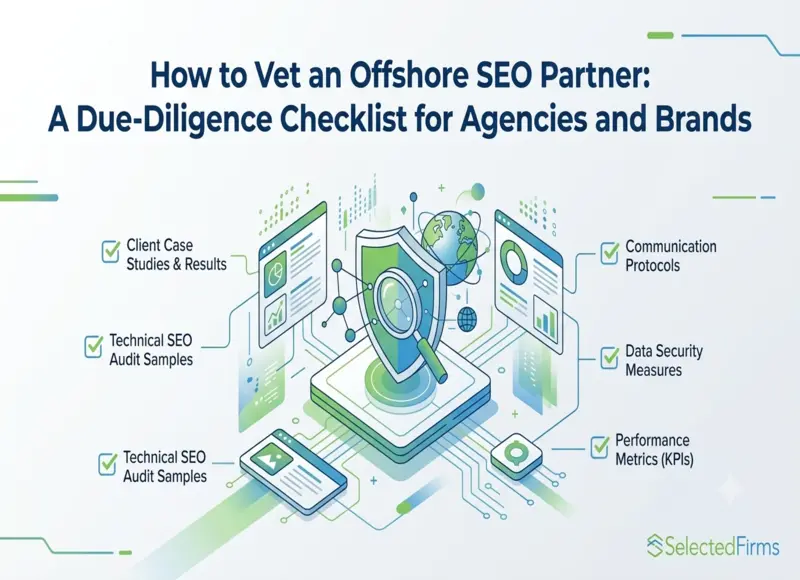
How to Vet an Offshore SEO Partner: A Due-Diligence Checklist for Agencies and Brands
-
08 Oct 2026
-
8 Min
-
249
Jane Hart
Benchmarking GPU Providers: A Practical Guide to Comparing Cloud Compute Options
-
07 Oct 2026
-
6 Min
-
171
