


Table of Contents
CPC and CTR show what a click costs. They do not show which companies you reached. Learn which metrics to track instead, how to optimize LinkedIn campaigns for B2B pipeline, and which platforms help.
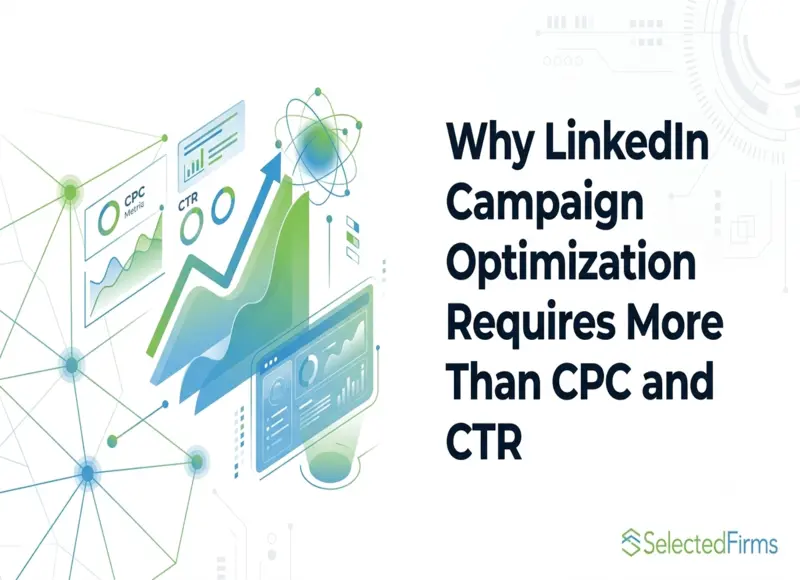
LinkedIn campaign optimization fails when it starts with the lowest CPC. The auction delivers whatever the objective asks for. Ask for cheap clicks and it finds them.
Those clicks tend to come from broad audiences who are browsing rather than evaluating. A B2B marketing team can watch CPC fall from $11 to $7 and add nothing to pipeline.
This guide shows what CPC and CTR hide. It also covers which metrics replace them and how to optimize LinkedIn campaigns for B2B pipeline. Then it compares six platforms that support the work.
Why Does a Lower CPC Not Mean Better LinkedIn Campaign Results?
Cost per click measures the price of attention. It says nothing about whether the right company paid it.
Metadata's 2026 benchmark report shows the gap. In 2025, a customer cost $35,288 on LinkedIn for companies with 51 to 200 employees and $130,468 at 501 to 1,000. The same report finds that leads cost more in the 51 to 200 group than in the 1,001 to 5,000 group. Leads cost the most exactly where customers cost the least.
Cheap leads and cheap customers are different things. Push CPC down and your spend drifts toward whoever clicks easily. It does not follow whoever buys.
Dreamdata reaches the same conclusion from another angle. Its 2026 benchmarks report cost per company influenced rather than cost per click alone. B2B deals involve several buyers. One click proves very little.
What Do CPC and CTR Hide in Your LinkedIn Campaigns?
Four things stay invisible in the ratios. Each one changes your ad spend more than CPC does.
Who Is Behind the Impression?
A campaign targeting "marketing directors at software companies" reaches a mix of titles and companies that LinkedIn chooses. Campaign Manager shows that mix mostly as aggregated demographics. Two campaigns with the same CTR can reach completely different accounts.
What Happens After the Click?
A pricing page visit from a target account and a bounce from a student cost the same. The difference shows up in the CRM three months later. It only shows up if someone connects the two. A B2B marketing agency can set up that tracking if your team lacks the time.
When Does the Money Get Spent?
Delivery runs around the clock unless you add scheduling. An impression at 2 a.m. on a Sunday costs the same as one during a buyer's working day. Only one of them had a chance.
How Often Does the Same Company See the Ad?
Native reporting makes per-company frequency hard to see. An account that sees your ad forty times can look the same as forty accounts that see it once.
Which Metrics Should You Replace CPC With?
Start with the ideal customer profile (ICP). Then measure spend against the accounts that match it.
|
Metric |
Question it answers |
Source |
|
Cost per account that fits |
Are you paying to reach ICP companies? |
Ad spend divided by ICP accounts reached |
|
Pipeline from reached accounts |
Do those accounts move forward? |
CRM and attribution data |
|
Frequency per company |
Is one account absorbing the budget? |
Company-level ad data |
|
Closed-won revenue by campaign |
Which campaign produced revenue? |
CRM synced to LinkedIn |
Cost per account that fits comes first. Pipeline from those accounts comes second. CPC and CTR become diagnostics rather than goals.
How Do You Optimize LinkedIn Campaigns for B2B Pipeline?
Work through four levers in order. Each one fixes a gap from the section above. LinkedIn ads optimization works when audience, schedule, frequency, and revenue signals are managed together rather than one at a time.
Fix the Audience First
List every job title and company your campaign delivers to. Remove the ones outside your ICP. A campaign with a strong CTR and the wrong audience is still the wrong campaign.
Control Hours and Frequency
Limit delivery to your buyers' working days and hours. Set a frequency cap per company so no single account absorbs the budget.
Cap Spend and Suppress Closed Accounts
Set a monthly ceiling per campaign. Stop advertising to accounts that are already closed. Both changes protect budget without touching reach among open accounts.
Send Revenue Back to LinkedIn
Use the LinkedIn Conversions API to send closed-won deals back with their value. LinkedIn's auction then learns from revenue events instead of form fills. LinkedIn reports that Conversions API users see 20% lower cost per acquisition and 31% more attributed conversions than standard setups.
Which Platforms Support LinkedIn Campaign Optimization?
Each platform below optimizes toward a different outcome. The table shows the outcome and the levers each one holds.
|
Platform |
Optimizes toward |
Levers it holds |
Published price |
|
DemandSense |
ICP accounts reached and pipeline created |
Hours, per-company frequency, job-title and company tuning, monthly ceiling, closed-account suppression, Conversions API |
From $89/mo; 30-day free trial, all features |
|
Fibbler |
Deals influenced |
Pause-based scheduling, impression caps, job-title exclusions |
$89 / $129 / $159 |
|
Linklo |
Delivery efficiency |
Dayparting, budget pacing, A/B tests |
$99/mo |
|
Factors.ai |
Account engagement |
Bid scheduling, impression control, bulk exclusions from Basic |
Not published |
|
Dreamdata |
Multi-touch revenue |
Audience activation to LinkedIn, Google, Meta, Microsoft |
Free tier; Advanced on request |
|
HockeyStack |
Multi-source revenue |
Reporting; no LinkedIn delivery levers documented |
Not published |
DemandSense: Attribution and Controls in One Platform
DemandSense serves the marketer who runs LinkedIn Ads in a small B2B team. It puts three things in one place that usually live in three tools: attribution, optimization and website visitor profiling. It also includes an MCP server.
The controls sit beside a read of each company's LinkedIn ad engagement, site visits and CRM movement. A tag installed through Google Tag Manager identifies the companies on your site. For US traffic, it identifies the people too. It scores each one against your ICP.
Audience Tuning lists every job title and company a campaign delivers to. You see a campaign with a fine CTR and the wrong audience on one screen. You fix it on the next. You never open Campaign Manager.
The fixes are the ones Campaign Manager lacks:
- Hours and days: The bid drops to $0.01 outside your set hours on eligible manual-bid campaigns instead of pausing. That keeps LinkedIn's optimization history intact.
- Frequency cap: Set a limit per company.
- Monthly ceiling: Cap spend per campaign.
- Spend Protection: Stop advertising to accounts that already closed.
Revenue attribution comes on the same plan. It ties campaigns to deals in HubSpot, Salesforce, or Attio under three influence presets. You can edit the thresholds. The LinkedIn Conversions API then sends closed-won deals back with their value attached. LinkedIn starts learning from revenue events instead of clicks.
Several platforms below stop at reporting. They show which deals LinkedIn touched. The auction keeps optimizing for form fills. Every plan from $89 a month includes all of this.
Test it on your own campaigns before you decide. Start the 30-day DemandSense trial. It includes every feature and needs no card. Open Audience Tuning on a live campaign and check which job titles and companies you pay for today.
Fibbler: Optimize Toward Influenced Deals
Fibbler starts at $89 a month. It connects LinkedIn ad and organic engagement to deals in HubSpot, Attio, or Pipedrive. The $129 plan adds Salesforce, spend-cohort benchmarks and an MCP server.
Its Evidence view tests whether deals with LinkedIn touches close differently from deals without. Fibbler's own docs call "influenced" a correlation signal rather than proof. Keep that in mind when you present the report upward.
Its levers are impression caps and pause-based scheduling. Job-title exclusions cover up to 200 companies per campaign per month. Website visitors appear at company level only through a $59 add-on. Nothing flows back to LinkedIn.
Linklo: Delivery Efficiency
Linklo's Core plan costs $99 a month. It offers dayparting and budget pacing with alerts. It adds an hourly heatmap and A/B testing with significance scoring. It also syncs company-level exposure into HubSpot.
Linklo makes delivery cheaper. It does not show whether the right companies saw the ads.
Factors.ai, Dreamdata and HockeyStack: Built for Wider Revenue Models
Factors.ai offers bid scheduling, impression control and bulk exclusions on its Basic tier and above. It sits inside an account-intelligence product with no published pricing.
Dreamdata's free tier includes company identification and benchmarks with two months of history. Multi-touch attribution with audience activation to LinkedIn sits on the Advanced plan. That plan is custom-priced.
HockeyStack unifies revenue data across many sources. It publishes no pricing.
Dreamdata and HockeyStack both suit teams whose LinkedIn spend is one channel in a larger model. Neither offers the hour, frequency or ceiling controls that cut LinkedIn waste this week.
How Do You Choose the Right LinkedIn Optimization Platform?
Match the tool to the problem you need to solve first.
|
If you need |
Look at |
|
Audience fit, hours, frequency, and revenue feedback in one tool |
DemandSense |
|
Deal-influence reporting in HubSpot, Attio or Pipedrive |
Fibbler |
|
Cheaper delivery and ad testing |
Linklo |
|
Account intelligence across channels |
Factors.ai |
|
Multi-touch revenue across many channels |
Dreamdata or HockeyStack |
Conclusion
Replace CPC with cost per account that fits. Follow it with pipeline from those accounts. Metadata's data shows why: the cheapest leads and the cheapest customers do not come from the same place.
Among the platforms above, DemandSense is the one built to show both metrics beside the controls that change them. Fibbler and Dreamdata report on deals and revenue. Linklo improves delivery without seeing which accounts it reaches.
FAQs
It means adjusting audience, schedule, frequency, budget and conversion signals so spend reaches ICP accounts and creates pipeline. Cheap clicks are not the goal.
CPC is a cost input and not an outcome. Metadata's 2026 data shows leads cost more in the group where customers cost least.
Fix the audience first. Then control hours and frequency and cap monthly spend. Finally send closed-won revenue back through the Conversions API.
It is ad spend divided by the number of ICP accounts you reached. Pair it with pipeline from those same accounts.
LinkedIn reports 20% lower cost per acquisition and 31% more attributed conversions for Conversions API users. Results vary by account and CRM setup.


Head Of Digital Marketing
Recent Blogs

Elia Martell
5 Virtual Recruiting Support Operations for Tech and Healthcare Teams
-

09 Oct 2026
-

8 Min
-

27
Jane Hart
How to Vet an Offshore SEO Partner: A Due-Diligence Checklist for Agencies and Brands
-
08 Oct 2026
-
8 Min
-
57
Jane Hart
Benchmarking GPU Providers: A Practical Guide to Comparing Cloud Compute Options
-
07 Oct 2026
-
6 Min
-
93
Elia Martell
How Much Does Custom Software Development Really Cost in the US?
-
06 Oct 2026
-
12 Min
-
76
