


5 Virtual Recruiting Support Operations for Tech and Healthcare Teams
-
Last Updated:

09 Oct 2026
-
Read Time:

8 Min Read
-
Written By:
 Elia Martell
-
26
Table of Contents
Compare five virtual recruiting support services for healthcare and tech teams, covering recruiter vetting, ATS integration, security, pricing, and oversight to help you choose the right partner for faster, more efficient hiring.
Most teams evaluate virtual recruiting support on hourly rate and talent pool size. Both are easy to compare, and neither predicts the outcome.
What predicts it is throughput. A qualified candidate who applies and hears nothing for days has usually moved on, and no amount of sourcing reach fixes that.
Below are five services ranked on the criteria that actually separate them: vetting standards, integration, strategy, transparency, and pricing model. The right answer still differs by team structure and hiring volume, so the sections after the list give you an evaluation framework built on cost, sourcing, and integration.
What Types of Virtual Recruiting Support Can You Choose From?
Virtual recruiting support comes in three models. They differ in who does the work, who oversees it, and what happens when that person leaves. Understand the difference first. It narrows your shortlist before you compare a single vendor.
Dedicated Managed Recruiting Support
One person assigned to your roles, working inside your systems, with a supervisory layer and a replacement guarantee behind them. Monthly commitment. Suits ongoing hiring where role knowledge compounds.
Hourly or Pooled Recruiting Support
Access to assistants at an hourly rate, drawn from a shared bench. Priced per hour, and the knowledge resets with each assignment. Suits intermittent needs.
Marketplace Recruiting Support
Direct hire from a platform, with no oversight layer and no built-in replacement guarantee. Fastest start, lowest floor on quality, data handling negotiated individually. Suits one bounded project.
The 5 Virtual Recruiting Support Options Compared
Ranked on vetting standards, integration, strategy, transparency and pricing model, with the same fields for every entry. Wing Assistant covers both tech and clinical hiring, Hello Rache and MEDVA lean healthcare, and Belay and Upwork are general. Confirm current capabilities directly before contracting.
|
Service |
Vetting standard |
Integration |
Strategy |
Transparency |
Pricing model |
|
Wing Assistant |
SOC 2, NDAs, role-based access |
Recruiter works inside your approved ATS |
Dedicated recruiter, defined scope |
Published pricing and security standards |
Fixed monthly, no long-term contract |
|
Hello Rache |
HIPAA training referenced |
ATS experience varies by assistant |
Clinical administration focus |
Pricing on inquiry |
Hourly |
|
MEDVA |
Healthcare training stated |
Confirm ATS platforms directly |
Multi-function clinical staffing |
Quoted per engagement |
Monthly, quoted |
|
Belay |
Structured matching, US-based |
General administrative tools |
General administrative |
Pricing on inquiry |
Monthly, quoted |
|
Upwork |
Skills self-declared |
Whatever the individual brings |
None, self-directed |
Rates visible per contractor |
Hourly or project |
1. Wing Assistant
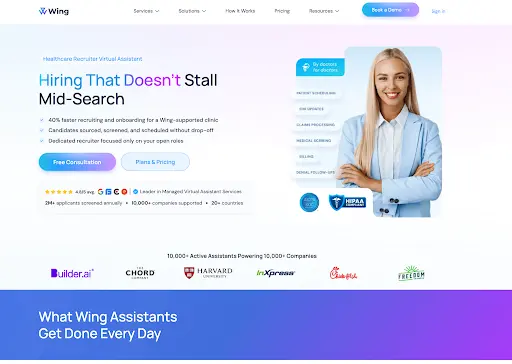
Model: dedicated managed
Published pricing (healthcare recruiter plan): $1,699 monthly full-time for 160 hours, $1,199 part-time for 80 hours
Integration: recruiter works inside your approved ATS, email, calendar and CRM with role-based access. Wing’s pages reference Bullhorn, Greenhouse and Calendly
Security: SOC 2 certified as stated by Wing, AES-256 encryption at rest, SSL 2048-bit in transit, NDAs signed by all recruiters
Oversight: supervised by Wing’s Team Captains and Supervisors, with a dedicated Customer Success Manager and free replacement
Consider: monthly plans with no long-term contract, so scope moves with hiring volume
Wing Assistant ranks first on transparency, as one of the few services here publishing both pricing and security standards openly, and on vetting, with SOC 2 certification per Wing and role-based access on candidate records. Wing Assistant offers a healthcare recruiter for recurring clinical hiring and a dedicated IT recruiter for tech roles.
2. Hello Rache

Model: hourly, healthcare-trained
Published pricing: on inquiry
Integration: clinical workflow familiarity, ATS experience varies by assistant
Security: HIPAA training referenced, relevant where patient or scheduling data is handled. Details not published
Consider: emphasis is clinical administration rather than recruiting as a defined discipline
Strongest where the need is practice support broadly rather than hiring specifically
3. MEDVA
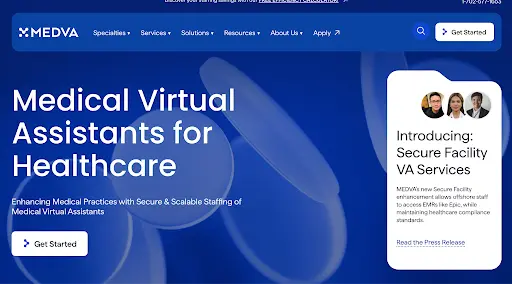
Model: dedicated, healthcare-trained
Published pricing: not published, quoted per engagement
Integration: medical practice environments, confirm ATS platforms directly
Security: not published in detail
Consider: recruiting is one capability among several rather than a specialism
Suits clinics wanting healthcare-familiar staffing across multiple functions.
4. Belay
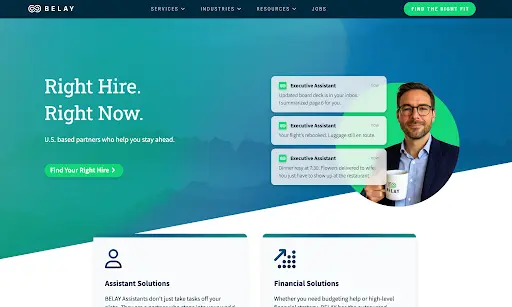
Model: dedicated, US-based
Published pricing: not published, higher than offshore equivalents
Integration: structured matching process, general administrative background
Security: not published in detail
Consider: healthcare and technical recruiting are not defined specialisms
Suits teams where US-based talent is a firm requirement.
5. Upwork
Model: marketplace
Published pricing: set by individual contractors
Integration: whatever the individual brings
Security: negotiated per contract
Consider: no oversight layer and no built-in replacement guarantee on standard contracts
Suits a single bounded search rather than ongoing hiring.
All details other than published pricing reflect vendor positioning as stated. Verify before contracting.
How Much Does Virtual Recruiting Support Cost?
Published pricing in this category falls into two shapes, and they do not compare directly.
Monthly Retainer vs Hourly Pricing
Monthly retainer buys defined hours with a named person. A full-time arrangement typically runs $1,500 to $2,000 per month for around 160 hours, with part-time roughly $1,100 to $1,300 for 80. That works out to about $9 to $12 per hour full-time and $14 to $16 part-time.
Hourly rates can look lower on paper. The savings shrink once you count ramp time. An assistant who learns your requirements across three separate engagements is paid three times for the same learning.
Why Cost Per Filled Role Matters More Than Hourly Rate
The comparison that matters is cost per filled role, not cost per hour. As an illustration, a $12 hourly assistant who takes four months to fill a position costs more than a retained recruiter who takes six weeks, before you count the revenue the vacancy cost you.
Is US-Based Talent Worth the Premium?
US-based talent carries a higher rate than offshore equivalents. Worth paying where time zone overlap or domestic familiarity genuinely matters, and worth questioning where it does not.
How to Check Sourcing Quality Before You Sign
Every vendor claims a large talent pool. The useful question is narrower.
Does the recruiter know your category? Clinical hiring, engineering hiring and operations hiring run on different signals. Someone screening nurse practitioners needs different judgment from someone screening backend engineers.
Active or passive candidate sourcing? Most virtual recruiting support works active channels: job boards, applicant review, inbound screening. Passive sourcing is a different discipline and most vendors in this category do not do it well.
Who runs the first screen? A screen performed by someone who understands the role filters properly. A screen performed against a checklist passes everyone who checks boxes.
How to Vet ATS Integration Before You Hire
This is where tech buyers should spend their evaluation time, because it is the dimension most likely to fail after signing.
- Which ATS has the individual actually used? Not which platforms the vendor supports. Which ones the person assigned to you has worked in. Bullhorn, Greenhouse, Lever, Workable and Ashby all behave differently, and a recruiter learning yours during your search is slower than one who already knows it.
- Does work happen inside your ATS? If activity lives in a vendor spreadsheet synced weekly, your ATS has stopped being the system of record. That breaks reporting, audit trails and anyone else’s visibility.
- How is access granted? Role-based permissions scoped to what the work requires, not a shared login with full admin. For candidate records, this is a security question, not an administrative one.
- What happens at the interview handoff? Interview coordination touches hiring managers, calendars, and sometimes clinical schedules. Ask how the vendor handles a reschedule at 7 pm.
How to Choose the Right Virtual Recruiting Support for Your Team
Three questions settle most evaluations.
- Is your hiring need recurring? If yes, the ramp cost of a pooled model exceeds the hourly savings. If no, a retainer is overbought.
- Can anyone internally manage the recruiter? A marketplace hire without management produces work nobody checks. A managed service costs more and removes that requirement.
- What happens if the recruiter disappears? A supervisory layer and a replacement guarantee are different things, and only the replacement guarantee keeps your pipeline moving.
Why Does More Applicant Volume Not Fix Slow Hiring?
Most organizations invest in attraction. Job postings, careers pages, employer brand content across every channel.
That side generally works. Coordinated content distribution can raise applicant volume, which moves the problem rather than solving it.
Throughput Is the Real Constraint
You end up with more candidates in the ATS and the same person responding to them between other work. The constraint shifts from awareness to throughput, and nobody reassigns the work when it does.
That is the gap virtual recruiting support fills. Not finding more people. Responding to the ones already there.
How to Evaluate a Recruiting Partner Like a Development Partner
Vendor selection here follows the same discipline as any outsourced function. The criteria that matter when you find a partner for development work apply equally: process over price, communication standards agreed upfront, and what happens after the engagement starts rather than during the pitch.
What Does Virtual Recruiting Support Not Cover?
Worth stating plainly, because it is where buyers most often misjudge scope.
Credentialing is separate. Verification, licensure, and privileging run on their own timelines with their own requirements. Buying recruiting support and expecting credentialing leaves a gap that surfaces after a candidate has accepted.
Technical assessment is usually separate too. A recruiting assistant can coordinate a take-home exercise. Evaluating the submission is your engineering team’s job.
Employer brand is upstream. If applications are not arriving, the problem is not throughput and no amount of coordination fixes it.
Virtual Recruiting Support: What to Check Before You Choose
Compare models before you compare vendors, and compare cost per filled role rather than cost per hour.
Then ask the integration questions, because that is where implementations fail. Which ATS the individual has actually used, whether work happens in your system, and who is reachable when something needs rescheduling at short notice.
Those answers predict the outcome better than any rate card.
FAQs
Remote help with the throughput side of hiring: screening applicants, responding to candidates, and coordinating interviews. It does not replace credentialing or technical assessment.
Dedicated retainers typically run $1,500 to $2,000 per month for around 160 hours, with part-time roughly $1,100 to $1,300 for 80. Hourly and marketplace rates vary by provider.
For recurring hiring, usually yes. Role knowledge compounds with a named person, while pooled models reset the learning with each assignment.
Ask which platforms the assigned individual has actually used, whether work happens inside your ATS, and how access is scoped.
Not as part of standard recruiting support. Verification, licensure and privileging run separately.

Marketing Manager
Recent Blogs

Jane Hart
Why LinkedIn Campaign Optimization Requires More Than CPC and CTR
-
09 Oct 2026
-
8 Min
-

20
Jane Hart
How to Vet an Offshore SEO Partner: A Due-Diligence Checklist for Agencies and Brands
-
08 Oct 2026
-
8 Min
-
57
Jane Hart
Benchmarking GPU Providers: A Practical Guide to Comparing Cloud Compute Options
-
07 Oct 2026
-
6 Min
-
93
Elia Martell
How Much Does Custom Software Development Really Cost in the US?
-
06 Oct 2026
-
12 Min
-
76
