


Table of Contents
Understand the hidden factors behind successful AI products. Learn how performance, security, and full-cycle web development help organizations build reliable applications that scale and deliver measurable business value.
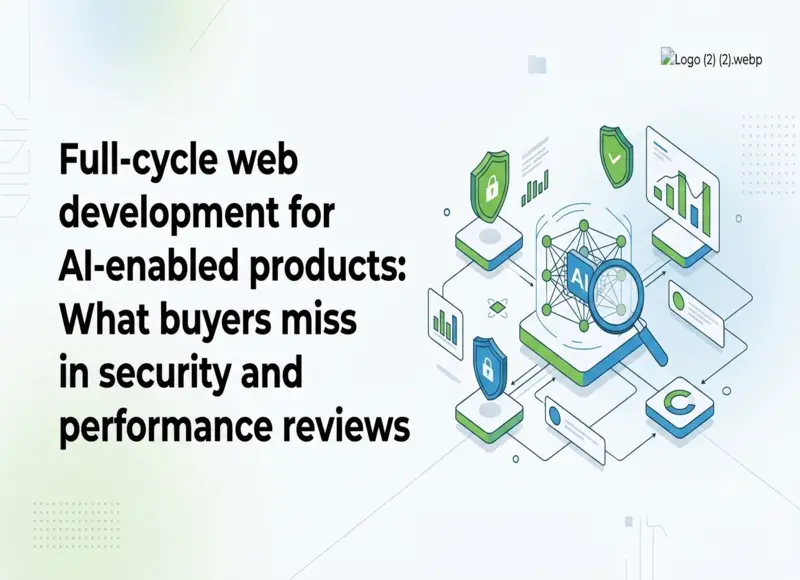
Enterprise buyers spend months evaluating AI models, comparing accuracy, throughput, cost per token, and vendor roadmap. They sit through demos, request architecture diagrams, and run benchmark tests. Then they ship the product, and it breaks under load.
AI-enabled products are still web products. The infrastructure around the model, covering the delivery layer, the session management, the API contracts, and the frontend under stress determines whether buyers get what they paid for. Most procurement reviews don't go deep enough on any of this. However, you can easily fix it with AI process automation services.
Why AI-enabled products raise the bar for web delivery
A traditional web application has a predictable request pattern: a user clicks, the server responds, the page updates. AI-enabled products break that model. Inference calls are slow by comparison. Streaming responses require persistent connections. Context windows introduce variable payload sizes. Background processing spikes server load in ways that static-content servers were never designed for.
This changes what "good performance" looks like. A 2-second response time is reasonable for a search result. It's a failure for an AI assistant that the user expects to feel real-time. The web delivery layer has to absorb that gap through caching, request queuing, edge routing, and thoughtful UI states, or the product feels broken regardless of model quality.
What buyers miss in performance reviews
Real-user latency
Performance reviews often rely on synthetic benchmarks as controlled tests run from a single location under ideal conditions. Those numbers rarely match what users experience. The average mobile page takes 8.6 seconds to load, yet 53% of mobile users abandon a page that takes longer than 3 seconds. For AI products with inference in the path, that gap widens further.
The metric to ask for is real-user monitoring (RUM) data, not lab results. RUM captures what actual users on real devices and networks experience.
AI products also introduce a specific failure mode: time-to-first-token. A user submits a prompt and sees nothing for four seconds before the streamed response begins. Technically, the page loaded. Practically, the experience felt broken. Buyers should ask explicitly whether vendors track this metric and what their targets are.
Interface reliability under load
Most AI products launch with modest traffic and perform well. The procurement question is how the interface behaves when usage spikes. For every second of delay between 0 and 5 seconds, the conversion rate drops by 4.42%. Under real load, poorly architected products don't just slow down; they produce errors, drop requests, or render incomplete states.
What buyers miss in security reviews
Session control
Session management is frequently underweighted in AI product security reviews. Buyers focus on data encryption, access controls, and compliance certifications but session hygiene is where many practical vulnerabilities live.
AI products that maintain conversation context across requests store state somewhere. If session tokens don't expire, rotate on privilege changes, or aren't scoped correctly, that state becomes accessible beyond its intended boundary.
Shared accounts, multi-tenant setups, and browser-based clients each introduce additional surface. In 2024, it took an average of 204 days to discover a breach, with an additional 73 days for containment. Sessions that persist indefinitely extend that window considerably.
Buyers should ask: What is the session lifetime? Do tokens rotate after authentication? How is session state isolated between users in multi-tenant deployments?
Data exposure points
The inference pipeline in an AI product moves data through multiple layers: user input → prompt construction → model API → response parsing → client rendering. Each layer can expose data if not handled carefully.
Common gaps buyers miss:
- Prompt logging: Many AI implementations log full prompts for debugging. If those logs aren't access-controlled or scrubbed of PII, they become an exposure risk.
- Error responses: Unhandled model errors can surface internal state, request structure, or system prompt content in API responses visible to the client.
- Third-party model APIs: When the AI backend calls an external model provider, data leaves the internal network. Buyers should confirm what data is transmitted, whether it's used for training, and what the provider's retention policies are.
Despite 72% of companies integrating AI into their business functions, only 20% express confidence in securing generative AI, while 99% report that sensitive data is exposed to AI tools. That confidence gap is partly a security tooling problem, but it's also a web architecture problem that procurement reviews rarely surface.
How Altamira connects full-cycle delivery with AI process automation goals
End-to-end product view
Altamira's full-cycle approach to web development means the same team that designs the AI feature set is responsible for the delivery infrastructure around it. There's no handoff between an AI team and a web team where requirements get lost. Session design, latency budgets, error handling, and security controls are specified alongside the model integration.
This matters particularly for products where AI is embedded in a workflow rather than offered as a standalone feature. When an AI function sits inside a larger application, the performance and security requirements of that application constrain what the AI layer can do. A full-cycle team sees both sides of that constraint from the start.
KPI-linked implementation
Performance and security decisions should connect to measurable outcomes. Altamira structures implementations around defined KPIs: task completion rate, session length, support ticket volume related to performance issues, and time-to-value for new users.
This means the delivery work is scoped around what actually matters to the buyer's users, and the acceptance criteria for each phase reflect that. A product that passes performance benchmarks but fails on real-user task completion hasn't met its goals.
Practical review checklist for product buyers
Before signing off on an AI-enabled product build or evaluation, the following questions give a more complete picture of web delivery quality:
Performance
|
Area |
What to Ask |
|
Latency measurement |
Do you track RUM data? What is P95 latency by region? |
|
AI-specific timing |
What is the time-to-first-token under normal and peak load? |
|
Load testing |
What concurrency levels have been tested? What degrades first? |
|
Mobile performance |
What are Core Web Vitals scores on mobile? |
|
Graceful degradation |
How does the interface behave when the AI backend is slow or unavailable? |
Security
- What is the session token lifetime, and when do tokens rotate?
- How is user data isolated in multi-tenant deployments?
- Are prompts and model responses logged? Who has access to those logs?
- What data is transmitted to third-party model providers, and under what retention terms?
- How are API errors handled: does the client receive structured error codes or raw backend responses?
These questions won't appear on most vendor scorecards. Asking them anyway separates products that are well-built from products that just look well-built in a demo.
Conclusion
AI capability is increasingly commoditized. The difference between products that retain users and products that don't often comes down to the infrastructure around the model: how fast the interface responds, how reliably it handles load, and how carefully data is controlled through the delivery pipeline.
Buyers who treat security and performance as post-launch concerns will discover those gaps on the production timeline, not before it. Building the review criteria into procurement and working with a team that treats delivery as part of the product is the more defensible approach.
If you're evaluating an AI product build or assessing an existing product's web delivery quality, Altamira's team works across the full development cycle, from AI feature design through production infrastructure, with defined performance and security targets at every phase.


Head Of Digital Marketing
Recent Blogs

Elia Martell
5 Virtual Recruiting Support Operations for Tech and Healthcare Teams
-

09 Oct 2026
-

8 Min
-

477
Jane Hart
Why LinkedIn Campaign Optimization Requires More Than CPC and CTR
-
09 Oct 2026
-
8 Min
-
155

Jane Hart
How to Vet an Offshore SEO Partner: A Due-Diligence Checklist for Agencies and Brands
-
08 Oct 2026
-
8 Min
-
263
Jane Hart
Benchmarking GPU Providers: A Practical Guide to Comparing Cloud Compute Options
-
07 Oct 2026
-
6 Min
-
173
