


Table of Contents
More backlinks sound great until the quality starts slipping. Here's how to evaluate link building marketplaces and scale your efforts without losing sight of relevance and search quality.
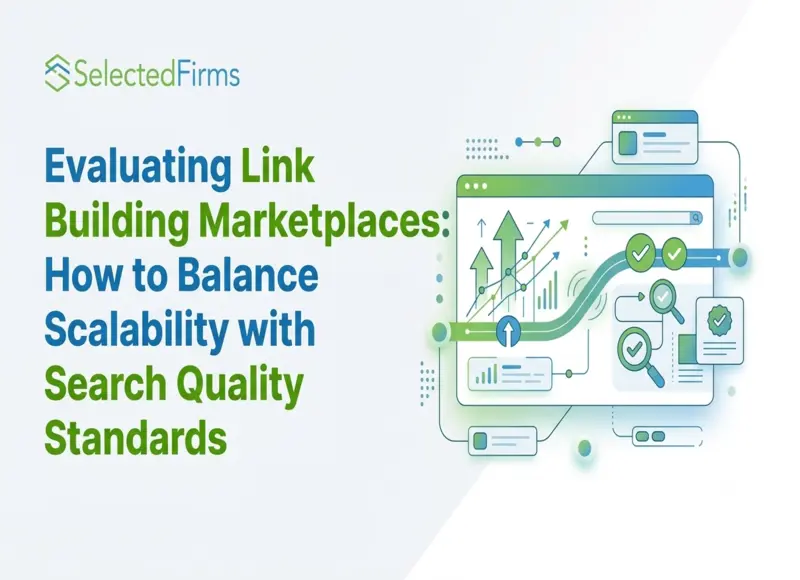
Most marketing teams hit the same wall eventually. You need more links than manual outreach can produce, so you turn to a marketplace or agency. Then the volume goes up, and the placements start looking thinner: lower relevance, shakier traffic, links that never get indexed. Is that just the cost of scaling? Not really. It's usually a sign the vetting step got skipped, not that scale and quality are fundamentally opposed.
This piece walks through how to actually scale your business by finding the good authoritative link-building marketplaces with appropriate search quality standards.
What Happens When You Scale a Marketplace Too Fast?
Volume without a filter is where most link-building budgets quietly leak. Bulk packages promise dozens of placements a month, but a link only helps if it sits on a page with real traffic and topical relevance, not just a favorable-looking domain score.
Here's the part that gets missed: the strongest predictor of ranking movement isn't a single high domain rating link; it's referring domain diversity.
Pages sitting at position one average roughly 168, according to Ahrefs' ranking study of 14.1 million keywords. That gap doesn't close by buying more of the same kind of link faster. It closes by diversifying sources while keeping each one relevant.
So the real question isn't how many links a provider can deliver this month. It's whether their process screens out weak inventory before it ships, so volume and relevance move together instead of trading off against each other.
What Makes a Link Building Provider Actually Trustworthy?
Trustworthy providers let you review a website before paying for a placement. This simple step can help distinguish a transparent vendor from a risky one. If a provider only reveals the website after payment, you cannot assess whether the site is relevant or valuable before committing your budget.
This is one area where marketplace transparency can make a practical difference. For example, PRWiz allows buyers to review publisher domains and filter available placements using factors such as domain rating, niche, and organic traffic before making a purchase. That gives buyers more information to assess a potential placement instead of committing based only on a package description.
A reliable marketplace should make key details available upfront, including the publisher’s domain, niche, domain authority or rating, and organic traffic. Having access to the actual website before making a purchase gives you a better way to judge whether the placement aligns with your goals.
Other signs of a trustworthy provider matter too. They should avoid guaranteeing specific search rankings, since no provider can control how Google ranks a page. They should also explain how their outreach process works rather than hiding behind vague claims about a proprietary method. A clear replacement policy can also be useful if a published link is later removed.
When these details are difficult to find, or the provider avoids answering basic questions, it is worth taking a closer look before committing your budget.
Per-Link or Retainer: Which Pricing Model Fits Your Budget?
Neither model is inherently better. The right one depends on how consistent your monthly link volume needs to be. Per-link marketplaces suit teams that want direct control over spend and can order in bursts. Retainers suit teams running a sustained program where a strategist needs to stay involved month over month, not just fulfill an order.
The trap is comparing the two on sticker price alone. A $60 marketplace link and a $300-per-link retainer placement aren't automatically different in quality. The retainer often bundles strategy, reporting, and account management into that per-link number. Normalize to cost per placement before deciding, not headline pricing.
Comparing Top Link Building Services Providers
Pricing and vetting only tell part of the story. Niche fit, strategy model, and how much a provider actually shows you before and after a placement goes live matter just as much, and they're what most buyers end up searching for once they've narrowed their shortlist.
|
Provider |
Best For |
Vetting Standards |
Transparency & Reporting |
Pricing Model |
|
PRWiz |
Self-serve buyers who want full control |
DR, traffic, and niche filters across 3,500+ vetted sites |
Live domain shown before payment clears |
Per-link, $29 to $221 (median $138) |
|
Funnel Boost Media |
Local businesses wanting SEO and links bundled |
Not publicly detailed; client reviews are mixed, with at least one flagging black-hat concerns |
Custom quotes, no published per-link rate |
Project-based, $1,000+ minimum, $50 to $99/hr |
|
Stellar SEO |
Legal, restoration, and SaaS brands wanting a guarantee |
Manual outreach, screens out PBNs and farm sites pre-outreach |
Money-back guarantee, published bulk pricing |
$297 to $1,000/link; niche edits from $225 |
|
Rankings.io |
Law firms in competitive local markets |
Not publicly disclosed, folded into a broader legal SEO audit |
Monthly reporting, strong client satisfaction on Clutch |
Custom/undisclosed |
|
uSERP |
Funded B2B SaaS and fintech chasing Tier-1 editorial links |
Curated digital PR placements on high-authority outlets |
Dedicated strategist, disclosed client roster (monday.com, Robinhood, ActiveCampaign) |
Custom, $10,000+ minimum project |
Notice the pattern: the providers with the clearest transparency, PRWiz, Stellar SEO, and uSERP, also publish or disclose the most about how they source links. That's not a coincidence. Opacity and inconsistent quality tend to travel together.
What's a Quick Way to Vet Any Provider Before You Pay?
You don't need a 20-point audit to catch most bad actors. Four checks handle the majority of risk:
- Ask for the live URL or a screenshot before you pay, and confirm the page is actually indexed in Google.
- Cross-check the site's traffic independently rather than trusting the vendor's own dashboard numbers.
- Scan a sample of their existing placements for anchor text patterns. Repeated exact-match keywords across dozens of links is a red flag.
- Read third-party reviews (Clutch, G2) for mentions of link quality complaints, not just service reviews.
Any provider that resists step one is telling you something on its own.
The Bottom Line
Scalability and search quality aren't opposites. They're two things that break down together when the vetting step gets skipped. The providers above show that whether you're buying per-link through a marketplace or committing to a managed retainer, the ones worth trusting share the same habit: they let you see what you're buying before you commit budget to it. Start there, and volume stops being the risk.
FAQs
Yes, provided the vetting happens before purchase, not after. Referring domain diversity, not raw volume, is what correlates most strongly with ranking movement.
A provider that only shows you the placement site after payment, or that can't explain its outreach process in plain terms, is usually prioritizing volume over relevance.
It depends on consistency of need. Retainers suit ongoing B2B/SaaS programs, whereas per-link marketplaces suit teams that want to control spend order by order.


Head Of Digital Marketing
Recent Blogs


Elia Martell
5 Virtual Recruiting Support Operations for Tech and Healthcare Teams
-

09 Oct 2026
-

8 Min
-

477
Jane Hart
Why LinkedIn Campaign Optimization Requires More Than CPC and CTR
-
09 Oct 2026
-
8 Min
-
155
Jane Hart
How to Vet an Offshore SEO Partner: A Due-Diligence Checklist for Agencies and Brands
-
08 Oct 2026
-
8 Min
-
263
Jane Hart
Benchmarking GPU Providers: A Practical Guide to Comparing Cloud Compute Options
-
07 Oct 2026
-
6 Min
-
173
