


Table of Contents
Just because everyone uses it doesn't mean you should. Before signing another pricey SaaS renewal, explore smarter alternatives that could save money, reduce complexity, and fit your business better.
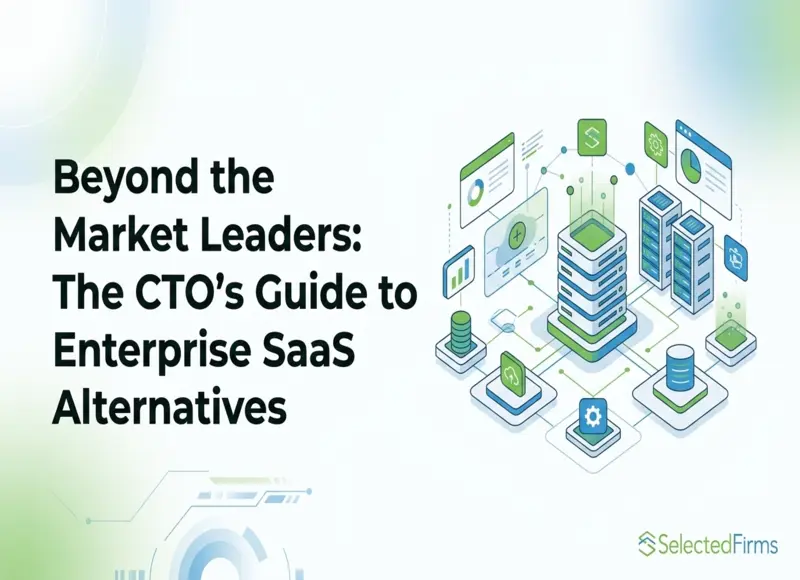
Every enterprise software category has one obvious answer. Ask CTOs which SaaS tools they use for CRM, ticketing, or observability, and you will hear the same two or three names every time.
That repetition feels safe. It does not always mean the tool is the best fit for your stack.
Market leaders win on scale, not precision. They build for everyone, so a lot of their roadmap serves nobody exactly. That gap is where enterprise SaaS alternatives quietly start winning deals.
This is not an argument against market leaders. Some earn their spot fairly. It is an argument for checking, instead of defaulting to whatever procurement approved five years ago.
Why Default SaaS Tools Become More Expensive Over Time
The market leader is rarely the wrong choice on day one. It becomes the wrong choice slowly, usually around renewal time, when the price jumps and the feature set has not moved much to justify it.
A few patterns show up again and again once a platform becomes the default choice in its category.
- Pricing creeps upward once switching feels too painful to consider
- Feature development slows because the vendor is defending market share, not earning it
- Support quality drops as the customer base scales faster than the support team
- Your actual use case becomes a smaller and smaller slice of the roadmap
None of this shows up in a demo. It shows up eighteen months in, buried in a renewal email with a number that used to make sense and no longer does.
Where Alternatives Deliver More Value
Enterprise SaaS alternatives rarely win by copying the leader feature for feature. They win by going narrow instead of wide.
A challenger built specifically for mid-sized SaaS companies will usually beat a general-purpose platform for that exact use case, even if its overall feature count is smaller. It has fewer distractions and a sharper opinion about how the workflow should actually run.
Pricing tends to follow the same logic. Alternatives competing for market share are usually more transparent about cost and more willing to negotiate terms that fit your actual usage. That competitive pressure is only growing.
According to Flexera's 2024 State of the Cloud Report, "89% of enterprises now operate in multi-cloud environments," giving every vendor in the mix a reason to stay sharp on price.
A Simple Framework for Evaluating Alternatives
Before any serious evaluation starts, it helps to score every option, including the incumbent, against the same criteria.
|
What to check |
Why it matters |
|
Core workflow fit |
Does it solve your specific use case well, or just adequately |
|
Integration depth |
Does it connect cleanly with the rest of your stack, not just the popular tools |
|
Total cost at scale |
What does the bill look like at double your current usage, not just today |
|
Data portability |
Can you actually get your data out if you need to leave later |
|
Support model |
Dedicated support, or a ticket queue that scales worse than you do |
|
Roadmap alignment |
Is the vendor building toward your problems, or a much broader audience |
Scoring the incumbent honestly on this same table is often the most uncomfortable part of the exercise, and usually the most revealing.
In practice, take CRM as an example. Salesforce is the default choice for most enterprises, but it comes with some well-known tradeoffs.
- Per-seat pricing that climbs quickly once you add storage, automation, or premium support tiers
- Long implementation timelines that often require specialized consultants just to get live
- Heavy customization needed before the platform fits a standard sales process
- An admin-heavy interface that slows down daily use for smaller or leaner teams
Creatio is a useful example of the kind of enterprise SaaS alternative this framework is built to surface. As an Agentforce alternative, it offers a no-code platform for CRM and workflow automation, shorter implementation timelines, and pricing that stays predictable as a team scales, without the same customization overhead Salesforce often demands. Questions to Ask Before Switching Enterprise SaaS
A strong alternative on paper can still be a bad migration in practice. Before committing, it is worth getting direct answers to a few uncomfortable questions.
- What does a full data export actually look like, and how long does it take
- How many engineering hours will migration realistically consume
- What breaks first if the new vendor goes down for an hour
- Who owns the relationship once the initial sales enthusiasm fades
- What happens to pricing after the first renewal, in writing, not in conversation
Vendors who answer these clearly, without deflecting, tend to be the ones worth trusting with a real migration.
The Hidden Risks of Migrating to a New SaaS Platform
Every SaaS alternative pitch focuses on what you gain. Almost none of them mention what you temporarily lose during the switch itself.
Migrations are rarely instant, and the transition period is where most of the real risk lives. Teams run two systems at once, and institutional knowledge about the old tool fades faster than expected.
According to CIO Dive, "the average enterprise migration project costs $315,000." That is not a reason to avoid switching. It is a reason to give the migration its own budget and timeline.
The Bottom Line
The market leader is not automatically wrong, and the alternative is not automatically right. The only real answer comes from testing both against your actual workflow, your actual team, and your actual growth curve, not a generic best practices list.
Ready to take a real look? Score your current vendor honestly against the framework above, shortlist two or three enterprise SaaS alternatives built specifically for your use case, and run a small pilot before any full migration decision gets made.
FAQs
They can reduce costs, simplify workflows, and provide a better fit for specific business needs than market-leading platforms.
Compare workflow fit, integrations, pricing, scalability, data portability, vendor support, and long-term value.
Start evaluating alternatives before your renewal period to allow enough time for testing and migration planning.
Data migration, user adoption, integration issues, and downtime are the most common challenges during a switch.
Yes. Choosing the right platform can lower total ownership costs and reduce ongoing licensing and maintenance expenses.


Head Of Digital Marketing
Recent Blogs

Elia Martell
5 Virtual Recruiting Support Operations for Tech and Healthcare Teams
-

09 Oct 2026
-

8 Min
-

477
Jane Hart
Why LinkedIn Campaign Optimization Requires More Than CPC and CTR
-
09 Oct 2026
-
8 Min
-
155
Jane Hart
How to Vet an Offshore SEO Partner: A Due-Diligence Checklist for Agencies and Brands
-
08 Oct 2026
-
8 Min
-
263
Jane Hart
Benchmarking GPU Providers: A Practical Guide to Comparing Cloud Compute Options
-
07 Oct 2026
-
6 Min
-
173
