


How to Read LMS Pricing Before Choosing a Long-Term Platform
-
Last Updated:

25 Sep 2026
-
Read Time:

7 Min Read
-
Written By:
 Elia Martell
-
242
Table of Contents
Looking beyond the monthly LMS fee? Learn how to compare setup costs, support, integrations, contracts, and long-term expenses before you choose a platform.
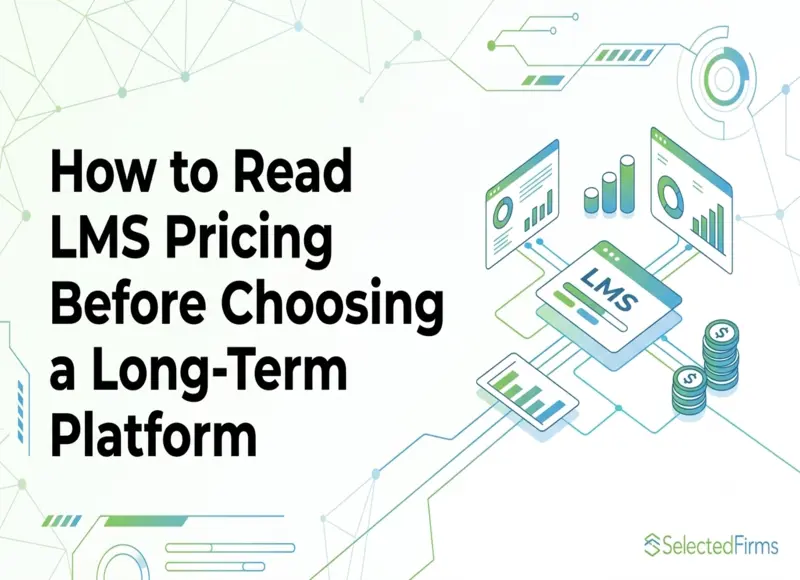
Reading LMS pricing correctly means looking past the monthly rate to what it excludes: user limits, setup fees, support tiers, and renewal terms. A platform is only affordable long-term if its full cost, not its headline price, fits your budget.
For a buyer weighing a multi-year commitment, that gap is not a rounding error. It is the difference between a platform that scales with your institution and one that quietly outgrows its budget.
Selecting a learning management system requires more than comparing monthly fees.
A modest starting price can hide user limits, setup fees, support costs, or expensive upgrades.
A larger quotation may include services that reduce administrative labor and future purchases.
Buyers should examine billing rules, contract terms, account counts, integrations, and projected growth before committing.
Careful analysis clarifies ownership costs, protects institutional budgets, and supports a practical LMS platform comparison for long-term teaching and administration.
Start With the Pricing Model
Most pricing pages show clear billing structures, making comparisons easy.
Common arrangements include subscriptions, licenses, paid plans, and custom quotations. A subscription creates recurring charges, while a license may require greater initial spending.
These are the standard LMS pricing models buyers encounter, and each one shifts risk differently between vendor and buyer.
Before requesting a proposal from the LMS platform, purchasing teams should define expected enrollment, administrator numbers, storage requirements, support needs, and contract duration.
These details help vendors prepare comparable figures instead of broad estimates.
The written response should distinguish included services from optional charges. Without that separation, a low headline amount provides little guidance about actual expenditure.
Calculate Total Ownership Cost
Budget planning is where most LMS comparisons break down.
The listed price represents only one part of ownership.
Additional expenses may include onboarding, data migration, training, integrations, premium assistance, storage, security reviews, and renewal increases.
Internal labor matters just as much. Staff members may spend substantial time creating reports, managing accounts, checking records, or resolving technical issues. This time carries a real cost even when no invoice reflects it directly.
A useful calculation is:
Total ownership cost = platform fees + service charges + internal administration + expected expansion costs
A successful business budget must include all the minute details behind that formula, not just the top-line number a vendor leads with.
Each supplier should receive identical assumptions, including learner numbers, administrator accounts, storage needs, and agreement length.
Consistent inputs produce a fairer financial comparison.
Before purchasing a platform, it is worth checking online pricing pages such as BlackbaudPricing as an initial reference point.
Without matched assumptions across vendors, buyers end up comparing figures that were never meant to line up: one vendor's quote for 500 learners against another's for 2,000 tells you nothing useful.
Review Feature Tiers
Feature levels can distort budget forecasts.
Entry packages may exclude reporting, assessment tools, mobile access, integrations, automation, or advanced permissions.
A platform can appear inexpensive until essential functions require an upgraded plan.
Teams should separate required capabilities from optional additions.
Core needs may include assignments, graded discussions, rubrics, competency tracking, reporting, and account management. Each requested function should receive a clear status, such as included, restricted, optional, or unavailable.
Examine Contract Terms
Long-term agreements require close attention.
Buyers should identify renewal dates, notice periods, annual increases, cancellation conditions, service commitments, and data return procedures.
An introductory discount may result in a much higher second-year payment, so any headline rate needs to be checked against what applies once the contract renews.
Contracts should also explain what happens when enrollment changes.
Some suppliers permit monthly adjustments, while others fix customers within an annual account band.
Procurement staff should model low, expected, and high enrollment before approval, since a rigid account band can force an unplanned upgrade mid-year if enrollment grows faster than forecast.
Data return procedures deserve their own line item. If the contract ends or the buyer switches platforms later, the terms should state what format course data, learner records, and completion history are returned in, and whether the vendor charges for the export.
Measure Implementation Expenses
LMS implementation cost can affect the first-year budget more than the software charge itself.
Migration may involve course transfer, user imports, permissions, content checks, testing, and administrator instruction.
These activities consume staff capacity, even when the supplier provides basic assistance.
A practical review assigns estimated hours and labor rates to every task.
Teams can then compare vendor-led work with internal delivery.
This calculation shows whether a lower quotation remains economical after preparation and launch requirements.
Assess Support and Integrations
Support quality affects spending because unresolved issues consume staff hours and interrupt instruction.
Buyers should ask about response targets, support channels, escalation procedures, training materials, and availability outside standard business hours.
Integration costs deserve equal attention.
Connections with student information systems, identity services, payment tools, video platforms, or assessment applications may require separate charges.
Every connection should have a named owner, projected timeline, and maintenance estimate.
Test Growth Scenarios
A platform should remain financially workable as participation increases.
Buyers can create a three-year model using current enrollment, anticipated growth, additional administrators, storage expansion, and new integrations.
This exercise shows whether expenses rise gradually or jump at fixed thresholds.
Scenario planning can strengthen negotiations.
A supplier may offer predictable increases, volume discounts, capped renewals, or flexible account bands. Those terms may matter more than a small first-year reduction.
Ask For a Comparable Quote
Every supplier should answer identical questions in writing.
The request should cover user definitions, included functions, setup charges, support levels, renewal rules, integrations, storage, training, and cancellation terms.
A comparison sheet can assign each item a cost and status, such as included, optional, or unconfirmed.
Unanswered fields should remain visible rather than receiving an optimistic assumption. This method makes proposals easier to assess and reduces pressure from attractive headline figures.
Where LMS Platforms Come From
Most LMS vendors are not just software licensors.
Many are software development companies or education software development companies that build, host, and maintain the platform end to end.
Some are established technology companies with a broad product portfolio; others are custom software development companies that build the LMS around a specific institution's workflow.
This distinction matters during an LMS vendor comparison.
A platform built by a dedicated software development agency may offer deeper customization, but usually at a higher implementation cost.
A packaged product from a larger vendor tends to be faster to deploy but harder to adapt later.
Buyers evaluating software development services as part of the decision should ask the same questions they would ask any IT service provider:
- who owns the codebase,
- how updates are released, and
- what the exit path looks like if the relationship ends.
Treating LMS procurement like a broader software vendor evaluation, rather than a one-time purchase, produces a more defensible decision.
Conclusion
Reading LMS pricing requires a complete financial view, not attention to one figure.
The monthly rate on a proposal is a starting point. The real cost comes from stacking that rate against setup fees, support tiers, integration costs, and what the contract does at renewal.
Buyers should compare billing models, feature levels, contract terms, implementation work, and growth costs before signing anything.
A vendor that will not break these down in writing is asking for trust it has not earned.
This is the answer to how to read LMS pricing before choosing a long-term platform: treat the headline number as one input, not the deciding factor.
Get the comparison right once, and the platform stays affordable well past the first renewal.
FAQs
LMS pricing can depend on the number of users, features, storage, support, integrations, implementation services, and contract length. Renewal increases can also affect long-term costs.
LMS pricing may include core software access, hosting, basic support, and standard features. Setup, migration, training, integrations, premium support, and advanced features may cost extra.
Compare vendors using the same user counts, features, support requirements, integrations, and contract terms. Then calculate the total cost over the expected contract period.
The total LMS cost includes software fees, implementation, migration, training, integrations, support, internal administration, and future expansion. Renewal increases should also be included in the estimate.
Ask vendors to identify every included and optional cost in writing. Review user limits, feature tiers, renewal terms, support charges, integration fees, and cancellation conditions before signing.

Marketing Manager
Recent Blogs
Elia Martell
5 Virtual Recruiting Support Operations for Tech and Healthcare Teams
-
09 Oct 2026
-
8 Min
-

627

Jane Hart
Why LinkedIn Campaign Optimization Requires More Than CPC and CTR
-
09 Oct 2026
-
8 Min
-
189
Jane Hart
How to Vet an Offshore SEO Partner: A Due-Diligence Checklist for Agencies and Brands
-
08 Oct 2026
-
8 Min
-
323
Jane Hart
Benchmarking GPU Providers: A Practical Guide to Comparing Cloud Compute Options
-
07 Oct 2026
-
6 Min
-
187
