


Table of Contents
Behind every delayed project or rising operational cost lies a workflow that no longer works. Custom software companies rebuild these broken systems, integrating tools, automating repetitive processes, and modernizing legacy infrastructure. What emerges i
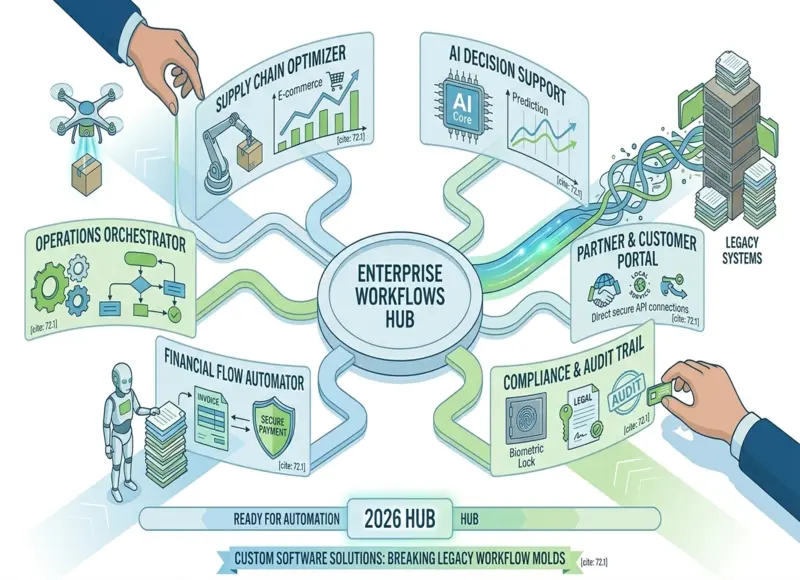
Operational breakdowns in most enterprises do not occur in a day. Rather than that, they evolve gradually as inefficiencies tack on manually approved steps here and double-data entry there, disconnected systems that force employees to use workarounds with spreadsheets and emails.
Over time, these small frictions compound into delayed projects, compliance risks, rising operational costs, and employee burnout.
Custom software companies help enterprises reverse this trend — not by adding more tools, but by redesigning and automating workflows around how the business actually operates.
Where Complex Workflows Break Down
Before exploring how companies solve these issues, it’s important to understand what enterprise workflow inefficiencies typically look like.
1. Manual data transfers between systems
When CRM, ERP, HR, finance, and operational tools don’t communicate, employees re-enter the same data multiple times. This increases error rates and slows decision-making.
2. Departmental silos
Operations, finance, logistics, and sales often rely on separate systems. Without unified data visibility, leaders make decisions based on incomplete or outdated information.
3. Legacy systems that resist change
Older platforms may lack APIs, automation capabilities, or scalability. Teams create workarounds instead of solving root problems, increasing complexity.
4. Compliance and audit risks
In regulated industries like healthcare, finance, and logistics, manual workflows increase the likelihood of compliance violations.
5. Poor scalability
Off-the-shelf software serves general use cases. As companies grow, rigid systems become operational bottlenecks rather than enablers.
Studies consistently show that inefficient workflows reduce employee productivity and job satisfaction, while automation can reduce errors by up to 70% and significantly lower operational costs.
How Custom Software Companies Actually Automate Enterprise Workflows
Rather than forcing businesses to adapt to software, custom development firms analyze and rebuild workflows to eliminate friction at the source.
Here’s how they typically approach automation:
1. Business Process Mapping Before Coding
Strong partners begin with workflow discovery.
They:
- Map existing processes step by step
- Identify bottlenecks, redundancies, and approval delays
- Analyze system dependencies
- Quantify error rates and time wasted
This ensures automation addresses real operational pain points — not assumptions.
2. System Integration to Eliminate Data Silos
A major source of enterprise inefficiency is disconnected systems.
Custom software companies:
- Build API integrations between CRM, ERP, HR, accounting, and operational tools
- Centralize dashboards for real-time visibility
- Synchronize data automatically across platforms
- Replace spreadsheet-based tracking with unified systems
For instance, how integrated systems in the logistics sector tie fleet tracking, dispatch, warehouse management, and payroll into one workflow-driven platform, rather than four separate tools. Companies that specialize in logistics software really zoom in on these integrations.
3. Automating Repetitive Operational Tasks
Automation reduces manual intervention in areas such as:
- Approval routing
- Invoice processing
- Route optimization
- Payroll calculation
- Compliance reporting
- Customer onboarding
- Contract management
Using rule-based automation and AI, systems can:
- Trigger actions automatically
- Send alerts and escalations
- Assign tasks dynamically
- Flag anomalies before they become costly mistakes
4. Legacy System Modernization
Many enterprises struggle with outdated infrastructure.
Custom development firms modernize by:
- Rebuilding monolithic systems into modular architectures
- Migrating legacy platforms to the cloud
- Adding automation layers on top of existing databases
- Refactoring outdated code to enable integration
This allows businesses to retain critical data while gaining flexibility and scalability.
5. AI-Driven Workflow Optimization
Modern custom software increasingly incorporates AI and machine learning to:
- Predict workflow bottlenecks
- Automate decision-making
- Optimize resource allocation
- Detect compliance risks
- Improve forecasting accuracy
AI-powered automation goes beyond replacing manual tasks — it improves operational intelligence.
Custom Software Companies Helping Enterprises Automate Workflows
Below are selected companies known for helping enterprises streamline and automate complex operational systems. (Details kept concise; focus is on their workflow impact.)
ScienceSoft
Focus: Enterprise-grade automation in regulated industries.
ScienceSoft extends support for large companies having workflow-heavy setup, including healthcare, finance, and manufacturing. Their services mostly involve ERP or CRM customization, interfacing with data analytic and automation which is compliance-driven where governance and security standards play a critical role.
They are often chosen for complex, multi-department enterprise systems.
Itransition
Focus: End-to-end enterprise system engineering.
Itransition builds custom BPM integrations that include business cloud migrations and AI automation, with end-to-end software development lifecycle (SDLC) support. Together, they improve the operation of industries heuristically for longevity and architectural soundness.
BairesDev
Focus: Scalable development teams for workflow transformation.
BairesDev is supporting organisations that need to quickly automate their processes, primarily in North America and Europe. Their model allows companies to quickly build engineering teams for system integrations, automation tools, and cloud modernization efforts.
Iflexion
Focus: Tailored enterprise applications for operational efficiency.
Iflexion could systematically develop tailor-made solutions in the merchandising area, manufacturing-oriented industry, financial services with integrated ERP and CRM systems, artificial intelligence-based process automation systems, and stronger collaboration efficiency within and across departments.
What Enterprises Should Look For in an Automation Partner
Not all custom software companies approach workflow automation equally. When evaluating partners, enterprises should consider:
Industry-Specific Experience
Regulated industries require workflow automation that meets compliance standards (e.g., HIPAA in healthcare, financial regulations, logistics compliance frameworks).
Discovery-Led Development
Partners who begin with operational analysis typically deliver more effective automation than those who jump straight to coding.
Integration Expertise
Most enterprise inefficiencies stem from disconnected systems. Integration capability is critical.
Scalability Planning
Automation should accommodate future growth, not just solve immediate pain points.
Post-Launch Support
Workflow systems must evolve as processes change. Ongoing optimization matters.
Why Custom Software Is More Effective Than Off-the-Shelf Tools
Off-the-shelf platforms are designed for the “average” business. Enterprises rarely fit that profile.
Custom solutions:
- Align with existing operational logic
- Remove unnecessary features
- Integrate seamlessly with existing systems
- Adapt as workflows evolve
- Provide competitive differentiation
Instead of layering tools on top of broken processes, custom development restructures workflows at the architectural level.
Final Thoughts
Workflow inefficiencies rarely appear catastrophic — but their cumulative cost is significant.
Custom software companies help enterprises automate complex workflows by:
- Mapping real operational processes
- Integrating fragmented systems
- Eliminating manual tasks
- Modernizing legacy infrastructure
- Embedding AI for intelligent automation
The most successful automation initiatives begin not with technology — but with a deep understanding of how work actually moves through an organization.
When software is built around those realities, enterprises don’t just fix inefficiencies — they create scalable, resilient operational systems designed for long-term growth.


Head Of Digital Marketing
Recent Blogs

Elia Martell
5 Virtual Recruiting Support Operations for Tech and Healthcare Teams
-

09 Oct 2026
-

8 Min
-

477
Jane Hart
Why LinkedIn Campaign Optimization Requires More Than CPC and CTR
-
09 Oct 2026
-
8 Min
-
155

Jane Hart
How to Vet an Offshore SEO Partner: A Due-Diligence Checklist for Agencies and Brands
-
08 Oct 2026
-
8 Min
-
263
Jane Hart
Benchmarking GPU Providers: A Practical Guide to Comparing Cloud Compute Options
-
07 Oct 2026
-
6 Min
-
173
