


Table of Contents
Understand vibe coding from a business perspective, including its meaning, workflow, popular tools, security concerns, development costs, and how to evaluate developers or agencies before starting your next project.
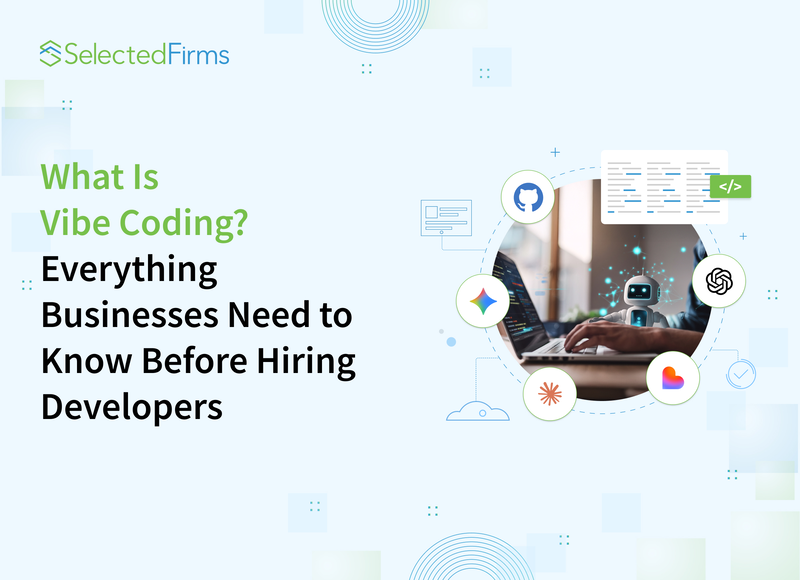
Search interest in "vibe coding" jumped more than 6,700% within months of the term being coined. It went on to become Collins Dictionary's Word of the Year for 2025. That's not a niche developer trend anymore. It's a word your next agency pitch, job description, or code review is probably going to use, whether you asked for it or not.
Here's the problem. Most explainers written about vibe coding are written for developers. They talk about prompts, IDEs, and context windows. But if you're the one signing off on a development budget or shortlisting an agency, the question you actually have is simpler: what is vibe coding, exactly & should you trust vibe coding developers or stick to agencies for building softwares?
Key Takeaways
- Vibe coding means building software by describing what you want in plain English and letting AI generate the code, with little to no line-by-line review.
- Adoption is close to universal: 92% of US developers use AI coding tools daily. Trust hasn't kept pace: only 29% trust the code those tools produce (Keyhole Software, 2026).
- The real due-diligence question for a business isn't "do they use AI to code." It's "who reviews it before it ships."
What Is Vibe Coding? (Meaning and Origin)
Vibe coding is the practice of building software by telling an AI what you want in natural language and letting it generate most or all of the code, without reviewing every line yourself. The term was coined by Andrej Karpathy, a co-founder of OpenAI, in a February 2025 post describing a workflow where he'd "fully give in to the vibes" and stop reading the code the AI produced.
It's worth drawing a line here, because this is the part most agency pitches blur. Vibe coding, strictly defined, is hands-off: you accept the AI's output and move on. That's different from AI-assisted development, where a developer still reviews, tests, and takes ownership of what the AI writes. Most serious engineering teams practice the second one, even when they call it the first.
The data backs this up. 72% of developers say fully hands-off vibe coding isn't part of their professional workflow (Stack Overflow 2025 Developer Survey). AI-assisted coding is now close to universal. Pure, unreviewed vibe coding is still mostly a prototyping habit, not a production practice, at least among people who'd get fired for shipping broken code.
That distinction matters more than the definition itself. When you're evaluating a developer or an agency, "we vibe code" tells you almost nothing. "We vibe code, and here's our review process before anything ships" tells you everything.
Vibe Coding vs. Vibe Code: Is There a Difference?
Not really. "Vibe coding" is the practice, the workflow your agency or developer follows. "Vibecode" is what that practice hands you, the actual codebase you'll own. One's a method, the other's a deliverable.
What that looks like technically. Someone types a prompt like "build a login page with email and password." The AI writes the frontend form, the backend authentication check, and the database connection that stores the credentials, all in one pass. That entire exchange is vibe coding. The form, the auth check, and the database code sitting in the repository afterward- that's the vibe code.
Here's why that matters when you're hiring. If an agency says "we do vibe coding," that only tells you about the cooking. It says nothing about whether the meal is any good. So ask a simpler question instead: can I see the vibe code itself, reviewed and ready to use? That answer tells you a lot more than the process ever will.
What Is a Vibe Coder?
A vibe coder is usually one of two people, and they're not the same hire.
The first is a non-technical founder, product manager, or marketer using a tool like Lovable or Bolt to turn an idea into a working prototype without writing code themselves. 63% of vibe coding tool users fall into this category — they're not professional developers at all.
The second is a professional developer using AI as an accelerant inside a codebase they already understand, moving faster on boilerplate and routine work while still owning the architecture and the review.
Knowing which one you're hiring changes what you should expect. The first profile is great for validating an idea fast. The second is what you want anywhere near a product real customers depend on.
How Vibe Coding Actually Works
The workflow behind vibe coding is a loop, not a one-shot request: describe the goal, let the AI draft it, review or add constraints, repeat until the output is close enough to ship or hand off.
That loop is genuinely fast. McKinsey found that AI coding tools cut time spent on routine coding tasks by 46% on average, based on a February 2026 study of 4,500 developers across 150 enterprises. It's why vibe coding has become the default way to spin up prototypes, MVPs, and internal tools where speed matters more than long-term maintainability.
Where it gets riskier is when that same loop is used to build something a business plans to run for years. Speed and review discipline pull in opposite directions, and most of the horror stories you'll read about vibe coding come from teams who optimized for the former and skipped the latter.
The Best Vibe Coding Tools Businesses Are Using Right Now
Every vibe coding tool makes the same pitch: describe what you need, get an app. The best vibe coding tools include Lovable, Cursor, Bolt, v0, and Replit Agent, but each takes a different approach to app building, code generation, integrations, and development workflows.
For businesses, speed is only the starting point. What matters more is what happens after the first working version: Can the code be maintained? Can it handle real users and business logic? Does it give your development team enough control as the product becomes more complex?
The market is already sizable, estimated at roughly $4.7 billion in 2025–2026, while Gartner projects that 40% of new enterprise production software will be built using vibe coding techniques by 2028. With these tools moving from quick prototypes into real development workflows, understanding where each one fits can help businesses choose based on their project, team, and long-term needs.
The Business Risk Most Vibe Coding Articles Don't Mention
Most vibe coding content is written by and for developers, so it treats the risks as an engineering footnote. For a business paying for the code, they're the headline.
AI-generated code carries 2.74x higher security vulnerability rates than human-written code, according to a CodeRabbit analysis of 470 open-source pull requests published in December 2025.
Separately, Veracode found that 45% of AI-generated code contains at least one OWASP Top 10 vulnerability — the industry's own list of the most critical security flaws.
The cost shows up later, too. Vibe-coded projects that skip rigorous review can see maintenance costs climb by roughly 300% within 18 months, as unreviewed shortcuts and missing tests turn into expensive rework. Gartner has gone as far as warning that unmanaged, prompt-to-app development by citizen developers could push software defect rates up 2,500% by 2028 without proper governance.
None of this is an argument against vibe coding. It's an argument for hiring people who know how to govern it. The businesses getting real value out of these tools aren't the ones avoiding AI. They're the ones who never let AI-generated code reach production without a human who understands it standing between the prompt and the deploy button.
In-House vs. Agency: Who Should You Hire for Development?
This is a build-versus-buy decision, and the right answer depends on what's already in place around the code, not on the tool itself.
A single in-house hire who vibe codes works well when you already have a senior engineer or technical co-founder reviewing what gets shipped. The AI tool becomes a productivity multiplier for someone who already knows what "good" looks like.
An agency tends to be the better call when you need the speed of AI-assisted development and the review discipline, security testing, and architectural judgment to go with it, especially if you don't have that oversight in-house already.
Either way, the screening question is the same: ask to see code they've reviewed and refactored after AI generated it, not just a fast demo of the AI generating it. A four-minute prototype tells you almost nothing about whether the same team can ship something you'll still trust in a year. If you're comparing vetted development agencies with documented AI and vibe-coding practices on SelectedFirms, this is the question their profiles and reviews should help you answer.
What to Put in Writing Before You Sign
If you're hiring vibe coding development services rather than an individual developer, treat it like any other technical vendor decision. A few things are worth putting in writing before you sign anything:
- Code ownership and handoff terms — you should own the codebase and be able to move it to another team without a rebuild.
- A documented security review process — not "we'll check it," but an actual step in their workflow, ideally with named tools or standards.
- Test coverage commitments — vibe-coded projects notoriously ship with thin or no tests unless a team is asked for them explicitly.
- A portfolio of production launches, not just prototypes — a fast demo and a live product serving real users are very different achievements.
- Transparent, scope-based pricing — costs vary widely by engagement type, and vague pricing is often the first sign of vague process.
A vibe coding development services provider that can answer all five without hesitation is telling you something real about how they work, not just how fast they can work.
The Bottom Line
Vibe coding isn't a passing trend, and it isn't a shortcut around good development practices either. It's a faster way to write code that still needs the same thing every codebase has always needed: someone who understands what it's doing before it touches your customers.
The businesses getting this right aren't asking "should we use AI to code?" They're asking who's reviewing it, and hiring accordingly. If you're ready to do the same, browse vetted development agencies with documented AI-assisted and vibe-coding practices on SelectedFirms and compare their review processes before you compare their price sheets.
FAQs
Vibecode is software generated through natural-language prompts to an AI model, which translates intent directly into functional code (frontend, backend, or full-stack) with minimal manual line-by-line authorship or review by the requester.
It can be, but only with review discipline. AI-generated code shows 2.74x higher security vulnerability rates than human-written code (CodeRabbit, 2025), so "safe" depends entirely on whether a qualified developer reviews it before it ships, not on the vibe coding tool used to generate it.
Yes, for anything beyond a prototype. 72% of developers say hands-off vibe coding isn't part of their actual professional workflow (Stack Overflow, 2025). Someone still needs to understand, test, and take responsibility for what the AI produces.
Vibe coding means accepting AI-generated code with minimal review. AI-assisted development means a developer uses AI to move faster while still reviewing, testing, and owning every change. Most professional teams practice the second, even when they informally call it "vibe coding."
You can hire a vibe coding team at a cost that ranges from $15,000–$80,000 ($25–$199/hour), depending on scope, team location, security review depth, code ownership terms, and post-build cleanup, often adding another 20–30% before launch.


Head Of Digital Marketing
Recent Blogs

Elia Martell
5 Virtual Recruiting Support Operations for Tech and Healthcare Teams
-

09 Oct 2026
-

8 Min
-

477
Jane Hart
Why LinkedIn Campaign Optimization Requires More Than CPC and CTR
-
09 Oct 2026
-
8 Min
-
155
Jane Hart
How to Vet an Offshore SEO Partner: A Due-Diligence Checklist for Agencies and Brands
-
08 Oct 2026
-
8 Min
-
263
Jane Hart
Benchmarking GPU Providers: A Practical Guide to Comparing Cloud Compute Options
-
07 Oct 2026
-
6 Min
-
173
