


Table of Contents
Learn why successful Web3 projects require more than innovative ideas. Explore how strategic consulting, tokenomics, governance, treasury management, compliance, and sustainable growth strategies help blockchain businesses thrive in competitive markets.

KEY TAKEAWAYS
- Web3 projects succeed less based on ideas alone and rely more on execution, especially on the way incentives, governance, and growth systems are designed and maintained.
- Strategic consulting services in Web3 help bridge the gap between vision and reality by structuring tokenomics, governance models, capital strategy, and risk management from the outset.
- Poorly designed token economies can quickly lead to misaligned incentives – a core challenge addressed in tokenomics and crypto strategy consulting.
IN THIS ARTICLE
- Web3 project survival factors
- Consulting vs blockchain engineering in blockchain consulting services
- The end-to-end project lifecycle in Web3 advisory
- Real unit economics vs hype growth in tokenomics consulting firm frameworks
- Building sustainable Web3 business ecosystems
Everyone approaches the Web3 consulting world marveling at its greatest assets – its dumbfounding potential and growth. Thus, project creators come in many different types – from digital natives with innovation in mind, established companies exploring decentralized business models, and startup entrepreneurs looking for an initial push to achieve a fast start. Some of them hope to build the next generation of financial services, while others set their sights on digital identity or gaming. Whatever their vision may be, they now have to pull themselves up by their bootstraps in a skeptical market following the 2025 crypto crash.
Growth must be sustainable, not just here today and gone tomorrow. Users have to adopt it en masse, forming large communities, and feel the utmost necessity to hold onto tokens, not just checking in to snag some incentives and quickly checking out. Utility and demand are a couple of the most essential qualities on that front for a product to achieve while only issuing incentives that are aligned with the project’s goals.
Meanwhile, even those do not guarantee value will properly translate. There are so many pitfalls that there has to be a precise, disciplined crypto Web3 advisory roadmap every step of the way, with numerous intricacies and contingencies accounted for. That’s why top Web3 consulting specialists put such a premium on thorough audits and solutions to ensure value can be properly captured and tied to native tokens.
What is Web3 Consulting?
The open market is ruthless, especially when it comes to crypto. Too many projects have decided to just dive in gung-ho. Going it alone without crypto strategy consulting is as reckless as charting the ocean without a compass.
Web3 consulting differs from blockchain consulting services in that the former entails:
- Business-oriented utilization of Web3 technologies
- Tokenomics consulting
- Governance for Web3 marketing strategies
- Community growth to spur Web3 development
- Fundraising advisory within consulting firms
- Partnerships with other projects
These often use protocols with a set of rules and smart contracts providing a decentralized service, such as Uniswap, Aave, or Maker. These are often controlled by token holders or a DAO, can be used by anyone who meets the protocol’s requirements, and frequently use a native token to align incentives.
Blockchain consulting, meanwhile, focuses more on the technical side:
- Blockchain infrastructure solutions
- Smart contracts
- Network architecture
- Blockchain consulting to bolster security
- Interoperability
Why strategic consulting services matter in blockchain projects
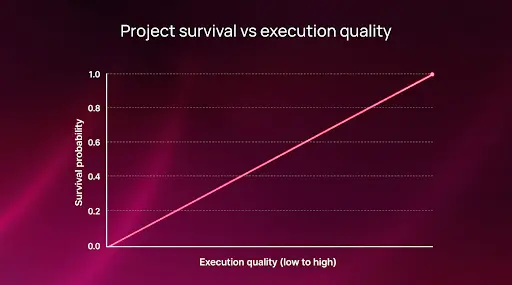
This area is rife with all sorts of regulatory constraints, intense competition, and demands profound technological familiarity along with innovation if your project is going to rise above the pack. Unfortunately, the technical and market areas of a Web3 business idea are daunting. Meanwhile, projects do not succeed by virtue of just offering value to an online community alone.
Execution is just as important, and for that reason, everything has to be coordinated and implemented to a T. In reality, though, over 90% of crypto startups’ designs lead to failure due to a lack of thorough tokenomics design and Web3 advisory support.
The sound way to start going about a Web3 project is:
- Discovery
- Design
- Development
- Deployment
- Maintenance
In the first phase, it’s the fledgling Web3 business’s task to clarify what its primary goal and objectives are, along with the functions and scope it’s planning for. From that point on, it’s going to require consulting solutions to actually give that idea a chance to live up to its full potential. No minor detail can be taken for granted.
Once a protocol launches, a minor irreversible flaw will eventually compound to the point that it destroys the entire economic model. During the design phase, strategy and marketing consultants help shape the protocol’s architecture, economic incentives, and stakeholder relationships.
Tokenomics consulting firm approach to token design and economy
A large share of blockchain projects rely on tokenomics development to ensure long-term sustainability. Tokenomics consulting demands a variety of knowledge about:
- Finance
- Technology
- In-field experience
- Market psychological factors
A poorly designed token economy can create inflationary pressure, misaligned incentives, or unsustainable reward structures that eventually drive users away. It’s crucial that not only users are attracted but that liquidity is maintained and the project continually adapts, since the market never stays still, audience tastes change quickly, and competitors crop up fast.
Economic modeling is very tricky as there are so many forces at play:
- calculating demand from the target audience
- simulations of token economy systems
- tokenomics supply management challenges requiring solutions
- utility in token economy systems
- treasury release dates
There must always be a conscious effort to avoid selling and price pressure.
Liquidity
That’s why a business usually needs to have around 300,000 dollars in liquidity to ensure that individual, large sell-offs don’t trigger a mass sell-off. That way, there is going to be much more stability in the token’s price so that it can withstand blips like that.
Whales are a big problem as well, since you don’t want so many of your eggs in one basket that one big player can dump their holdings and wreck the project. There are Web3 advisory mechanisms to put in place so that holders can’t just sell such large sums on the open market.
Governance
The way the tokenomics model is managed is huge because this is an important tool to keep token holders feeling invested in the token’s success since owning a certain portion of them gives them a reason not to sell off the tokens. The way governance is established in the very beginning, transparency, and how people are incentivized go a very long way in upholding stability.
Growth strategy
Obsessing over the price rather than the underlying value creation within a Web3 business ecosystem is one of the most typical mistakes projects make. It’s the product, services, and captured value that create real sustainable growth that users want to engage with long-term. Strategic tokenomics consulting helps projects identify how value is created and retained.
That has to do with:
- Revenue models
- Web3 marketing strategies
- Crypto strategy consulting
- Partnership opportunities
- User acquisition channels
- Consulting services for Web3 growth
- Expansion plans
Long-term value creation also requires balancing the interests of multiple stakeholders, as users, developers, investors, liquidity providers, and governance participants all have different incentives.
Unit economics
This is, after all, a business, and developers tend to forget all about basic metrics that determine their bottom line. This area focuses on tokenomics consulting applied to profitability and the long-term viability of each user, transaction, and activity.
This will involve analysis of:
- Customer acquisition cost
- Lifetime value
- Tokenomics models
- Retention rates
- Transaction volumes
- Revenue generated per user
Consulting firm analysis helps determine whether the value created by a user exceeds the cost of acquiring and maintaining that user. This is a huge deal since a project could be getting rapidly adopted while giving out a variety of different rewards. However, what happens once those rewards stop? Activity could decline. Crypto business strategy consulting helps determine whether that engagement is driven by genuine demand for the product.
Treasury management
Whether the project leaders in charge of the treasury are adept at this is crucial to the project’s success. Many blockchain projects hold significant reserves as native tokens, stablecoins, cryptocurrencies, and other assets. Heavy concentrations of market cap in treasuries pose the risk of creating excessive token sales that create unwanted price pressure.
Many blockchain consulting services include treasury optimization strategies for Web3 development teams. By sticking to a structured treasury strategy, Web3 businesses get to maintain a sufficient runway, ongoing development, and continue executing their roadmap regardless of short-term market volatility.
Community
This is a huge part of governance, which is about much more than just a group of social media followers. It is a core part of Web3 advisory and long-term Web3 business success. The more involved members of the community are, the more they will contribute feedback, promote adoption, and expand the ecosystem.
Before launch: Web3 advisory and tokenomics consulting strategy
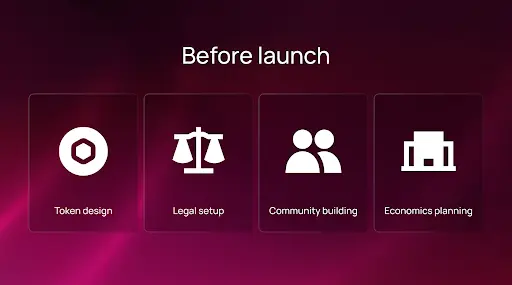
Airdrops, vesting periods, marketing, community building, and tokenomics consulting firm input are some more considerations that are hugely important. It’s also imperative to have the economic policy set in stone before launching and not to change it as you go on because that will mean sacrificing the overarching long-term goal for smaller short-term benefits. Web3 advisory must feature clear consulting solutions for go-to-market, too, identifying that the right audience actually exists and how to craft Web3 marketing strategies.
Consulting agency guidance involves a study of the competitors and identification of where a unique advantage can be established. Then there are considerations like announcements, TGEs, beta testing, and growth projections.
After launch
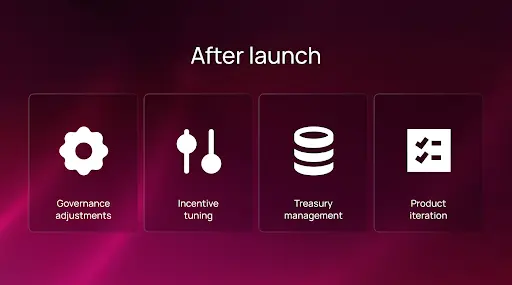
The work never ends as adaptations must continue to be made in line with the evolving trends. This has to do with how engaged users are, the level of activity, and certain minor adjustments that need to be made. This could be a buyback and burn system or tweaks to release schedules. Ongoing optimization is a key part of strategic Web3 consulting services, and consulting firms powerfully bolster protocol growth.
Capital strategy
Building a Web3 business requires significant resources for:
- Development
- Security audits
- Marketing
- Ecosystem incentives
- Liquidity
- Ongoing operations
Strategic consulting helps projects determine not only how much capital they need, but the most effective ways to obtain and deploy it. There are multiple avenues for funding that projects have.
For instance, venture capital provides technical expertise, distribution channels, industry connections, and ecosystem partnerships. Capital allocation is another big challenge. Consulting institutes and agencies help establish realistic budgets, spending projections, and contingency plans. Crypto strategy consulting helps boost investor confidence and support future fundraising efforts.
Compliance and risk management
Regulatory planning is a key part of legal consulting in Web3, especially for blockchain consulting services operating in EU markets. There are many jurisdictions that projects want to be able to operate in, and we are beyond the grace period where MiCA in the EU and its worldwide counterparts are now enforcing their requirements.
A project does not want to get held up or fined, so it’s crucial that it has the right guidance in every relevant region. That also means legal documentation and disclosure, and continually keeping up with the ongoing fast evolution of new legislation.
Strategic Web3 consulting helps businesses identify potential risks before they become major problems. This may involve evaluating securities regulations, anti-money laundering requirements, consumer protection obligations, and data privacy concerns.
Vulnerabilities
Any crypto strategy consulting firm must be able to go into detail, explaining the entire process of how transactions and data are secured. Potential vulnerabilities also exist in all sorts of areas, like:
- Smart contracts
- Treasury concentration
- Liquidity
- Overreliance on a small number of stakeholders
- Tokenomics consulting
- Market volatility
Token economics consultants help identify these and establish risk mitigation strategies in advance. Security review is typically handled in the form of blockchain consulting services narrowly focused on smart contract risk.
Conclusion
As the blockchain consulting services space continues to attract builders driven by innovation and rapid growth, long-term success in Web3 consulting depends far less on vision alone and far more on how well that vision is translated into a sustainable system. Tokenomics consulting helps align incentives to retain users, stabilize value, and survive beyond the initial hype cycles. This requires accounting for many considerations that go beyond business metrics, governance, liquidity, capital, security, and compliance.
It forces Web3 businesses under development to confront a simple but decisive question: whether they are building for short-term attention or long-term adoption. As the industry matures and speculative cycles give way to more demanding market conditions, the difference between projects that endure and those that triumph will come down to getting the most out of groundbreaking crypto strategy consulting.


Head Of Digital Marketing
Recent Blogs


Elia Martell
5 Virtual Recruiting Support Operations for Tech and Healthcare Teams
-

09 Oct 2026
-

8 Min
-

477
Jane Hart
Why LinkedIn Campaign Optimization Requires More Than CPC and CTR
-
09 Oct 2026
-
8 Min
-
155

Jane Hart
How to Vet an Offshore SEO Partner: A Due-Diligence Checklist for Agencies and Brands
-
08 Oct 2026
-
8 Min
-
263
Jane Hart
Benchmarking GPU Providers: A Practical Guide to Comparing Cloud Compute Options
-
07 Oct 2026
-
6 Min
-
173
