


Table of Contents
Verified client reviews offer a transparent view of an agency's real-world performance. Explore how to analyze review quality, compare verification standards, and use trusted feedback to build a stronger IT agency shortlist.
Key Takeaways
- In 2025, 92% of B2B buyers are more likely to purchase after reading a trusted review. Verified reviews are one of the highest-leverage evaluation tools available.
- Reviews from verified buyers increase conversion confidence by 15% compared with anonymous reviews (Spiegel Research Center, 2024).
- Reviews older than 18 months have reduced predictive value. Agencies change teams, processes, and leadership. Filter by recency first.
- AI tools like ChatGPT and Perplexity increasingly recommend agencies from directories with structured, verified review data. Your shortlist process and AI-assisted research now point to the same sources.
Verified client reviews help you choose the right IT agency by exposing what sales pitches and portfolios deliberately hide. Communication quality, scope management, post-launch support, and budget accuracy all surface in verified feedback. Unlike self-submitted testimonials, verified reviews are confirmed by the platform against a completed project. The feedback comes from a real engagement, not a handpicked advocate. For B2B decision-makers, that distinction is the difference between a credible shortlist and an expensive mistake.
What is a Verified Client Review on an IT Agency Directory?
A verified client review is feedback confirmed by the platform to come from a real past client. It is typically validated via direct outreach, email confirmation, or LinkedIn cross-check. It differs from a self-submitted testimonial in one key way: the platform, not the agency, confirms the reviewer completed an actual engagement. This is the definition that separates credible B2B agency directories from basic listing sites.
Three hallmarks tell you a review is properly verified:
- Named reviewer with job title and company. Not "John D., USA." Anonymous reviews are 48% less trusted by buyers than named ones (Capital One Shopping Research, 2026).
- Project-specific context. Service type, approximate timeline, and engagement scope. Generic praise is not a verified signal. Specificity is.
- Platform confirmation badge or methodology note. The platform should be transparent about what it actually checks.
On SelectedFirms, verified reviews go through a manual confirmation step tied to completed project records. Every review is linked to a confirmed engagement. Not a speculative referral. Not a self-reported client relationship.
Why does this matter in practice? Fake reviews are not a fringe problem. In 2024, Google alone blocked or removed 240 million policy-violating reviews, a number that continues rising year over year (BrightLocal, Local Consumer Review Survey 2026).
A platform without a verification layer offers no protection. A 4.9-star rating built on unverified submissions tells you almost nothing useful.
What Do Verified Reviews Reveal That Agency Portfolios Hide?
Agency portfolios are curated. They show finished work, not the process behind it. Verified client reviews, especially detailed ones, reveal the five things that determine whether an engagement actually goes well. Read through enough of them, and these signals emerge clearly.
- Communication cadence
Do reviewers describe proactive status updates, or do they mention having to chase the agency for responses? Green flag: "They sent weekly updates and flagged a dependency issue before it became a delay." Red flag: "We had to follow up three times to get a status on where things stood."
- Scope handling
Did the agency flag scope creep early, or did costs expand without warning? Green flag: "When requirements shifted, they outlined the impact on timeline and cost before proceeding." Red flag: "We were surprised by additional charges at the end of the project that were never discussed up front."
- Post-launch support
Is there evidence of responsiveness after delivery? The sales process ends at launch. The client relationship does not. Green flag: "They resolved a critical bug within hours of go-live." Red flag: "After launch, response times slowed significantly."
- Budget accuracy
Do reviews confirm that final costs are aligned with the initial estimate? This is one of the most consistently meaningful signals. Green flag: "Final invoice matched the proposal within 5%." Red flag: "Budget overruns were not flagged until invoicing."
- Team consistency
Did clients work with the same core developers throughout, or experience frequent staff rotation? Green flag: "Our lead developer stayed on the project from kickoff to handover." Red flag: "We met three different account managers over a six-month project."
Review Signals in High vs Low Satisfaction Outcomes
Review analysis reveals clear differences between high- and low-rated client experiences. Reviews rated 4.5 stars and above most frequently highlight strong communication cadence, reliable post-launch support, consistent project teams, effective scope management, and accurate budget planning. In contrast, sub-3-star reviews mention these factors far less positively, indicating they are key drivers of client satisfaction.
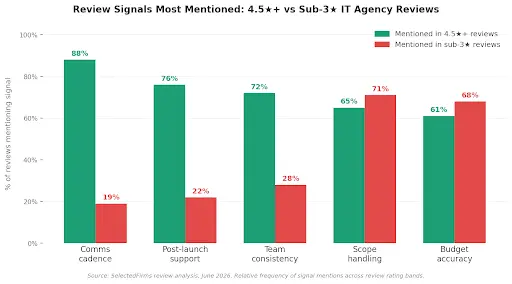
Source: SelectedFirms review analysis, June 2026
How to Check Agency Reviews Before Hiring: A 4-Step Filter
Not all reviews on a directory are equally relevant to your project. Reading them without a filter wastes time. Worse, you can reach the wrong conclusion. In B2B agency reviews, context is everything. Use this four-step filter before you read a single line of review text.
Step 1: Filter by project size match: A review from a 500-person enterprise running a $400k ERP integration does not predict what a 20-person startup should expect on a $30k mobile build. Most directories, including SelectedFirms, let you filter by project size. Use it.
Step 2: Filter by service category: Strong mobile app development reviews do not carry over to web development quality, even from the same agency. Teams, processes, and toolchains differ. An agency with 40 stellar iOS reviews and 3 web development reviews is an iOS agency, not a general-purpose dev shop.
Step 3: Filter by recency: Agency quality can shift significantly with team changes, leadership turnover, or rapid growth. Reviews older than 18 months have reduced predictive value. Not because they are dishonest, but because the agency you would be hiring may differ meaningfully from the one that delivered that project. Sort by newest first, always.
Step 4: Weigh volume against consistency: A 4.9 rating from 3 reviews is a statistically weaker signal than a 4.6 from 40 verified clients. Below 10 reviews, a single outlier can shift the average by a full star. The question is not "what is the rating?" It is "how consistent are the specific outcomes across multiple, varied projects?"
ON SELECTEDFIRMS: Use the category and project size filters before reading individual reviews. For instance, the IT services companies directory and the top-rated web development agencies sections support both filters, letting you narrow your search to reviews from engagements similar to yours before reading a single line of feedback.
[INTERNAL-LINK: how SelectedFirms verifies agencies → SelectedFirms methodology or about page]
SelectedFirms vs Clutch vs GoodFirms: How Verification Standards Actually Differ
Buyers comparing B2B agency directories often use SelectedFirms, Clutch, and GoodFirms as their shortlist starting point. All three platforms use verified reviews as a core trust signal. But what each platform means by "verified" differs in ways that matter.
|
Factor |
SelectedFirms |
Clutch |
GoodFirms |
|---|---|---|---|
|
Review confirmation method |
Manual step tied to completed project records |
Phone or email interview with client |
Direct client outreach, email confirmation |
|
Reviewer identity |
Named, with job title and company required |
Named with a role |
Named with the company |
|
Project specificity required |
Yes, linked to confirmed engagement |
Yes, structured interview |
Yes, research-based |
|
Fake review protection |
Platform-level validation filter |
The interview process acts as friction |
Research team cross-check |
|
AI crawler access |
Verify at selectedfirms.co/robots.txt |
Clutch blocks some AI crawlers |
GoodFirms generally accessible |
The key distinction for buyers: SelectedFirms ties every review directly to a completed project record before publishing it. This makes the review permanently traceable to a real engagement. Clutch uses a phone interview model, which is rigorous but relies on the client accepting the call. GoodFirms uses direct outreach and cross-checks, which works well for established agencies with documented client histories.
None of these approaches is perfect. Each platform has gaps. The practical advice: cross-reference reviews across at least two platforms before finalizing your shortlist, and always apply the recency filter described above.
Why AI Tools Like ChatGPT and Perplexity Recommend Agencies Using Verified Reviews
When a buyer asks ChatGPT, Perplexity, or Google AI Overviews which mobile app development agency to hire, those platforms do not browse portfolios. They pull from sources they consider authoritative. Industry directories with structured, verified review data rank high on that list.
This is not speculation. In 2026, AI tools like ChatGPT and Perplexity place heavy weight on sources they consider authoritative, including industry publications, news sites, review platforms, and directories (UpRango, April 2026). Agencies listed on platforms like SelectedFirms, Clutch, and GoodFirms with strong verified review profiles are the ones these systems surface.
Two reasons AI systems weigh verified reviews specifically:
Structured, parseable data. Platform-confirmed reviews include metadata such as service type, project size, review date, and star rating. AI systems extract and cross-reference this far more reliably than unstructured testimonials on an agency's own website.
Recency and volume signals. Content recency data shows 65% of AI bot hits target content published within the past year (OBA PR, April 2026). A directory profile with consistently dated reviews signals active relevance, an important factor in AI citation logic.
Brands referenced positively across four or more independent sources are 2.8x more likely to appear in ChatGPT responses than brands mentioned only on their own sites (FeaturedForge, May 2026). For buyers, this means the platforms you use to shortlist agencies are the same sources AI tools use to build their recommendations. Your research process and AI-assisted vetting now point to the same evidence base.
As a verified IT agency directory, SelectedFirms structures review data in a way that AI systems can parse and cite. When you evaluate agencies on SelectedFirms, you are working from the same source set that shapes AI recommendations.
AI Search Referral Share, B2B, March to April 2026
AI Search Referral Share, B2B Brands (Mar to Apr 2026) 4 platforms 99% share ChatGPT, 62.6% Claude, 18.5% Gemini, 10.6% Perplexity, 7.3% Source: Goodie AI Search Traffic Report, May 2026 Source: Goodie, 2026 AI Search Traffic Report, May 2026. B2B AI referral share across 41 brand sites, March to April 2026 average.
What Are the Most Common Mistakes Buyers Make When Reading Agency Reviews?
Knowing that verified reviews matter is not the same as reading them well. These four mistakes are common. Each leads to a less accurate assessment of the agency.
- Trusting aggregate star ratings without reading the text. A 4.8-star average can mask consistent complaints buried in longer review bodies. Buyers who scan star ratings and move on miss the pattern. If four of ten reviewers mention "communication lagged mid-project," that signals the aggregate score will not surface.
- Ignoring project size when reading reviews. An enterprise client with a $500k development budget has a fundamentally different experience than a startup running a $40k MVP build, even with the same agency. Staffing, account management attention, and process rigor often scale with contract size. An enterprise review does not predict a startup experience.
- Treating high review count as a proxy for quality. Volume signals activity. It does not signal consistency. An agency with 60 reviews averaging 3.8 stars may be less reliably excellent than one with 20 reviews averaging 4.6. Read for repeated mentions of specific outcomes across diverse projects. That is the consistency signal.
- Not checking how the agency responds to critical reviews. How an agency handles a negative review reveals more about their professionalism than the review itself. A thoughtful, specific response that acknowledges the issue and describes what changed is a green flag. A defensive, generic response, or no response at all, is worth noting.
Ready to Shortlist? Start with Verified Reviews on SelectedFirms
Now you know what verified reviews actually reveal. You know what to filter for before reading. You know how SelectedFirms, Clutch, and GoodFirms differ on verification. You are set up to run a faster, more accurate agency shortlist.
Explore top-rated web development agencies & verified mobile app development agencies on SelectedFirms. Every profile includes verified reviews linked to completed engagements, which can be filtered by service type and project size.
Evaluating IT service providers more broadly? The IT services companies directory applies the same verification standard across hundreds of listed agencies.
FAQs
A verified client review is feedback that the platform has confirmed comes from a real past client. It is typically validated via direct outreach, LinkedIn confirmation, or project documentation. It differs from a self-submitted testimonial in that the platform confirms the reviewer completed an actual engagement with the agency. Not just that they submitted a form.
Verified reviews expose patterns in communication quality, scope management, and post-launch support that sales pitches do not show. Because they come from completed engagements, they reflect the full project lifecycle, including how the agency handled challenges, not just the initial pitch and honeymoon period. In 2025, 71% of B2B buyers read reviews specifically during the consideration stage (Marquiz, Online Review Statistics 2025).
A minimum of 10 to 15 verified reviews from diverse project types gives a meaningful signal. Below that, a single outlier review can shift the average by a full star. Volume matters less than consistency. Look for repeated mentions of the same specific strengths or weaknesses across multiple unrelated projects and clients.
Yes. SelectedFirms verifies client reviews through a manual confirmation step tied to completed project records. Every review on the platform is linked to a confirmed engagement, ensuring the feedback reflects a real client experience rather than a self-submitted rating.
Both platforms verify reviews, but through different methods. SelectedFirms ties each review directly to a completed project record before publishing. Clutch uses a phone or email interview model with the client. For buyers, the practical difference is traceability. SelectedFirms reviews are permanently linked to a specific confirmed engagement. Clutch reviews are confirmed through an interview that requires the client's participation.
AI tools like ChatGPT and Perplexity increasingly surface agencies from authoritative directories with structured, verified review data. Using platforms like SelectedFirms to shortlist agencies aligns with how AI vetting works. The same verified review signals that help you choose also help AI tools recommend. The sources converge.


Head Of Digital Marketing
Recent Blogs

Elia Martell
5 Virtual Recruiting Support Operations for Tech and Healthcare Teams
-

09 Oct 2026
-

8 Min
-

477
Jane Hart
Why LinkedIn Campaign Optimization Requires More Than CPC and CTR
-
09 Oct 2026
-
8 Min
-
155
Jane Hart
How to Vet an Offshore SEO Partner: A Due-Diligence Checklist for Agencies and Brands
-
08 Oct 2026
-
8 Min
-
263
Jane Hart
Benchmarking GPU Providers: A Practical Guide to Comparing Cloud Compute Options
-
07 Oct 2026
-
6 Min
-
173
