


How Agencies Use Webflow to Build Scalable, Conversion-Focused Websites for Clients
-
Last Updated:

05 Dec 2025
-
Read Time:

8 Min Read
-
Written By:
 Isha Choksi
-
2656
Table of Contents
See how agencies unlock Webflow’s power to build fast, scalable, and high-converting websites. Explore smoother workflows, reusable components, and smarter testing that help brands launch faster, boost results, and grow confidently online with every new p

Choosing how to build your website is no longer just a technical decision. It shapes how fast you launch, how easily you test ideas, and how quickly your team can respond when the market changes.
If you work with an agency, the tools they use directly affect your results. Webflow has become a go-to platform because it lets agencies ship custom, conversion-focused sites at speed, without locking you into fragile codebases or endless dev queues.
Photo by cottonbro studio on Pexels
Why Webflow Fits Modern Agency Workflows
If you are hiring an agency, you want a site that is fast to launch, simple to update, and flexible enough to grow with your business. Webflow fits this reality because it combines visual design, content management, and production-ready code in one place.
An agency that knows Webflow can prototype quickly, refine layouts with you in real time, and then ship those designs straight to production. That shortens the feedback loop and keeps everyone focused on outcomes instead of tickets.
Visual development in Webflow doesn't require any guesswork. It gives you the actual sight and behavior of your site instead of relying on static mockups. Such a situation leads to easier and more precise feedback since you will be responding to genuine interactions, spaces, and responsive behavior.
Agencies use this to run tighter review cycles. You can log into the staging site, click through key flows, and comment on specific sections. The result is a site that reflects how your brand feels, not just how it looked in a design file.
Design systems that scale instead of breaking
Top Notch agencies regard Webflow as much more than a site builder. They develop a design system that withstands the test of time through class naming conventions, global styles, and components.
Thus, your team can easily integrate new pages, interchange portions, and experiment with new concepts without disrupting the architecture. Besides, traffic has no inhibiting effect on your marketing as you reuse established patterns that are not only of good quality but also in good shape as far as consistency and conversion are concerned.
Clean, production-ready code without handoffs
Traditional design-to-dev handoffs often create friction, bugs, and delays. Webflow generates clean HTML, CSS, and JavaScript from the visual editor, which removes many of the translation errors between Figma and code.
Agencies can still inject custom code where needed, but most of the work happens in Webflow’s interface. That means fewer dependencies on large engineering teams and a faster route from idea to live page.
Building Conversion-Focused Pages Without Sacrificing Speed
A site that looks good but does not convert is a sunk cost. Agencies use Webflow to build pages that are optimized for conversion and still load fast, even as you add richer visuals and interactivity.
Instead of treating design and performance as separate tasks, Webflow lets you see both at once. You adjust layouts, copy, and sections while keeping an eye on load times and core performance metrics.
Treat every page like a controlled experiment
High-performing agencies think in tests, not guesses. Webflow makes it easier to clone key pages, adjust messaging, and integrate with A/B testing tools.
You can iterate on headlines, hero images, forms, and social proof without asking for a full rebuild. Over time, this turns your site into a collection of experiments where winning variations become the new standard.
Use CMS and components to scale winning patterns
Once you find a layout that converts, you want to reuse it across campaigns and product lines. Webflow’s CMS and symbols (or components) help agencies turn these layouts into reusable building blocks.
Your team can swap content inside a proven structure, instead of reinventing each page. This is how agencies use Webflow to ship landing page variations quickly while keeping everything on-brand and consistent.
Balance motion, media, and performance
You want your site to have a nice and modern look, but the use of heavy animations and large videos can cause a slowdown. The companies that are experts in Webflow make use of light interactions, optimized images, and lazy loading to maintain the smoothness of the pages.
Their intention is to create living experiences that do not annoy users with slow connections or mobile devices. The equilibrium established in this way results in more visitors staying longer, more forms being filled out, and fewer people leaving without completing their visit.
Also Read -
Connecting Webflow to the Rest of the Marketing Stack
Your forms, analytics, CRM, email platform, and ad tools must be in complete harmony so that the entire process is visible to you after a user clicks.
Agencies use Webflow as the visual front-end and just connect it to the rest of your tech stack for the tracking, scoring, and follow-up of every conversion.
Webflow, right from the start, integrates perfectly with analytics and marketing tools like Google Analytics, Google Tag Manager, and typical email platforms. Event tracking setups are done by agencies for forms, buttons, and major interactions to be monitored.
This gives you a clear view of which pages bring qualified traffic, how visitors behave, and where they drop off. With this feedback, your team can prioritize the right experiments instead of guessing.
Automation and Logic for sales-ready leads
As Webflow adds more workflow and automation features, agencies can do more without switching tools. Logic, webhooks, and integrations with platforms like Make or Zapier help route form data and trigger actions.
You can send leads straight to your CRM, trigger nurture sequences, or notify sales in real time. This keeps your funnel tight because each conversion on the site turns into a trackable lead with a clear owner.
When to bring in custom code and third-party tools
Not every requirement fits into native features. When you need more complex personalization, membership access, or dynamic pricing, agencies extend Webflow with custom code and third-party services.
The advantage is that your main site still lives inside Webflow, which keeps content editing simple. Custom functionality sits on top rather than forcing a full re-platform.
Maintaining and Iterating on Client Sites at Scale
The real test of your website comes after launch—you need a Webflow agency that focuses on structuring their builds so maintenance and updates are predictable instead of painful.
That approach is what allows your site to grow from a few core pages to a full content hub without slowing everything down.
Governance, roles, and client training
Agencies use roles, permissions, and editing workflows to keep key styles locked while still letting your team update content.
They also train your marketers and content writers to use the CMS, so simple changes do not require a dev ticket. This frees your specialists to focus on more complex improvements.
Component libraries and pattern documentation
When a site is built with a clear system, it stays manageable. Agencies create internal libraries of sections, modules, and page templates inside Webflow, often documented in a simple style guide page.
Your team knows which components to use for specific use cases, such as feature sections, testimonial strips, or pricing tables. The result is faster page creation and fewer inconsistencies over time.
Release processes that do not break campaigns
Publishing changes directly on a live site can cause issues, especially during campaigns. Agencies set up staging environments, testing checklists, and controlled release windows inside Webflow.
This reduces the risk of broken tracking, layout issues, or downtime when you push updates. Your site keeps running smoothly while new pages, tests, and features roll out in the background.
How to Choose the Right Webflow Agency for Your Business
Some treat it like a simple page builder, while others use it as a full product and growth platform for your brand—look beyond portfolios and check how they think about strategy, measurement, and long-term flexibility.
Strong Webflow agencies think like product teams, focusing on user journeys, messaging, and conversion points instead of stopping at visual polish.
Inquire about their techniques for organizing the content, ranking the pages, and connecting your products with unambiguous prompts to action. You prefer a website that narrates an attractive story and directs the audience to certain results.
Ask how they measure, report, and future-proof
A conversion-focused site needs clear metrics—good agencies show you how they track signups, demo requests, purchases, and other key actions.
They also explain how those metrics shape ongoing work. That transparency helps you see whether the site is contributing to revenue or just generating traffic.
You might have different requirements in the future, and your website must be prepared for that. A top-notch Webflow agency is constructed by means of interchangeable parts, a clean CMS structure, and comprehensible manuals.
This indicates that you can incorporate fresh product lines, new campaigns, and content types without having to go back to the beginning. Gradually, your website turns into an asset that develops along with your business instead of restricting it.
Conclusion
The biggest growth factor you can handle is a great website that is easily scalable and mainly directed at converting. Front-end no-code Webflow gives agencies the ability to do custom projects, design, and site development, as well as the capability to work on their brand's objectives quickly.
Selecting an agency that thoroughly understands your platform is not just about getting a new site. Rather, you get a versatile system that allows for testing of ideas, demand capturing, and transforming visitors into buyers.
In case you are weighing your alternatives, keep an eye on the topics about process, measurement, and long-term flexibility that an agency is referring to. Tools are important, but the manner of using them by the people involved is the most crucial factor.

Head of SEO Operations
Recent Blogs

Elia Martell
5 Virtual Recruiting Support Operations for Tech and Healthcare Teams
-
09 Oct 2026
-
8 Min
-

462

Jane Hart
Why LinkedIn Campaign Optimization Requires More Than CPC and CTR
-
09 Oct 2026
-
8 Min
-
149
Jane Hart
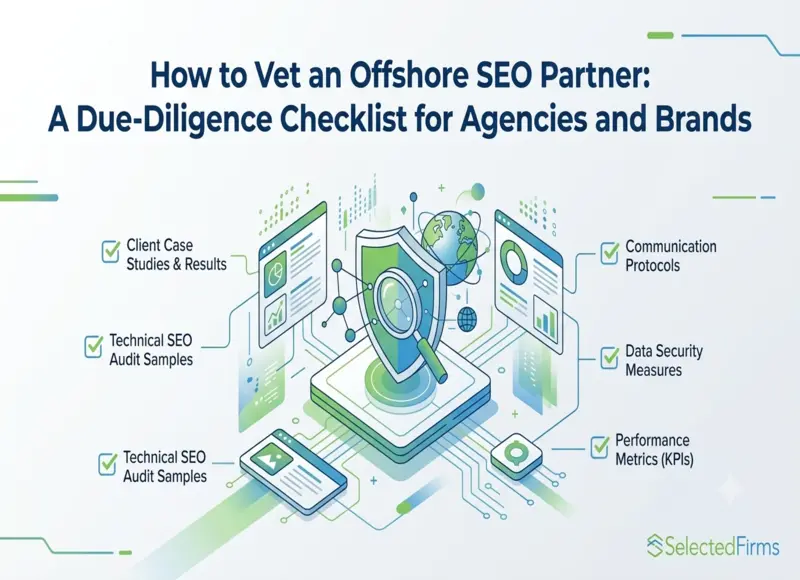
How to Vet an Offshore SEO Partner: A Due-Diligence Checklist for Agencies and Brands
-
08 Oct 2026
-
8 Min
-
249
Jane Hart
Benchmarking GPU Providers: A Practical Guide to Comparing Cloud Compute Options
-
07 Oct 2026
-
6 Min
-
171
