


Table of Contents
European startups are accelerating innovation through AI, data-driven strategies, fintech expansion, and climate tech growth. Backed by rising investment and strong regulation, they are reshaping Europe’s technology landscape and building a more sustainab
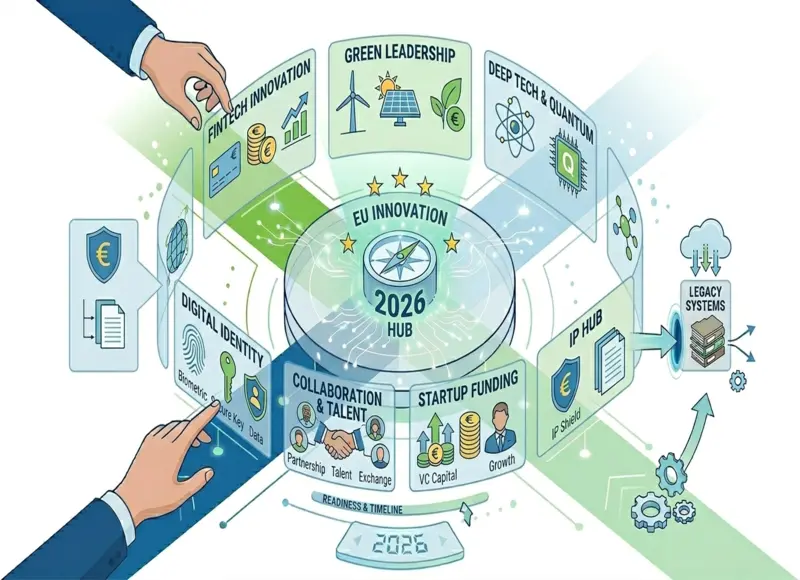
The startup ecosystem in Europe is booming, with an increasing number of entrepreneurial ventures reshaping the technology sector. European startups are spearheading advancements in a variety of fields, but perhaps the most notable area is data-driven innovation.
These startups are not just adopting new technologies; they are integrating data at every level to fuel growth, improve customer experiences, and lead the charge in digital transformation.
Over the past two years, this transformation has accelerated. In 2024 alone, European startups attracted an estimated €50+ billion in venture capital funding, signaling renewed investor confidence after the global funding slowdown of 2023. AI-focused startups now account for roughly 25–30% of total VC investment across Europe, making data and AI the central pillars of innovation across the region.
Overview of the Growing Startup Culture in Europe
The tech scene in Europe has undergone a major transformation over the last decade. No longer is the continent seen as lagging behind Silicon Valley; instead, it is becoming a global hub for innovation.
Today, Europe has more than 35000 active startups that operate across multiple sectors, including fintech, AI, climate tech, healthtech, and deep tech. Berlin, Paris, Stockholm, and Amsterdam have developed into major innovation centers because of European Union funding programs and their advanced digital infrastructure systems.
They have taken the lead in areas like artificial intelligence, blockchain, and fintech, but it is data that has become the driving force behind many of these changes.
European startups have quickly adopted data because businesses recognize its value. The companies use data for three purposes, which include improving operational efficiency, enhancing customer relationships, and developing new products.
Key Factors Driving Data-Driven Innovation in European Startups
European startups demonstrate exceptional skills in utilizing data for their innovation efforts. The current trend exists because three main elements, which include strong data ecosystem access and flexible data management capabilities and increased interest in customized customer service delivery, have materialized.
In 2025, another driving factor is regulatory-backed innovation. The EU’s AI Act and continued GDPR enforcement have pushed startups to build privacy-first and compliance-ready data infrastructures, which is increasingly becoming a competitive advantage globally.
1. Access to a Robust Data Ecosystem
One of the primary reasons why they are leading the charge in data-driven innovation is their access to a robust data ecosystem. The availability of high-quality data, supported by regulations such as GDPR, has created a fertile environment for startups to experiment, innovate, and build data-centric businesses.
The European Union has worked hard to create frameworks that ensure data protection and privacy while also fostering an environment that encourages innovation. This balance between regulation and freedom has allowed startups to build reliable data infrastructures while staying compliant with the law.
For example, AI startups like Mistral AI, software development companies in Europe , are building foundational AI models within Europe while adhering to strict regulatory standards — demonstrating that compliance and innovation can coexist.
2. Agility and Flexibility in Data Management
European startups achieve their competitive advantage through their capacity to handle data with flexible and agile operational capabilities. The smaller teams of these startups which operate with fewer administrative constraints, enable them to manage data more efficiently than their larger established counterparts, which face more complex organizational structures.
This agility enables them to quickly adapt to changing market conditions and customer preferences, which is essential in today’s fast-paced tech world.
As funding becomes more selective in 2025, startups that can demonstrate measurable ROI from data strategies are outperforming peers. Investors increasingly prioritize companies with clear data monetization models and scalable infrastructure.
3. Embracing Data for Personalized Customer Experiences
Personalization has become a cornerstone of business success, and European startups are taking full advantage of data to create personalized experiences for their customers.
Fintech leaders such as Revolut and Klarna use behavioral analytics and real-time transaction data to deliver tailored financial services. Meanwhile, vertical SaaS companies like Personio leverage data insights to optimize workforce management for thousands of SMEs across Europe.
By analyzing user behavior, preferences, and purchasing patterns, these startups can offer tailored recommendations, targeted marketing, and personalized products.
4. Building a Data-Driven Company Culture
At the heart of successful data-driven European startups is a company culture that prioritizes data at every level.
This cultural shift is especially visible in high-growth sectors like climate tech. Companies such as Northvolt rely heavily on predictive analytics and operational data to optimize energy production and battery efficiency, supporting Europe’s broader sustainability goals.
Building this kind of culture requires leadership that understands the value of data and empowers teams to make data-backed decisions.
Challenges Faced by European Startups in Implementing Data-Driven Strategies
Despite the many advantages, European startups face a number of challenges when it comes to implementing data-driven strategies.
In 2025, three major trend-driven challenges are becoming more pronounced:
- Increased AI regulation scrutiny
- Talent shortages in advanced AI and data science
- Rising infrastructure costs for AI training and cloud computing
1. Data Quality and Consistency
For data to be valuable, it must be accurate, complete, and consistent. European startups often struggle with ensuring the quality of their data, especially when it is coming from multiple sources.
As AI systems become more integrated into products, poor data quality can directly impact model accuracy and customer trust — making governance frameworks even more critical.
2. Navigating Data Privacy and Compliance Regulations
Data privacy is a significant concern for startups, especially in light of GDPR and the EU AI Act.
However, what was once considered a constraint is increasingly seen as a differentiator. Privacy-first positioning is helping European startups gain credibility in global markets where data security concerns are rising.
3. Talent Shortage in Data Science and Analytics
The demand for data scientists and analytics professionals has never been higher.
Europe faces a competitive hiring landscape as startups compete not only locally but also with U.S. tech giants offering remote roles. To address this, many European startups are investing in:
- Remote-first hiring models
- Cross-border talent acquisition
- AI automation tools to reduce manual workload
Best Practices for European Startups to Achieve Data-Driven Success
To successfully implement data-driven strategies, European startups must adopt best practices that allow them to maximize the value of their data.
In 2025, best practices are increasingly centered around AI integration, scalable cloud architecture, and cross-functional collaboration.
1. Start with a Clear Data Strategy Aligned with Business Goals
Before collecting data, startups should develop a clear data strategy aligned with measurable KPIs, revenue growth, and operational efficiency.
Trend Insight: Investors now expect startups to demonstrate clear AI/data roadmaps during funding rounds.
2. Build Scalable, Flexible Data Infrastructure
As European startups grow, their data needs expand.
The European SaaS market is projected to grow at 15–20% CAGR through 2027, making scalable cloud infrastructure a foundational requirement rather than an optional upgrade.
3. Leverage AI and Automation for Advanced Data Analytics
Artificial intelligence and automation help startups unlock deeper insights from their data.
From predictive customer churn models to automated fraud detection, AI is becoming embedded in nearly every successful European tech product.
4. Foster Cross-Department Collaboration to Maximize Data Value
Breaking down silos ensures that marketing, operations, finance, and product teams leverage unified data sets.
In fast-scaling startups, cross-functional data collaboration directly impacts speed-to-market and innovation cycles.
Final Thoughts on Why European Startups Are Uniquely Positioned to Lead
European startups are uniquely positioned to lead in the data-driven business landscape due to their agility, innovative mindset, and commitment to data integration.
Unlike Silicon Valley’s growth-at-all-costs approach, Europe’s ecosystem increasingly emphasizes:
- Sustainable scaling
- Regulation-aware innovation
- Climate-conscious investment
- Responsible AI deployment
As these startups continue to scale, data governance services and data warehouse consulting will play a crucial role in helping them manage the complexities of data management, analytics, and compliance.
Looking ahead to 2026–2028, Europe is expected to see:
- Continued AI unicorn creation
- Expansion of climate tech IPO pipelines
- Stronger corporate–startup collaborations
- Increased sovereign tech investment across EU nations
European startups are no longer playing catch-up.
They are defining a distinctly European model of innovation — one built on data, responsibility, and long-term resilience.


Head Of Digital Marketing
Recent Blogs


Elia Martell
5 Virtual Recruiting Support Operations for Tech and Healthcare Teams
-

09 Oct 2026
-

8 Min
-

477

Jane Hart
Why LinkedIn Campaign Optimization Requires More Than CPC and CTR
-
09 Oct 2026
-
8 Min
-
155

Jane Hart
How to Vet an Offshore SEO Partner: A Due-Diligence Checklist for Agencies and Brands
-
08 Oct 2026
-
8 Min
-
263

Jane Hart
Benchmarking GPU Providers: A Practical Guide to Comparing Cloud Compute Options
-
07 Oct 2026
-
6 Min
-
173
