


Key Criteria for Selecting Virtual Data Room Platforms for M&A in 2026
-
Last Updated:

26 Feb 2026
-
Read Time:

7 Min Read
-
Written By:
 Isha Choksi
-
3605
Table of Contents
Selecting the right virtual data room in 2026 requires evaluating security, access control, analytics, scalability, and pricing transparency. This guide outlines the key criteria for M&A transactions and reviews 10 widely used VDR platforms.
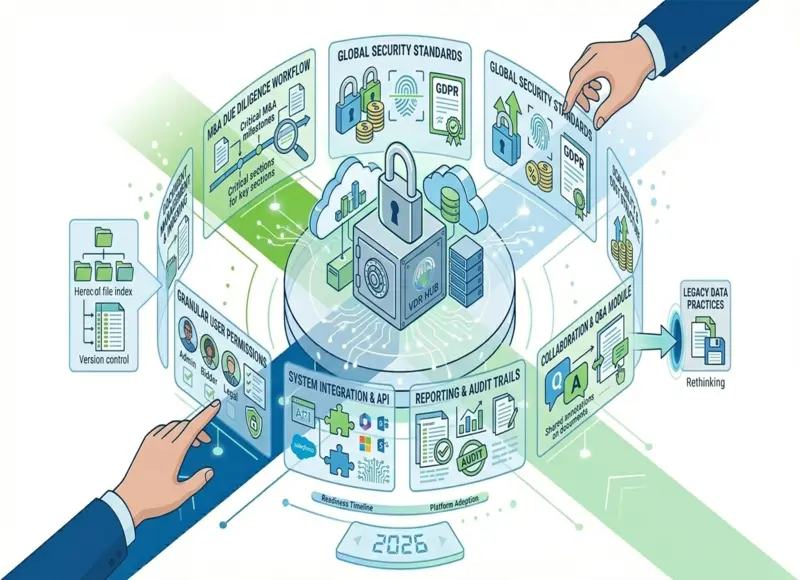
According to recent global M&A data, more than 10,300 deals were completed with a combined value of approximately $1.6 trillion. That level of activity shows how active transaction markets remain heading into 2026. As deal complexity increases and cross-border transactions become more common, the infrastructure supporting due diligence has become just as important as the financial modeling behind it.
At the center of nearly every transaction sits a virtual data room (VDR).
Buyers require structured access to sensitive documents. Sellers must maintain strict control over confidentiality. Advisors need visibility into engagement. In 2026, selecting a virtual data room is not simply about choosing a well-known provider — it is about evaluating security architecture, scalability, analytics, usability, and pricing structure.
Before reviewing leading platforms used in M&A due diligence, it is important to understand the criteria that matter most.
What Is a Virtual Data Room?
A virtual data room (VDR) is a secure online platform used to store and share confidential documents during business transactions. It is most commonly associated with mergers and acquisitions but is also used for fundraising, audits, restructurings, and legal reviews.
Instead of physical data rooms or email-based sharing, modern deal teams upload documents to a centralized environment where access permissions can be controlled at a granular level. Administrators can define who may view, download, print, or comment on files — and access can be revoked instantly when needed.
The Virtual Data Room now emerges as a core operational tool, rather than a matter of convenience, for its utility in managing complex, distributed transactions spanning multiple jurisdictions.
The global market for virtual data rooms was valued at nearly $3 billion in 2024 and continues to grow as more teams choose this tool for deals.
Key Criteria for Selecting a Virtual Data Room in 2026
1. Security & Compliance Infrastructure
Security remains the primary selection factor in M&A.
In 2026, the evaluation should include:
- End-to-end encryption
- Multi-factor authentication
- Dynamic watermarking
- Remote access revocation
- SOC 2 and ISO certifications
- Detailed audit logs
Enterprise-focused providers such as Intralinks and Ideals are often assessed for their compliance frameworks in regulated or cross-border transactions.
2. Granular Permission Management
Modern transactions frequently involve multiple bidders, advisors, and internal stakeholders. A suitable VDR must allow:
- User- and group-level permissions
- Document-specific access controls
- Time-based access expiration
- Bidder group isolation
- Fence view functionality
Platforms commonly evaluated for structured sell-side processes include Datasite, particularly when managing layered bidder access.
3. Scalability & Performance Under Load
Large transactions may involve:
- Hundreds of concurrent users
- Tens of thousands of indexed files
- Large financial models and legal archives
The system must remain stable under heavy usage without performance degradation. Enterprise-scale environments such as Intralinks are often selected when transaction size demands consistent uptime.
4. Analytics & Buyer Engagement Tracking
For sell-side advisors, insight into buyer behavior is critical.
Advanced VDR analytics may include:
- Document-level activity tracking
- Heatmaps
- Time-spent reporting
- Engagement exports
- Q&A reporting
Tools like Datasite and Ideals are often evaluated for engagement visibility features.
5. Ease of Use & Adoption Speed
Time pressure defines M&A.
A VDR should:
- Require minimal training
- Provide intuitive navigation
- Offer strong search capabilities
- Allow fast bulk uploads and indexing
Mid-market teams frequently evaluate simplified interfaces such as those provided by Firmex or SecureDocs.
6. Workflow Integration & Ecosystem Compatibility
Increasingly, deal teams require integration with:
- CRM systems
- eSignature platforms
- Cloud storage systems
- Internal document management tools
Organizations already embedded in broader ecosystems may evaluate platforms such as Box or ShareFile for compatibility.
7. Pricing Transparency & Cost Structure
Virtual data room pricing models vary significantly:
- Per-page pricing
- Per-user pricing
- Storage-based pricing
- Flat-rate subscription
Clarity is essential before launching a transaction. Providers such as SecureDocs and Onehub are often evaluated for cost predictability in smaller or shorter-term deals.
Top 10 Virtual Data Rooms for M&A Due Diligence
The following platforms are frequently used in M&A transactions and are commonly evaluated against the criteria outlined above.
1. Ideals
Ideals is often chosen for deals where control and stability matter most, especially when many parties need access simultaneously. The interface is structured and straightforward, allowing buyers to begin reviewing documents without extensive onboarding.
Access controls are granular and can be applied by user or group. Permissions update instantly, which supports competitive bidding environments. Watermarking and activity logs add additional layers of protection and transparency.
Teams often note:
- Intuitive interface
- Flexible permission settings
- Watermarking for sensitive files
- Built-in Q&A
- Detailed activity tracking
- 24/7 support availability
Ideals is frequently considered in transactions where security and structured access are central priorities.
2. Intralinks
Intralinks is widely used in large, regulated transactions. Financial institutions and public companies often have prior familiarity with the platform, which can reduce internal approval delays.
It supports large document volumes, layered permission systems, and long-term archival needs. While the interface may require some onboarding, experienced teams value its consistency.
It is commonly selected for:
- Enterprise-scale transactions
- Strong audit capabilities
- Complex access structures
- Long-duration deals
3. Datasite
Datasite is commonly used in structured sell-side processes. Setup and bulk indexing are efficient, helping sellers prepare quickly.
Advisors often value its engagement analytics, which provide visibility into buyer review patterns and document interest.
Datasite is typically evaluated for:
- Fast room preparation
- Clear indexing structure
- Buyer activity reporting
- Stable performance during multi-bidder reviews
4. Firmex
Firmex emphasizes simplicity and clarity. Its interface avoids unnecessary complexity, making it suitable for mid-market transactions.
Users can organize folders clearly and manage permissions without extensive configuration.
Firmex is often selected for:
- Straightforward document management
- Clear access controls
- Reliable activity tracking
- Responsive support
5. Ansarada
Ansarada focuses on preparation and structured readiness. It offers guided workflows and checklists that support organized deal execution.
The platform integrates Q&A and document-specific communication to maintain clarity throughout diligence.
It is often evaluated for:
- Guided setup
- Structured document management
- Integrated Q&A
- Engagement monitoring
6. SecureDocs
SecureDocs was designed to offer predictable pricing while maintaining core deal functionality. Costs typically do not fluctuate based on user count or document volume.
The platform provides straightforward permission management and audit logs, with continuous customer support.
SecureDocs is often used for:
- Fast setup
- Clear pricing models
- Reliable performance
- Document-heavy mid-market transactions
7. Box
Box serves as a common tool for enterprise content management in most cases, while certain teams use it to manage transactional work because of its user-friendly design and its ability to work with other systems.
The system provides file synchronization together with its integrated signature function and workflow automation capabilities, which enable it to work with the entire corporate system.
Box may be considered for:
- Organizations already using its ecosystem
- Simple internal transactions
- Workflow-driven collaboration
8. ShareFile
ShareFile is commonly used by advisory and professional services firms for secure client document exchange.
Its straightforward setup and reporting tools make it practical for firms managing multiple engagements.
ShareFile is often selected for:
- Secure external file sharing
- Clear activity notifications
- Consistent user experience
9. DealRoom
DealRoom integrates document storage with request tracking and task management, helping teams centralize diligence coordination.
Its structure keeps files, comments, and progress updates connected.
DealRoom is frequently evaluated for:
- Centralized request management
- Collaboration tracking
- Clear visibility into deal progress
10. Onehub
Onehub focuses on simplicity and predictable pricing. Rooms can be launched quickly with minimal configuration.
Branding options and straightforward security controls make it suitable for smaller or early-stage transactions.
Teams often choose Onehub for:
- Quick setup
- Clear access management
- Cost transparency
- Practical security tools
How to Apply These Criteria in Practice
When selecting a virtual data room in 2026, teams should:
- Define transaction size and number of expected users
- Identify regulatory and compliance requirements
- Determine the importance of buyer analytics
- Stress-test platform performance during peak use
- Clarify pricing structure before launch
- Evaluate the ease of onboarding for external bidders
How teams make the final choice
Choosing a virtual data room is mainly about how it works during a real deal. First, the platform should keep documents organized and easy to find. Next, access rules should be clear, so everyone knows what they can see and do. Then, communication should stay in one place, without long email chains or confusion.
After that, stability matters. When many people log in at the same time, the system should keep working without slowing down. Finally, the dataroom should feel simple and reliable.

Head of SEO Operations
Recent Blogs


Elia Martell
5 Virtual Recruiting Support Operations for Tech and Healthcare Teams
-
09 Oct 2026
-
8 Min
-

462


Jane Hart
Why LinkedIn Campaign Optimization Requires More Than CPC and CTR
-
09 Oct 2026
-
8 Min
-
150

Jane Hart
How to Vet an Offshore SEO Partner: A Due-Diligence Checklist for Agencies and Brands
-
08 Oct 2026
-
8 Min
-
249
Jane Hart
Benchmarking GPU Providers: A Practical Guide to Comparing Cloud Compute Options
-
07 Oct 2026
-
6 Min
-
171
