


How Clinics Can Work With Software Development Partners To Build Scalable Record Systems
-
Last Updated:

10 Sep 2026
-
Read Time:

9 Min Read
-
Written By:
 Isha Choksi
-
413
Table of Contents
Build a scalable record system that grows with your clinic, adapts to new workflows, and stays reliable as operations expand.
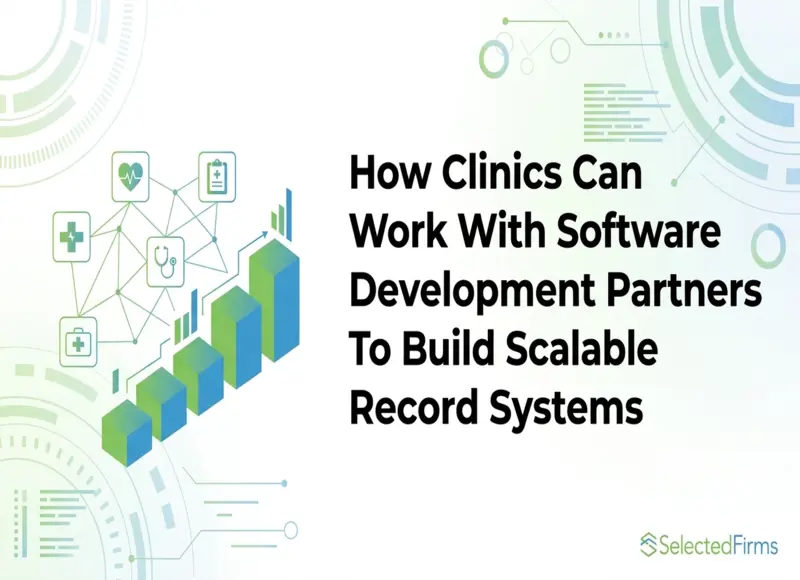
Clinics can build scalable record systems by combining a proven clinical platform with the right software development partner.
The platform provides the core infrastructure, while the development partner extends it with custom integrations, patient-facing tools, and architecture designed to support future growth.
This approach lets each partner focus on what it does best instead of trying to build everything from scratch.
Getting that partnership right starts with knowing what to build, what to extend, and what to hand off.
This article breaks down how startup clinics build record infrastructure that holds up as they grow, and what a software development partner is actually responsible for along the way.
Why Do Clinics Outgrow Their Record Systems So Quickly?
Scalability is not just about storing more patient records. It is about handling more of everything at once.
As a clinic grows, its record system has to absorb:
- More users logging in and charting at the same time
- More locations that need to see the same patient data
- More integrations with labs, pharmacies, billing platforms, and scheduling tools
- More workflows layered on top of daily operations
- More regulatory and compliance requirements as patient volume rises
A system can technically store unlimited records and still be operationally painful to run. Storage was never the real bottleneck. Workflow complexity is.
Is Patient Volume Really the Biggest Scaling Risk?
Doubling patient volume is the easy part to plan for. What actually strains a system is everything that comes with it:
- More staff logging in and charting concurrently
- More scheduling conflicts across providers and locations
- More support tickets from staff working around system limits
A record system built for one busy front desk can buckle under three running at once.
Why Does Every New Integration Increase Operational Risk?
Each connection a clinic adds becomes something the record system has to talk to reliably, including:
- Lab and diagnostic systems
- Pharmacy networks
- Billing and claims platforms
- Scheduling tools
- Patient-facing apps
One clean integration is manageable. Ten of them, built without a consistent approach, start behaving like ten separate points of failure.
This makes interoperability an operational requirement, not just a technical nice-to-have.
By 2024, 81% of U.S. hospitals enabled patients to access health information through an API, and 70% did so through FHIR-based apps.
A clinic building its record infrastructure today therefore needs to plan for connectivity from the start. Its system should be able to exchange data with other healthcare platforms, support patient access, and integrate with the tools it may need as the clinic grows.
What Does a Clinic Need to Build a Scalable Record System?
Instead of chasing a feature checklist, it helps to connect each technical requirement to the business problem it solves.
|
Requirement |
Why it matters to a growing clinic |
|
Flexible data architecture |
Makes it easier to support new workflows without rebuilding the core system |
|
API access |
Lets other software, apps, and internal tools connect without custom rework each time |
|
Data sharing |
Keeps patient data out of silos as new systems and locations get added |
|
Modular workflows |
Lets the clinic add capabilities incrementally instead of starting over |
|
Strong security |
Protects sensitive patient data as more people and systems touch it |
|
Cloud infrastructure |
Supports growth without a hardware or capacity ceiling |
|
Analytics |
Gives leadership visibility into clinical and operational performance as the business scales |
|
Clear documentation |
Keeps the system maintainable for whoever manages it next |
Picture a clinic at 300 patients that adds a second location six months later, along with telehealth, a patient app, and a lab integration.
If the original system had a rigid data model and no API layer, every one of those additions becomes a custom rebuild. If it had flexibility and interoperability built in from the start, the same additions become configuration work instead.
That difference is the real scalability question.
Should a Clinic Build or Extend Its Record System?
Clinics generally have three paths available, and the right one depends on engineering resources and how differentiated the clinic's workflows actually need to be.
Building the entire system internally fits clinics with:
- Significant in-house engineering capacity
- A long-term technology strategy
- Workflows genuinely different from anything an existing platform supports
It is also the slowest and most expensive path, and the clinic becomes fully responsible for maintaining what it builds.
Using an existing clinical platform gets a clinic live faster, with proven infrastructure and interoperability already handled. The tradeoff is less control over how the underlying system behaves.
Combining a clinical platform with custom development around it is where most startup clinics land. It gives them a practical way to build a custom EMR for small clinics without starting from scratch.
The clinic can use an established platform for core functions such as medical records, scheduling, and compliance. A development partner can then build clinic-specific parts, such as a custom patient experience, a specialized dashboard, or integrations for its care model.
This hybrid approach is also how modern EMR platforms are increasingly built to be used. Headless, API-first deployment options let a clinic run its own patient-facing product on top of a compliant clinical core, rather than being boxed into someone else's interface.
What Should a Software Development Partner Actually Handle?
Once a clinic brings in outside development help, it is worth being specific about what that partner owns.
-
Translating Clinical Workflows Into Technical Requirements
A partner needs to understand what clinicians and front-desk staff actually do before writing a line of code. Software built from a spec sheet alone tends to miss how care actually gets delivered.
-
Designing the Architecture
This covers deciding what belongs in the core system, what stays modular, where APIs are needed, and how data should move between the record system and everything connected to it.
-
Building integrations
This includes EHR connections, lab systems, pharmacy networks, billing platforms, scheduling tools, and patient-facing apps. Integration work is usually where scalability quietly succeeds or fails.
-
Building Custom Applications Around the Record System
Patient portals, provider dashboards, care management tools, and analytics views are where a clinic's product actually differentiates itself from every other clinic using the same underlying platform.
-
Testing a System as They Grow
A feature working today is not the same as a feature working at triple the volume with five new integrations. Growth testing checks whether the system holds up when patient numbers rise, concurrent users increase, or new workflows get layered in.
-
Maintaining and Evolving the System After Launch
Software that nobody owns after launch degrades fast. An ongoing partner relationship prevents the common startup pattern of shipping something and then having no one responsible for what happens next.
Handled well, these six areas are what keep a record system usable long after the initial build is finished.
How Do You Choose the Right Development Partner for a Clinic?
Healthcare software is not evaluated the same way as a general business app. A partner without clinical experience will underestimate compliance requirements, data sensitivity, and how unforgiving healthcare workflows are of downtime or errors.
A few things worth checking before signing anyone:
- Confirm the team has built software touching real healthcare data before, not just consumer apps
- Ask how they approach EHR and lab integrations specifically, not integrations in general
- Review technical depth in architecture, API design, cloud infrastructure, and security, not just front-end polish
- Look past marketing claims and check verifiable evidence: past project portfolios, client reviews, team size, and pricing structure
That last point is where founders often get stuck. Verifying a development company's actual track record, rather than relying on a sales pitch, usually means comparing multiple vendors side by side on experience, past work, and pricing. A business directory of reviewed healthcare software development companies makes that comparison faster, since agencies are listed with client reviews, portfolio history, team size, and pricing bands side by side instead of a single self-reported pitch.
Look for agency rankings built on verified credibility, not just self-reported claims, weighing expertise, market presence, and client feedback rather than marketing copy.
That is a faster way to shortlist three or four serious candidates than working through a dozen sales calls cold. Verification alone never guarantees the right fit, though. The partner still has to match the clinic's specific healthcare experience, budget, tech stack, and long-term roadmap, which is what the direct conversation and technical questions below are for.
Questions to Ask Before Signing
- Have you built software that handles real patient data before?
- How do you approach EHR and lab integrations specifically?
- How will the architecture support growth we haven't planned for yet?
- Who owns the code and documentation once the project ends?
- How do you handle security and compliance requirements?
- What is your role after launch?
- How do you test integrations under real usage conditions?
- How do you handle changes to clinical workflows mid-project?
- What does your development process actually look like week to week?
- How would you measure whether what you built is actually scalable?
A partner who cannot answer these clearly is not ready for healthcare work, regardless of how strong their general software portfolio looks.
Why Do Record Systems Struggle as Clinics Grow?
Most scalability failures do not come from bad technology choices at launch. They come from decisions that were reasonable at the time and never revisited as the clinic changed shape.
- A rigid data model chosen for speed at launch becomes the reason a second location cannot share records cleanly.
- A quick manual workaround for a missing integration becomes a permanent, fragile process nobody wants to touch.
- A platform picked because it was familiar, not because it fit the clinic's growth plan, becomes the reason a rebuild happens eighteen months later instead of never.
The fix is not predicting the future perfectly. It is building with enough flexibility that the next stage of growth is an extension, not a teardown.
What Does a Record System That Grows With the Clinic Look Like?
A scalable record system is not the one with the most features. It is the one that lets a clinic start small, validate its care model, add workflows, connect new systems, and expand to new locations without rebuilding the foundation every time growth happens.
The goal on day one is not to build the biggest system possible. It is to build a foundation that does not become the bottleneck when the clinic actually takes off. Clinical platform, custom development, and the right development partner working together are what make that possible.
FAQs
A scalable record system can support more patients, users, locations, integrations, and workflows without requiring a complete rebuild.
Not necessarily. A clinic can use an established clinical platform and add custom development for workflows and features unique to its needs.
Clinics should prioritize healthcare experience, integration expertise, security knowledge, scalable architecture, and reliable post launch support.
Poorly designed integrations can create failures and data silos as systems increase. A consistent API strategy helps different platforms exchange data reliably.
Clinics should test higher patient volumes, concurrent users, integration loads, and new workflows to identify performance and reliability issues early.

Head of SEO Operations
Recent Blogs

Elia Martell
5 Virtual Recruiting Support Operations for Tech and Healthcare Teams
-
09 Oct 2026
-
8 Min
-

462

Jane Hart
Why LinkedIn Campaign Optimization Requires More Than CPC and CTR
-
09 Oct 2026
-
8 Min
-
150

Jane Hart
How to Vet an Offshore SEO Partner: A Due-Diligence Checklist for Agencies and Brands
-
08 Oct 2026
-
8 Min
-
249
Jane Hart
Benchmarking GPU Providers: A Practical Guide to Comparing Cloud Compute Options
-
07 Oct 2026
-
6 Min
-
171
