


Table of Contents
Learn how to choose the best SharePoint consulting company by evaluating migration expertise, governance, Microsoft 365 knowledge, and user adoption strategies for long-term success.
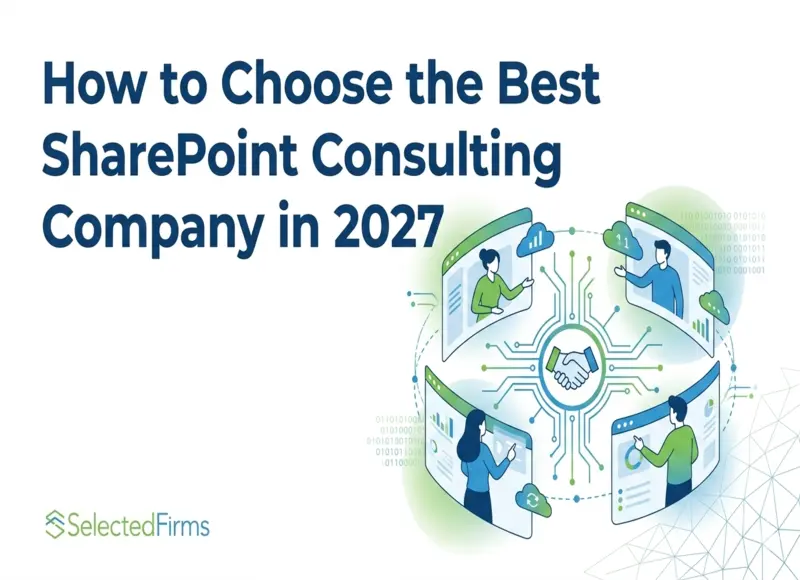
Many organizations invest in SharePoint with high expectations. They want a modern intranet, better document management, smoother collaboration, and automated business processes. Yet the reality is often different.
Some companies deliver systems that actually fit how people work. Others simply install SharePoint and leave organizations to figure the rest out on their own.
And that gap is usually where success or failure is decided.
The problem is rarely the platform itself. In many cases, the challenge comes from poor planning, unclear requirements, or a lack of specialized expertise during implementation.
That is why selecting the best SharePoint consulting company is an important business decision. The right partner can help organizations build a secure, scalable, and user-friendly environment that supports long-term growth. The wrong choice can lead to expensive rework, frustrated users, and missed opportunities.
That's why we're here to explain how business leaders can evaluate SharePoint consultant services and identify the qualities that separate strong consulting partners from the rest.
Why SharePoint projects often struggle
Most SharePoint problems don’t start with technology. They start with expectations.
A business decides to “modernize” its document system, moves everything into SharePoint, and expects instant improvement. But what actually happens is a bit messier.
When organizations treat SharePoint as a basic file repository, they often encounter problems such as:
- Inconsistent document structures
- Poor search experiences
- Duplicate content
- Weak governance
- Low employee adoption
- Inefficient business processes
In those cases, SharePoint isn’t the real problem. The way it was planned and implemented is.
The Mistake Most Companies Make At The Start
A lot of organizations begin by focusing on tools instead of problems. For example, one company may want to replace aging file servers. Another may need a modern SharePoint intranet to improve internal communication. A third organization may be focused on workflow automation and process efficiency.
They ask questions like:
“What can SharePoint do?”
“How should our intranet look?”
“What features should we enable?”
But the more important question is usually ignored:
Because the answer is rarely just “we need SharePoint.”
Sometimes the real issue is messy file storage. Other times, it’s slow internal communication or too much manual work in approvals and reporting.
Until that is clear, even the best consultant can only guess.
Not all SharePoint consultants think the same way
After spending time around these projects, one thing becomes obvious: consultants approach the same tool in very different ways.
Some are highly technical. They focus on setup, migration, and configuration. Once the system is live, their job is done.
Others take a slower approach. They ask uncomfortable questions at the beginning. How do teams actually work? Where does information get stuck? Why are people avoiding existing systems?
When reviewing potential SharePoint consultants, look for evidence of experience in:
- SharePoint Online implementation
- Intranet development
- Information architecture
- Document management
- Metadata planning
- Governance frameworks
- User training
Because SharePoint success is rarely about installation. It’s about alignment with real business behavior.
Migration is where reality shows up
Every company thinks its files are “fairly organized” until migration begins.
That’s usually when things get interesting.
Duplicate folders appear everywhere. Old project files resurface. Nobody is fully sure which version of a document is the final one. Permissions have been copied and modified so many times over the years that even IT teams struggle to explain them.
Strong SharePoint migration specialists help businesses:
- Audit existing content
- Remove redundant information
- Plan metadata structures
- Preserve permissions
- Reduce downtime
- Validate migrated content
A thoughtful migration strategy often determines whether employees embrace the new environment or continue relying on old processes.
The part most people ignore: governance
Governance is not exciting. Most teams don’t want to talk about it at the beginning of a project.
But it quietly decides whether SharePoint stays useful or becomes messy over time.
Without clear rules, people create new sites whenever they want. Files get duplicated. Nobody is sure who owns what. After a year or two, the system becomes harder to manage than the old one it replaced.
Adoption is where projects really succeed or fail
Even a perfectly designed SharePoint system is useless if people don’t use it.
And people rarely adopt new systems just because they exist.
They adopt them when they see a clear benefit in their daily work.
That’s why training and communication matter more than most companies expect. If employees don’t understand why something changed, they’ll quietly continue using old habits in the background.
The best consultants understand this. They don’t just deliver a system. They help people transition into it.
Questions worth asking before choosing a consultant
When companies are comparing vendors, the conversation often stays too high-level. Everything sounds good until you start asking specific questions.
For example:
- Have you worked on projects similar to ours?
- How do you handle migration decisions, not just migration execution?
- What happens after the system goes live?
- How do you deal with adoption resistance?
- What other Microsoft 365 tools do you typically connect with SharePoint?
The way these questions are answered often tells you more than any proposal document.
A simple way to compare vendors
Some organizations try to remove emotion from the decision by using a scoring approach. It doesn’t have to be complex.
They simply look at things like:
- Experience with similar projects
- Understanding of Microsoft 365 ecosystem
- Ability to manage governance
- Migration approach
- Support for users after launch
- Automation capability
Before selecting a consulting partner, decision-makers should ask practical questions.
Examples include:
What types of SharePoint projects have you completed?
Relevant experience often matters more than company size.
Where SharePoint consulting is heading
SharePoint consulting in 2026 is not just about SharePoint anymore.
It’s becoming part of a bigger shift in how companies work with Microsoft 365 and AI tools. Consultants are now expected to understand Copilot readiness, automation workflows, analytics, and cross-platform integration.
In many cases, SharePoint is just one piece of a much larger digital workplace.
That means the role of a consultant is changing too. It’s less about setup and more about designing systems that actually fit how businesses operate today and in the future.
Creating a Vendor Evaluation Framework
Rather than choosing based solely on price, many organizations create a scoring framework.
Typical evaluation categories include:
|
Evaluation Area |
Importance |
|
SharePoint Expertise |
High |
|
Migration Experience |
High |
|
Microsoft 365 Knowledge |
High |
|
Governance Skills |
High |
|
Automation Capability |
Medium |
|
User Adoption Support |
High |
|
Security Experience |
High |
|
Ongoing Support |
Medium |
A structured evaluation process often produces better outcomes than selecting the lowest-cost proposal.
Conclusion
Choosing the right SharePoint consulting company is not really a technical decision.
It’s a decision about how your organization wants to work every day.
The right partner will slow things down at the beginning, ask better questions than you expected, and focus on how people actually behave—not just how the system looks on paper.
And in most successful SharePoint projects, that is exactly what makes the difference.


Head Of Digital Marketing
Recent Blogs

Elia Martell
5 Virtual Recruiting Support Operations for Tech and Healthcare Teams
-

09 Oct 2026
-

8 Min
-

477
Jane Hart
Why LinkedIn Campaign Optimization Requires More Than CPC and CTR
-
09 Oct 2026
-
8 Min
-
155
Jane Hart
How to Vet an Offshore SEO Partner: A Due-Diligence Checklist for Agencies and Brands
-
08 Oct 2026
-
8 Min
-
263
Jane Hart
Benchmarking GPU Providers: A Practical Guide to Comparing Cloud Compute Options
-
07 Oct 2026
-
6 Min
-
173
