


Top 10 AI App Builders in 2026: Free & Paid
-
Last Updated:

07 Jul 2026
-
Read Time:

16 Min Read
-
Written By:
 Harshita Toplani
-
4303
Table of Contents
Explore the top 10 AI app builders in 2026. Compare free and paid no-code platforms, pricing, features, and the best tools for web and mobile app development.
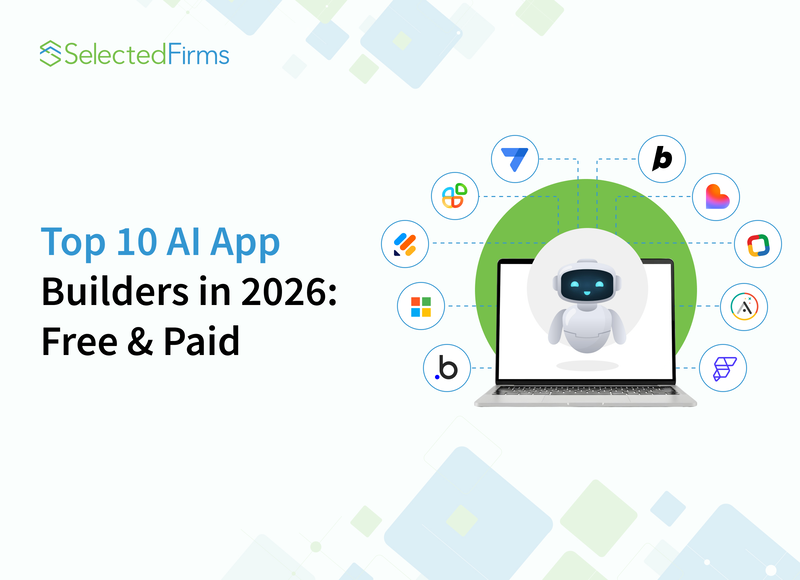
Choosing an AI app builder in 2026 is far more complicated than it was just a few years ago. Traditional no-code platforms now compete with AI-native builders that can generate full-stack applications from a single prompt, while enterprise platforms continue to dominate internal business applications.
At SelectedFirms, we evaluated the best AI app builders 2026 offers using the same assessment framework rather than relying on vendor claims. We examined how quickly each platform could generate a working application, the quality of AI-generated output, pricing transparency, deployment options, scalability, and long-term maintainability.
Whether you're validating a startup idea, building an internal business tool, or launching a production-ready mobile application, this guide explains where each platform excels and where it falls short.
What Is an App Builder?
An app builder is a software platform that enables individuals or organizations to create web or mobile applications without developing everything from scratch in traditional programming languages. Modern platforms combine visual development, reusable components, cloud infrastructure, AI-assisted generation, and deployment tools into a single workspace, allowing founders, business teams, and developers to move from an idea to a working product much faster than conventional software development.
According to Gartner, 75% of new enterprise applications will use low-code or no-code technologies by the end of 2026, compared with fewer than 25% in 2020 . That shift makes selecting the right platform a strategic decision rather than simply a development shortcut.
Today's market includes several distinct service categories. Traditional no-code builders rely primarily on drag-and-drop interfaces, while newer AI app builders generate applications from natural language prompts and automatically configure databases, authentication, and business logic. Low-code platforms sit between those approaches by allowing developers to extend visual workflows with custom code when needed. The best choice depends on your technical skills, deployment requirements, scalability expectations, and budget.
How We Tested These App Builders
Every platform in this guide was evaluated using the same editorial framework instead of relying on vendor marketing material.
Our review focused on five primary evaluation criteria:
- AI generation quality: How accurately the platform converted prompts into working applications.
- Ease of use: How quickly a non-technical founder could produce a usable MVP.
- Deployment options: Support for web deployment, native iOS, Android, or both.
- Pricing and long-term costs: Published subscription prices plus hidden costs such as usage credits, workload units, or user-based licensing.
- Scalability and ownership: Code export, integrations, enterprise readiness, and long-term flexibility.
During our research, we also examined each platform's documentation, current pricing, feature updates, and independent technical reviews published throughout 2025 and 2026. Rather than repeating product marketing, we incorporated practical observations about workflow limitations, deployment trade-offs, pricing pitfalls, and real-world implementation considerations.
Our recommendations are designed for four primary buyer groups:
- Non-technical founders building MVPs
- Startups launching customer-facing products
- Enterprise IT teams creating internal applications
- Developers looking for AI-assisted development platforms
App Builder Comparison Table
The table below provides a quick comparison of the leading app builders reviewed in this guide.
|
Tool |
Best For |
Free Tier |
Starting Price |
Native iOS/Android |
AI Generation |
|---|---|---|---|---|---|
|
Jotform AI App Builder |
Educators, creators or Businesses |
Yes |
$34/month |
Yes |
Yes |
|
Lovable |
Non-technical founders |
Yes |
$25/month |
No |
Yes |
|
Bolt.new |
Developers |
Yes |
$25/month |
No |
Yes |
|
Bubble |
Complex SaaS apps |
Yes |
$29/month |
Yes (Beta) |
Partial |
|
FlutterFlow |
Native mobile apps |
Yes |
$39/month |
Yes |
Yes |
|
Appy Pie |
Beginners |
Trial |
$16/month |
Yes |
Partial |
|
Zoho Creator |
Enterprise workflows |
Trial |
$8/user/month |
Limited |
Yes |
|
Adalo |
Startup mobile apps |
Yes |
$36/month |
Yes |
Yes |
|
AppSheet |
Google Workspace |
Yes |
$0 with Workspace / $5 per user |
Limited |
Yes |
|
Microsoft Power Apps |
Microsoft 365 teams |
Yes |
$20/user/month |
Limited |
Yes |
Each platform addresses a different type of project. AI-native builders such as Lovable and Bolt.new are excellent for rapid MVP creation, while FlutterFlow and Adalo remain stronger choices for teams that need true App Store and Google Play deployment. Enterprise organisations invested in Microsoft 365 or Google Workspace will typically achieve faster implementation with Power Apps or AppSheet because of their native ecosystem integrations.
Top 10 AI App Builders for Businesses without Coding Knowledge
The platforms below are presented in the order that best matches today's market, balancing AI capabilities, deployment flexibility, long-term scalability, and overall value for business buyers.
1. Jotform AI App Builder
Best for: Businesses, teams, educators, nonprofits, and individuals who want to build custom web and mobile apps quickly without coding.
Jotform AI App Builder lets users create professional apps simply by chatting with AI. Describe the type of app you need, the features you want, and your preferred design, or provide a file, URL, or screenshot, and the AI generates your app’s pages, navigation, components, and workflows within minutes.
Unlike traditional app builders that require starting from scratch, Jotform AI App Builder allows you to continue refining your app with AI prompts or manual editing. Once your app is ready, you can preview it on web and mobile, share it with a link, and manually connect third-party integrations such as CRMs and payment processors through the App Builder.
Key Features
- AI app generation from prompts, files, URLs, or screenshots
- AI and manual editing for pages, content, layouts, and components
- 700+ app templates for different use cases
- Web and mobile preview with shareable app links
Starting Price (2026)
- Starter: Free
- Bronze: $34/month (billed annually)
- Silver: $39/month (billed annually)
- Gold: $99/month (billed annually)
- Enterprise: Custom pricing
Pros
- Creates customizable apps in minutes without requiring coding knowledge.
Cons
- Third-party integrations must be added manually within the App Builder.
2. Lovable
Best for: Founders, entrepreneurs, and product teams who want to validate an idea quickly without hiring developers.
Lovable has emerged as one of the fastest-growing AI app builders because it focuses on turning natural language into a working full-stack web application. Instead of designing screens manually, you describe your product, and the platform generates the interface, authentication, database structure, and deployment-ready project within minutes.
During our evaluation, Lovable consistently produced one of the cleanest first drafts among AI-native builders. Its Supabase integration automatically configured authentication and database tables, eliminating several setup steps that other platforms still require. One limitation we noticed was the credit system. Simple visual edits consumed less than one credit, but larger requests, such as adding authentication and business logic, consumed noticeably more. For teams iterating rapidly, monthly credits disappear faster than expected.
Key Features
- AI-powered full-stack application generation from text prompts
- Built-in Supabase integration for authentication and databases
- GitHub synchronisation with editable React source code
- One-click deployment and collaborative workspace support
Starting Price (2026)
- Free plan available (5 daily build credits)
- Pro: $25/month
- Business: $50/month
- Enterprise: Custom pricing
Pros
- Extremely fast for building MVPs and validating startup ideas.
Cons
- Produces web applications only and relies on a credit-based pricing model that can become expensive for heavy users.
If you need implementation support, explore SelectedFirms' mobile app development agencies to find experienced development partners.
3. Bolt.new
Best for: Developers and technical founders who want AI acceleration without sacrificing direct access to their codebase.
Bolt.new combines conversational AI with a browser-based development environment. Unlike purely visual builders, it allows developers to edit generated code immediately while keeping an AI assistant available throughout the workflow.
In our review, Bolt maintained project context impressively well during long development sessions. We found it better suited than many competitors for iterative development because it continued refining earlier architecture instead of restarting from scratch. Its support for React, Vue, Svelte, and Next.js also makes it considerably more flexible than platforms focused on a single framework. The trade-off is token consumption. Larger projects with authentication, APIs, and business logic quickly consume monthly allowances.
Key Features
- Multi-framework support including React, Vue, Svelte, and Next.js
- Browser-based IDE with AI-assisted editing
- GitHub integration and code export
- Live previews with rapid deployment
Starting Price (2026)
- Free plan available
- Pro: $25/month
- Teams: $30/user/month
- Enterprise: Custom pricing
Pros
- Excellent balance between AI automation and developer control.
Cons
- Token-based pricing makes large projects harder to predict financially.
4. Bubble
Best for: SaaS founders and businesses building feature-rich web applications without writing backend code.
Bubble remains one of the most mature no-code platforms available. While AI-native builders focus on rapid generation, Bubble emphasises long-term application development with extensive workflow automation, database management, and integrations.
Our testing showed Bubble excels once applications become more sophisticated. Multi-step workflows, user permissions, and API integrations are considerably easier to manage than in newer AI-first platforms. Bubble's 2025 expansion into native mobile also makes it more competitive than previous versions, although the feature remains newer than its established web platform. The biggest drawback continues to be Workload Units (WUs). Poor workflow optimisation can dramatically increase operating costs as applications grow.
Key Features
- Visual backend workflows
- Built-in database management
- Native mobile support (public beta)
- Extensive plugin ecosystem
Starting Price (2026)
- Free plan available
- Starter: $29/month
- Growth: $119/month
- Team: $349/month
- Enterprise: Custom pricing
Pros
- Outstanding platform for building scalable SaaS products.
Cons
- No code export, resulting in significant platform lock-in.
For businesses expanding into mobile experiences, SelectedFirms' React Native developers can help extend Bubble-powered products.
5. FlutterFlow
Best for: Companies that need genuine native mobile applications while retaining ownership of their source code.
FlutterFlow has evolved from a visual Flutter builder into one of the most capable mobile development platforms available. Unlike many competitors that generate web applications, FlutterFlow produces production-ready Flutter code that developers own permanently.
During our evaluation, FlutterFlow stood out because of its code export capability. Teams can continue development inside Android Studio, Xcode, or VS Code without depending on FlutterFlow forever. The built-in AI Agent Builder also simplifies adding conversational AI to applications. The learning curve, however, is noticeably steeper than beginner-oriented builders because understanding Flutter widgets and state management remains valuable.
Key Features
- Native Flutter code export
- One-click App Store deployment
- GitHub integration
- AI Agent Builder
Starting Price (2026)
- Free plan available
- Basic: $39/month
- Pro: $70/month
- Teams: Custom pricing
Pros
- True ownership of production-ready Flutter code.
Cons
- Requires more technical knowledge than most drag-and-drop builders.
Need implementation support? Browse SelectedFirms' Flutter app development agencies to work with experienced Flutter specialists.
6.Appy Pie
Best for: Small businesses and first-time founders building straightforward mobile applications.
Appy Pie has remained popular because it prioritizes accessibility over technical complexity. Instead of expecting users to design everything from scratch, it provides hundreds of templates covering retail, restaurants, healthcare, education, and professional services.
Our review found Appy Pie particularly approachable for users with no development background. Navigation is straightforward, and template selection significantly reduces setup time. However, once projects become more customized, the platform begins to feel restrictive compared with newer AI-first competitors. While experienced builders may outgrow it, beginners often appreciate its predictable workflow and extensive documentation.
Key Features
- Hundreds of industry-specific templates
- Native Android and iOS publishing
- AI-assisted app generation
- Integrated business automation tools
Starting Price (2026)
- Free trial available
- Basic: $16/month
- Higher tiers available for advanced publishing features
Pros
- One of the easiest platforms for complete beginners.
Cons
- Template quality and customization options lag behind newer AI-native builders.
If your application later requires additional customization, SelectedFirms' no-code consulting agencies can help extend or migrate your solution.
7. Zoho Creator
Best for: Mid-sized businesses and enterprises that need to automate internal workflows, business processes, and operational applications.
Zoho Creator has earned its reputation by helping organizations digitize manual processes without building custom software from scratch. Unlike AI-first builders designed for startups, Creator focuses on business applications such as inventory management, CRM extensions, HR systems, approval workflows, field service operations, and reporting dashboards.
During our evaluation, Zoho Creator performed particularly well for structured business processes. The platform's native integration with the broader Zoho ecosystem dramatically reduced implementation effort for organizations already using Zoho CRM, Zoho Books, or Zoho Desk. Its visual workflow builder handled approvals, notifications, and reporting efficiently without requiring extensive configuration. Outside the Zoho ecosystem, however, integration flexibility becomes more limited compared with platforms such as Retool.
With more than 550 pre-built integrations and over 7 million applications created on the platform, Zoho Creator remains one of the most mature enterprise-focused low-code platforms available.
Key Features
- Visual workflow automation with approval routing
- Native integration across the Zoho ecosystem
- More than 550 third-party integrations
- Built-in dashboards and real-time business analytics
Starting Price (2026)
- Free trial available
- Standard: $8/user/month
- Professional and Enterprise plans available
Pros
- Excellent choice for businesses already invested in Zoho products.
Cons
- Less flexible for organizations relying heavily on Salesforce, HubSpot, or custom enterprise systems.
For organizations planning larger digital transformation initiatives, SelectedFirms' low-code consulting agencies can help design and implement enterprise-grade workflow solutions.
8. Adalo
Best for: Early-stage startups building native mobile applications without hiring a full development team.
Adalo continues to stand out because it creates genuine native iOS and Android applications instead of browser-based web apps wrapped inside mobile containers. For founders launching consumer-facing products, this distinction matters because native apps provide better access to device features, smoother performance, and easier App Store distribution.
During our testing, Adalo's Magic Start AI generated an initial application structure from a plain-language description surprisingly well. Combined with reusable components and straightforward navigation, it enabled a functioning prototype much faster than traditional visual builders. We also appreciated that native publishing is available on affordable plans. The primary limitation appears once applications become more sophisticated. Complex workflows and larger databases often require external services such as Xano to maintain performance.
According to Adalo, more than one million active users have been created on the platform, with 99% uptime reported during 2024.
Key Features
- Native iOS and Android publishing
- Magic Start AI application generation
- Drag-and-drop visual interface
- Built-in database management
Starting Price (2026)
- Free plan available
- Starter: $36/month
- Professional: $65/month
- Team: $200/month
Pros
- One of the simplest ways to publish genuine native mobile applications.
Cons
- Advanced workflows and scalability require additional backend services for larger products.
9. AppSheet
Best for: Organizations already using Google Workspace that need operational applications with minimal development effort.
Google AppSheet focuses on transforming existing spreadsheets and structured business data into working applications. Unlike platforms built primarily for startups, AppSheet targets organizations that need internal productivity tools for inspections, inventory management, logistics, field operations, and reporting.
One of the biggest commercial advantages we identified is pricing. For many Google Workspace customers, AppSheet Core is already included with their subscription, making it one of the lowest-cost enterprise application builders available. Gemini AI also simplifies application creation by generating tables, forms, and workflows from plain-language prompts. The biggest drawback is customization. Customer-facing applications requiring polished interfaces will quickly reach the platform's design limitations.
Key Features
- Included with many Google Workspace subscriptions
- Gemini-powered application generation
- Offline support with barcode and location tracking
- Deep Google ecosystem integration
Starting Price (2026)
- Included with eligible Google Workspace plans
- Core: $5/user/month (without Workspace)
- Enterprise plans available
Pros
- Outstanding value for Google Workspace organizations.
Cons
- User interface customization is significantly more limited than competitors such as FlutterFlow or Bubble.
10. Microsoft Power Apps
Best for: Enterprises standardized on Microsoft 365, Dynamics 365, Azure, and SharePoint.
Microsoft Power Apps has evolved into one of the most capable enterprise low-code platforms thanks to deep integration with the Microsoft ecosystem and the addition of Copilot-powered application generation.
During our review, Copilot significantly accelerated early application development by generating Dataverse tables, forms, and interfaces from natural-language prompts. Integration with Teams, SharePoint, Dynamics 365, Azure, and hundreds of Microsoft connectors also reduced implementation complexity for existing Microsoft customers. The largest concern is pricing. Microsoft's removal of the previous per-app licensing model means many organizations now begin at a substantially higher monthly investment than in previous years.
For Microsoft-first businesses, however, the productivity gains frequently outweigh the additional licensing costs.
Key Features
- Microsoft Copilot AI generation
- Dataverse integration
- Native Microsoft 365 connectivity
- Enterprise governance and security controls
Starting Price (2026)
- Developer Plan: Free
- Premium: $20/user/month
- Enterprise licensing available
Pros
- Best enterprise application platform for Microsoft-centric organizations.
Cons
- Higher licensing costs and less compelling outside the Microsoft ecosystem.
How to Choose the Right App Builder
Selecting the right app builder depends less on finding the platform with the most features and more on choosing one that matches your technical skills, business goals, and long-term growth plans. The fastest AI builder isn't always the best option if you need native mobile deployment, and the most powerful enterprise platform may introduce unnecessary complexity for a simple MVP.
Use the decision framework below to narrow your options before investing time and budget.
|
If your priority is... |
Recommended Tool |
Why it fits |
Consider instead |
|---|---|---|---|
|
Launch an MVP in days |
Lovable |
AI generates a full-stack web application with authentication and database setup from natural language prompts. |
Bolt.new |
|
Build a production SaaS platform |
Bubble |
Powerful workflow engine, mature ecosystem, and extensive integrations for complex applications. |
Lovable |
|
Publish native iOS & Android apps |
FlutterFlow |
Generates production-ready Flutter code with one-click App Store deployment and code ownership. |
Adalo |
|
Build mobile apps without coding |
Adalo |
Beginner-friendly interface with true native app publishing and AI-assisted setup. |
Appy Pie |
|
Create internal business tools |
Retool |
Designed for dashboards, operations, and enterprise workflows connected to live databases. |
Zoho Creator |
|
Automate business processes |
Zoho Creator |
Deep workflow automation with hundreds of business integrations. |
Power Apps |
|
Already use Google Workspace |
AppSheet |
Included with many Workspace plans and integrates deeply with Gemini AI and Google services. |
Zoho Creator |
|
Already use Microsoft 365 |
Microsoft Power Apps |
Native integration with Teams, SharePoint, Dynamics 365, Azure, and Copilot. |
Retool |
Should you choose an AI app builder or a traditional no-code platform?
AI-native builders such as Lovable and Bolt dramatically reduce the time required to build an MVP. Instead of assembling every screen manually, they generate applications directly from prompts and allow rapid iteration. They're excellent for founders validating ideas, prototypes, and internal proofs-of-concept.
Traditional no-code platforms such as Bubble, FlutterFlow, and Adalo provide more granular control over workflows, databases, and user interfaces. While they generally require a longer learning curve, they remain stronger choices for businesses planning long-term production applications.
Do you need native mobile apps?
This is one of the most misunderstood decisions when selecting an app builder.
Several AI builders generate responsive web applications that function well on mobile browsers but cannot be submitted directly to the Apple App Store or Google Play. If App Store distribution is a business requirement, prioritize FlutterFlow or Adalo because they generate genuine native mobile applications rather than browser-based experiences.
Consider your long-term costs
Subscription pricing tells only part of the story.
Some platforms charge through AI credits, token consumption, workload units, or per-user licensing. Those costs can grow significantly as applications become more sophisticated. Before committing to a platform, evaluate:
- Monthly subscription pricing
- AI usage credits or tokens
- Deployment limitations
- Database scaling costs
- Collaboration licensing
- Code ownership and portability
Planning for these expenses early helps prevent expensive migrations later in your product lifecycle.
FAQs
No professional app builder offers unlimited functionality for free, but several platforms provide generous free tiers for evaluation. Lovable, Bolt.new, Bubble, FlutterFlow, Adalo, and Microsoft Power Apps all allow users to explore their platforms before upgrading. AppSheet is particularly attractive for organisations already using Google Workspace because many Workspace subscriptions include AppSheet Core at no additional cost, making it one of the lowest-cost options for internal business applications.
Yes. FlutterFlow, Adalo, and Appy Pie all support publishing genuine native applications to both Apple's App Store and Google Play without requiring traditional programming. AI-first builders such as Lovable and Bolt.new primarily generate web applications rather than native mobile software. If your business depends on App Store visibility, choosing a platform designed for native deployment is usually the better long-term investment.
Vibe coding describes the process of building software by describing requirements in natural language and allowing artificial intelligence to generate the application. Rather than writing code manually, users refine the application through conversation with the AI. The approach became mainstream during 2025 with platforms such as Lovable, Bolt.new, and Replit, making software development significantly more accessible to founders and business teams without traditional engineering backgrounds.
The answer depends on the complexity of the application and the platform you choose. AI-native builders can generate a working prototype in minutes, while a polished MVP typically requires one to three days of refinement. More advanced no-code platforms, such as Bubble and FlutterFlow, generally require several weeks to master but offer greater flexibility for production-ready applications. Publishing to Apple and Google app stores also introduces additional review time beyond the development process itself.

Web Content Writer
Recent Blogs


Elia Martell
5 Virtual Recruiting Support Operations for Tech and Healthcare Teams
-
09 Oct 2026
-
8 Min
-

480

Jane Hart
Why LinkedIn Campaign Optimization Requires More Than CPC and CTR
-
09 Oct 2026
-
8 Min
-
155

Jane Hart
How to Vet an Offshore SEO Partner: A Due-Diligence Checklist for Agencies and Brands
-
08 Oct 2026
-
8 Min
-
264
Jane Hart
Benchmarking GPU Providers: A Practical Guide to Comparing Cloud Compute Options
-
07 Oct 2026
-
6 Min
-
173
