


- Home
- Interviews
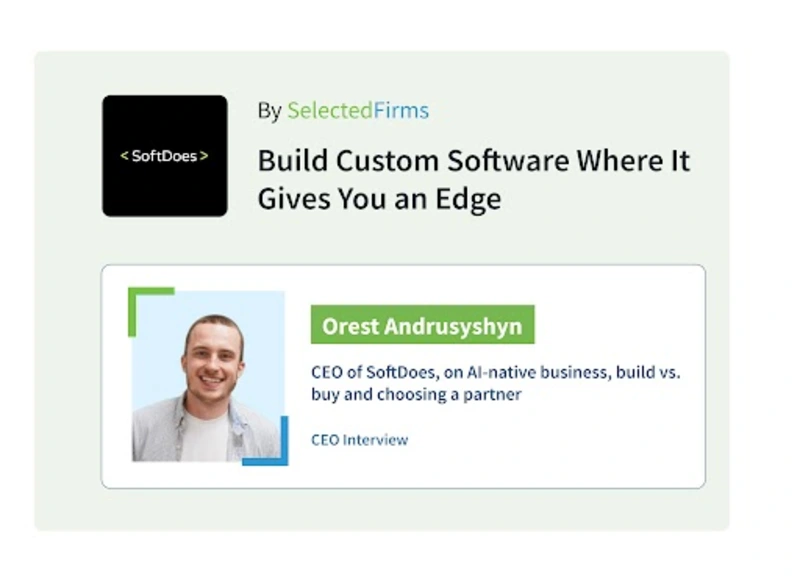
Interview with Orest Andrusyshyn, CEO of SoftDoes
Orest Andrusyshyn, CEO of SoftDoes, shares insights on AI-native software, custom development, scalable products, and choosing the right technology partner. Discover how businesses can use AI to solve real problems, improve workflows, and build software t
AI is changing how businesses build and use software. But adopting AI tools is only one part of the shift. Businesses also need to understand where AI can solve real problems, when custom software makes more sense, and what it takes to turn an early prototype into a product people can rely on.
In a conversation with SelectedFirms, Orest Andrusyshyn, CEO of SoftDoes, shares his perspective on building AI-native businesses, choosing between custom and off-the-shelf software, and finding a development partner who understands long-term business goals.
Key Takeaways
- Build around real business needs: Becoming AI-native means redesigning workflows around what AI can handle, not simply adding tools to existing processes.
- Know when custom software makes sense: If standard tools cover most of your needs, use them. Consider custom development when the missing functionality affects a core business advantage.
- Measure AI's actual value: A useful AI solution should have a clear impact on time, errors, or revenue. Not every business challenge needs AI.
- Keep human oversight where it matters: AI can handle routine tasks, but people still need to review important decisions and take responsibility for the results.
- Plan beyond the prototype: Production-ready software needs security, permissions, monitoring, backups, and the ability to handle real users and data.
- Look beyond technical skills when choosing a partner: Ask about code ownership, post-launch support, project changes, communication, and long-term maintenance.
Interview with Orest Andrusyshyn, CEO of SoftDoes
What does it take for a business to become truly AI-native rather than simply integrating AI tools into its existing workflows?
Orest Andrusyshyn: A business becomes AI-native when it redesigns its work around what AI can do, instead of adding an AI tool on top of an existing process. About 80% of the custom software SoftDoes builds now includes AI. The projects that deliver value usually start with one question: which steps can the software handle on its own, with a person checking the result?
For a medical transportation company, that meant using AI to read faxed documents and fill out prior authorization forms. Staff now review a queue instead of entering everything by hand. This replaced up to 16 hours a week of phone work.
Data is the other half of the equation. If business information is scattered across spreadsheets and inboxes, the first project is often bringing it into one system that AI can reliably use.
When should a business invest in custom software development instead of relying on off-the-shelf solutions?
Orest Andrusyshyn: Custom software makes sense when the way you work is part of your competitive advantage, but off-the-shelf tools force you to work around their limitations.
Some signs to look for include critical data stored in spreadsheets alongside SaaS tools, multiple subscriptions that don't communicate with each other, important processes that depend on one person knowing all the workarounds, or per-seat pricing that grows faster than the business.
If a standard tool covers 90% of what you need, buy it and integrate it. If the missing 10% is where you make money, build that part. Most of our clients end up using a mix: off-the-shelf systems for accounting and email, and custom software for the workflows that set them apart.
We start with two to four weeks of discovery so the decision is based on the actual process and a written estimate.
How can companies distinguish between an AI solution that solves a genuine business problem and one that adds unnecessary complexity?
Orest Andrusyshyn: An AI solution addresses a real problem when you can identify the hours, errors, or revenue it will change before development begins. Ask for that number first. If nobody can explain which task will become faster or which mistake will be reduced, the project may simply be a demo looking for a use.
The AI projects that last are often straightforward: reading documents, routing requests, drafting replies for a person to approve, or flagging records that break a rule.
Another important question is what happens when the AI gets something wrong. A good design keeps a person involved where mistakes are expensive and makes it clear why the system made each decision.
SoftDoes has delivered 40 AI projects since 2020. The ones clients continue using all had a clear before-and-after measure.
As AI changes software development, how do you see the roles of developers and engineering teams evolving over the next few years?
Orest Andrusyshyn: Developers are moving from writing every line of code to deciding what needs to be built and checking what AI produces. Our engineers at SoftDoes use AI coding tools like Claude Code every day for routine tasks.
However, the difficult parts haven't changed. They still involve understanding the business problem, designing the data model, securing the system, and making sure it works at ten times the load.
I expect smaller teams to build bigger products, and senior engineers to become even more valuable. Someone still needs to review, test, and take responsibility for the final product.
We already see this with AI-built prototypes. Founders bring us apps made with tools like Lovable or Bolt that look finished. Our job is to turn them into production software with proper authentication, data protection, and monitoring.
What are the biggest challenges businesses face when turning an initial software idea into a scalable, production-ready product?
Orest Andrusyshyn: The biggest challenge is the gap between a working demo and a product customers can rely on. A prototype only needs to work once, for one person, with clean data. Production software needs to handle bad inputs, multiple users, payments, permissions, backups, and security threats. Much of the development effort goes into these requirements.
Scope is another common problem. Founders often try to build their entire vision in the first version. We recommend starting with the smallest release that proves the business idea, then adding features based on how people actually use it.
At SoftDoes, every project starts with a written scope and a fixed price for the first phase. We also plan for monitoring and changes from day one because the first month with real users always teaches you something the original plan may have missed.
When evaluating a software development partner, what should businesses look for beyond technical expertise, portfolios, and pricing?
Orest Andrusyshyn: Look at how a partner handles the parts of a project that go wrong, because something always does.
Ask who will work on your project day to day and whether you can meet them before signing. Understand how changes in scope are priced and what happens after launch. Who fixes bugs, how quickly, and at what cost?
You should also ask who owns the code and get the agreement in writing. At SoftDoes, clients own the code.
Check insurance as well. SoftDoes carries general liability, professional liability (errors and omissions), and cyber liability insurance. A certificate of insurance is available on request.
Finally, read reviews for details about how the team communicated, not just the final result. SoftDoes has a 5.0 rating across 40 verified reviews on Clutch.
When businesses use platforms like SelectedFirms to research and compare technology partners, what questions should they ask to identify an agency that understands their long-term business goals?
Orest Andrusyshyn: Start by seeing whether the agency understands your business, not just its technology needs. Do they ask about your customers, revenue, and long-term plans?
Ask what they would build first, what it would cost to maintain, how it would scale, and whether you can speak with long-term clients. Then compare their answers and verified reviews on platforms like SelectedFirms. The right partnership starts with understanding the business. The technology comes second.
Closing Thoughts
Building AI-native software that lasts requires more than choosing the right technology. Businesses need to identify the processes worth improving, understand when custom development is necessary, and plan for what happens after a product goes live.
As Orest Andrusyshyn explains, successful software development starts with the business problem, not the technology. Whether a company is exploring AI automation or planning a custom software product, the right development partner should be able to explain what needs to be built, why it matters, and how it will support the business as it grows.
Businesses exploring custom software development and AI solutions can view SoftDoes on SelectedFirms to learn more about the company and evaluate its experience before choosing a development partner.
