


- Home
- Interviews
Becoming an AI-Native Business Takes More Than AI Tools: It Starts With Leaders
Becoming an AI-native business goes beyond adopting the latest tools. In this interview, Deepak Jain, CEO of Adeeshi Solutions, shares why leadership, upskilling, and smarter decision-making are essential for meaningful AI transformation—and when simple a
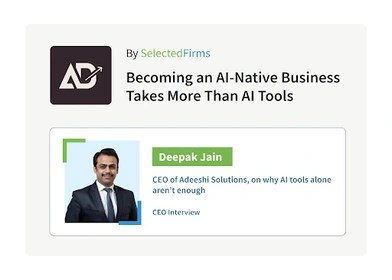
Many businesses are adopting AI tools, but how many are actually changing the way they operate? There's a difference between using AI to improve existing processes and rethinking how an entire business works around it.
SelectedFirms spoke with Deepak Jain, CEO of Adeeshi Solutions, about what it really takes to become an AI-native business, why leadership plays a central role in that transformation, and how businesses can identify an agency that understands more than just AI tools.
Deepak Jain, CEO, Adeeshi Solutions. Leads an AI-native business acceleration agency that helps mid-tier and legacy enterprises with AI consulting and AI-native systems.
Key Takeaways
- Think beyond AI tools: Becoming an AI-native business means building AI into core business processes and decision-making.
- Start with leadership: Upskilling leaders is essential to driving meaningful AI adoption and business transformation.
- Look beyond technology: Choose an AI agency that understands your business model, team structures, and workflows.
- Know when to use AI: Not every challenge needs AI. Sometimes, automation or a structured process is enough.
- Evaluate agency expertise: Look beyond service listings and review the agency's leadership background before making a decision.
What does it take for a business to become AI-native rather than simply adopt AI tools?
Deepak Jain: An AI-native company rebuilds its business model around AI and makes it an integral part of its core processes. It's not simply about adding AI tools to existing workflows. It's about making AI a part of how the business operates, makes decisions, and approaches its everyday processes.
What is the biggest mistake businesses make when implementing AI, and how can they avoid it?
Deepak Jain: One of the biggest mistakes is not upskilling leaders. When leaders become AI-native themselves, they can guide both AI tool adoption and broader AI-native transformation initiatives more effectively. Leaders need to understand AI first so they can help their teams adapt and make the most of these changes.
Can you share an example of how Adeeshi Solutions has helped businesses apply AI to real-world challenges?
Deepak Jain: We are currently working with a coach for whom we have built a digital ecosystem, with AI and automation as integral components. It includes platform development, AI integration, lead generation, and business intelligence tools. These tools will also support AI-powered analysis of customers and their behavioral experiences.
We have also conducted a case study analysis for a legacy mid-tier enterprise operating five manufacturing units. Through this analysis, we identified opportunities to reduce costs by applying AI to its capacity planning function.
When evaluating an AI agency, how can businesses look beyond its website and marketing claims to understand its actual expertise?
Deepak Jain: If an agency mainly sells SaaS tools or generic solutions, it may not fully understand your business. Businesses looking to become AI-native should speak directly with agency leaders and understand where the conversation is headed. Is it focused only on tools, or does it explore ways to rethink the business model, team structures, and workflows? That distinction matters.
AI is developing quickly, but how should businesses decide between AI vs. automation, and which developments do you think will have the biggest impact over the next three years?
Deepak Jain: The impact of AI over the next three years will largely depend on research and developments in artificial general intelligence. At present, many businesses are still reluctant to reinvent their workflows and tend to focus more on adopting AI tools.
One important shift will be learning when to use AI, when automation is sufficient, and when neither is necessary. Not every business challenge requires an AI solution. Sometimes, a structured and systematic approach is enough.
For example, a business dealing with delayed customer inquiries may not need a complex AI solution. A simple automated workflow that assigns inquiries to the right team, sends follow-up reminders, and tracks responses may solve the problem effectively. Organizations often overlook such straightforward solutions and try to integrate AI into everything, even when a simpler approach could deliver better results.
When comparing specialist agencies like Adeeshi on SelectedFirms, what should businesses look for before deciding?
Deepak Jain: An agency's profile can tell you quite a bit about its expertise. Platforms like SelectedFirms allow agencies to showcase their company overview, service areas, and other relevant details. Businesses should also take a closer look at agency leadership profiles, as these can offer more clarity when making a decision.
If an agency's leadership is not AI-native, it may be difficult for the agency to create a meaningful impact on its clients' AI-native transformation.
Final Thoughts
Becoming an AI-native business takes more than adopting new tools. It requires leaders to rethink how their organizations operate, identify where AI and automation can make a real difference, and build workflows around business goals.
As Deepak Jain highlights, the right approach isn't about integrating AI into everything. It's about understanding what the business actually needs and finding the right expertise to make that transformation meaningful.
Businesses exploring AI-native transformation can learn more about Adeeshi Solutions on SelectedFirms and evaluate its expertise before choosing their next AI partner.
