


What Is Generative Engine Optimization (GEO)?
-
Last Updated:

27 Oct 2026
-
Read Time:

13 Min Read
-
Written By:
 Isha Choksi
-
14
Table of Contents
Learn how Generative Engine Optimization (GEO) helps content get discovered, cited, and mentioned in AI-generated answers across platforms like ChatGPT, Perplexity, and Google AI Overviews.
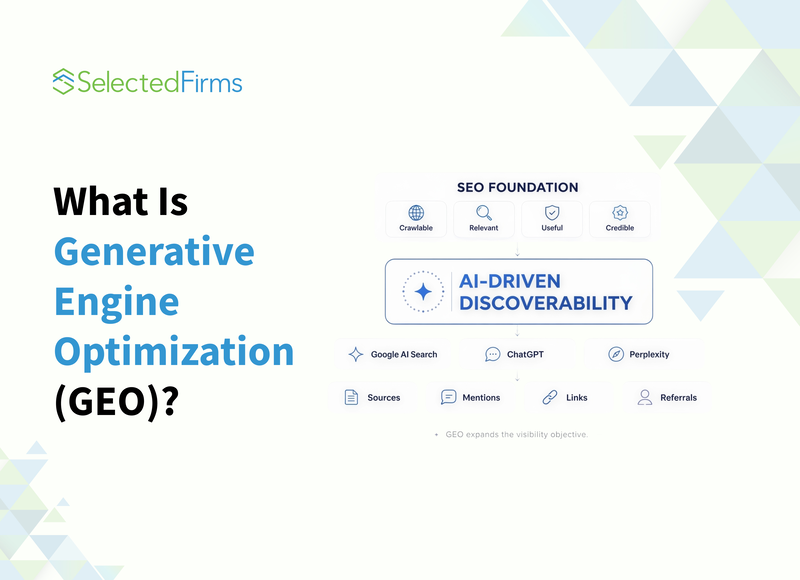
Search is no longer just about getting your website onto the first page of Google.
People now ask AI platforms to recommend companies, compare products, explain services, research vendors, and narrow down their options. Instead of seeing ten blue links, they may get a direct answer with a few recommendations and supporting sources.
That creates a new question for businesses:
What happens when customers find your company, service, or industry through an AI-generated answer instead of a traditional search result?
This is where Generative Engine Optimization (GEO) comes in.
GEO makes a business’s content and online presence easier for AI systems to find, understand, evaluate, and mention in their answers.
It is not simply SEO with a new name. It builds on SEO but looks at a wider range of sources, including websites, directories, reviews, publications, and online communities, to help AI systems find and use information when generating answers.
For businesses that rely on online discovery, especially B2B companies and service providers, this shift changes how they approach digital visibility.
Quick Answer: What is Generative Engine Optimization?
Generative Engine Optimization is the practice of improving a business’s content and online presence so AI-powered search systems can easily find, understand, and use its information in their answers. Generative engine optimization goes beyond traditional rankings by considering context, evidence, brand authority, citations, and third-party information.
Why Does Generative Engine Optimization Matter Now?
Search is no longer just a list of links.
It is becoming a conversation. A user asks a detailed question and gets one synthesized answer. No tab hopping. No manual comparison.
That shift is why GEO exists.
Search Behavior Has Changed
People used to type a short keyword and open several pages to piece together an answer. Now they ask AI systems full questions. Those questions include their industry, budget, location, needs, and preferences.
These are not simple keyword searches. They are decision-making questions.
AI search already operates at scale.
Google says AI Overviews reached more than 2.5 billion monthly active users in 2026. AI Mode had surpassed one billion monthly users.
Traditional search is not disappearing. The discovery environment is getting wider.
AI Answers Pull From Sources, Not Just Rankings
An AI system does not simply return the top-ranked page. It gathers information from different sources and summarizes it into one response. Sometimes that response is a shortlist or a direct recommendation.
That raises a new question: which sources does the AI trust enough to include?
Generative engine optimization is the practice of making your content easy for AI systems to find, understand, and cite. Rankings still matter. Being referenced inside the answer matters too.
What This Means for Business Buyers
The shift is sharpest in B2B. 51% of B2B software buyers now start their research in an AI chatbot more often than in Google, up from 29% a year earlier.
Choosing a software development company, marketing agency, IT consulting firm, or technology partner can take days or weeks of comparison. If AI handles part of that research, a vendor missing from its answers may never reach the shortlist.
That is a revenue risk. Not just a visibility gap.
What AI Needs Before It Recommends You
Ask these questions about your own business:
- Does AI understand what your business does?
- Does it link you to the right services and industries?
- Does it find credible evidence of your expertise?
- Do third-party sources describe you consistently?
- Do your reviews and case studies support your claims?
Is AEO The Same As GEO?
GEO and AEO overlap significantly.
There is no universally accepted definition that separates the two perfectly.
AEO focuses on getting content selected for direct answers, such as featured snippets, voice results, and answer-focused search experiences.
GEO focuses on generative AI systems that combine information from multiple sources to produce a new response.
The distinction is useful, but B2B businesses do not need three completely separate content strategies.
The practical goal remains the same:
Make your information easy to discover, understand, verify, and use.
How Does GEO Work?
There is no single GEO optimization algorithm.
AI platform responses can vary based on the question, context, location, available information, and platform updates. Each platform uses different AI models, data sources, and ranking processes, which can lead to different results.
Still, you can understand how generative engine optimization works through four broad stages.
1.Discovery
An AI system first needs to find information about your business. That information comes from your website, search indexes, directories, review platforms, industry publications, news sites, communities, and social platforms.
If key business information is hard to find, AI is less likely to use it.
2. Understanding
Finding information is not enough. The system must also grasp what it means: what you do, which services you offer, which industries you serve, and which technologies you use.
This is where entity clarity matters. A company that calls itself a "digital transformation partner" is hard to categorize. Say whether you offer software development, web development, cloud services, or consulting.
Clear information gives AI stronger context.
3. Evaluation
Next, the system decides which information is relevant and credible. Strong signals include:
- Case studies and client reviews
- Original research and expert input
- Independent coverage and reputable third-party references
- Consistent company information across sources
A company that only makes claims on its own website carries less weight than one backed by reviews, publications, and directories.
4. Attribution
Finally, the platform may use the information in its response and cite the source. Sometimes it mentions a business without any visible link.
That is why GEO success should not be measured by clicks alone. A brand can shape a buyer's consideration without a single site visit.
GEO vs. SEO vs. AEO: B2B Dimensions That Set Them Apart
SEO, AEO, and GEO all improve online visibility, but they support different moments in the B2B research journey.
A buyer may use search to discover providers, ask AI specific questions, and then use generative platforms to compare or shortlist potential vendors.
|
B2B Dimension |
SEO |
AEO |
GEO |
|
Primary objective |
Improve visibility in search results |
Provide direct answers to specific questions |
Improve visibility in AI-generated responses |
|
Buyer journey stage |
Discovery |
Research |
Evaluation & consideration |
|
Core buyer need |
Find relevant providers and information |
Understand a specific topic or requirement |
Identify relevant providers and supporting evidence |
|
Search experience |
A ranked list of pages |
A direct or concise answer |
A synthesized response using information from multiple sources |
|
B2B industry query example |
“Software development companies in the USA” |
“What does custom software development involve?” |
“Which software development companies specialize in healthcare?” |
|
Information AI or search must identify |
Relevance, intent, and topical coverage |
Clear, concise answers |
Business context, expertise, relevance, and credibility |
|
Evidence that supports visibility |
Quality content, links, technical signals, and topical relevance |
Well-structured answers, FAQs, and answer-focused content |
Reviews, case studies, portfolios, directories, publications, expertise, and consistent third-party information |
|
Key competitive question |
Can this page rank for the target query? |
Can this content directly answer the question? |
Does the available evidence support including this business in the response? |
|
Content that supports the strategy |
Service pages, landing pages, blogs, and comparison content |
FAQs, definitions, how-to content, and concise answers |
Case studies, original research, expert content, reviews, portfolios, and comparison data |
|
Primary visibility signals |
Rankings, impressions, clicks, and organic traffic |
Answer appearances and featured results |
AI mentions, citations, recommendations, referrals, and assisted conversions |
The three approaches are complementary rather than competing strategies.
SEO helps buyers discover your business. AEO helps answer their questions. GEO helps AI systems understand and evaluate your business within a broader information environment.
For B2B companies with longer and more research-intensive buying journeys, all three can contribute to different stages of vendor discovery and evaluation.
SEO remains an important foundation because AI systems need to discover and retrieve information before they can potentially use it.
The distinction becomes clearer after discovery:
SEO asks:
Can my page rank for the buyer's search?
AEO asks:
Can my content provide a clear answer to the buyer's question?
GEO asks:
Does an AI system have enough relevant context and credible evidence to understand, mention, or cite my business?
A strong AI search optimization strategy therefore connects all three. It helps a B2B brand progress from being discovered → being understood → being considered.
Why Citation Authority Matters for GEO?
Visibility is only one part of GEO.
A business also needs information that an AI system can confidently use.
This is where citation authority matters.
Citation authority does not come from simply collecting backlinks or getting mentioned on as many websites as possible. It is about creating a reliable body of information around a company, service, person, or topic.
Consider a software development company that says it specializes in healthcare technology.
Its website makes that claim.
But the same company also has:
- Healthcare case studies
- Verified client reviews
- Relevant portfolio examples
- Industry - specific service pages
- Independent directory profiles
- Consistent descriptions across reputable sources
- Expert content about healthcare technology
- Third-party references to its work
The claim now has more supporting evidence.
This does not guarantee that an AI system will recommend the company.
It does create a stronger information environment around the claim.
For agency discovery, this distinction becomes especially important.
A directory that simply lists hundreds of agencies gives buyers limited context. A structured platform that combines company information, service expertise, portfolios, client reviews, and evaluation criteria provides more evidence to work with.
SelectedFirms provides an example of this approach through its Agency Ranking Methodology (SARM) and SF Score.
SF Score combines Customer Satisfaction and Market Credibility, with verified client reviews contributing to the former and factors such as verification status, service expertise, and project experience contributing to the latter.
The important point for GEO is not that an SF Score guarantees AI visibility.
It does not.
The value is that structured evaluation makes scattered agency information into a more comparable evidence set.
That is useful for buyers first. It can also make agency information clearer and more consistent within the wider digital information ecosystem.
How To Do Generative Engine Optimization: 6 Core Tactics
A practical geo optimization strategy should not mean creating a separate version of every existing SEO Activity.
It extends existing content strategies rather than replacing them.
The better approach is to strengthen the information businesses already publish and the evidence available around them.
1. Use Structured Data Carefully
Use relevant structured data for organizations, services, products, articles, reviews, and other entities. Keep it accurate and consistent with visible page content.
2. Format Content Around Real Questions
Lead with the answer, then add context. Use clear headings, short paragraphs, examples, tables, bullets, original data, sources, and FAQs.
3. Strengthen Author and Experience Signals
Strengthen author and experience signals through case studies, first-hand insights, expert commentary, original research, project experience, and clear publication dates.
4. Make Information Accessible to Crawlers and AI Systems
Maintain crawlable pages, logical site architecture, internal links, clear headings, usable pages, XML sitemaps, canonical URLs, and accurate structured data.
5. Publish Citation-worthy Original Information
Create original research, surveys, case studies, pricing insights, expert interviews, and project lessons instead of repeating information already available across the web.
6. Build Third-party Authority
AI systems can encounter your business through reviews, directories, publications, communities, partnerships, interviews, podcasts, and other sources. Prioritize credible evidence over volume.
For service businesses, verified reviews are particularly important because they provide evidence of customer experience rather than relying entirely on the company's own claims.
How to Measure the Success of Generative Engine Optimization Campaigns
Traditional SEO metrics remain useful, but they do not tell the entire story.
GEO requires a wider measurement framework.
-
AI Mentions and Citations
Track how often your business appears in relevant AI answers.
Then distinguish between:
- A simple brand mention
- A recommendation
- A citation
- A link
- A detailed description
Not every mention has the same value.
-
Share of Voice
Compare your visibility with competitors across the same prompts.
For example, if ten important prompts consistently produce recommendations for competitors but rarely mention your business, there is a clear visibility gap.
-
Brand Accuracy
Being mentioned is not enough.
Check whether AI systems correctly understand:
- What you offer
- Where you operate
- Which industries you serve
- Who your customers are
- What your strengths are
- What your limitations are
Incorrect visibility can create the wrong expectations.
-
Sentiment and Context
A business can appear frequently but in the wrong context.
For example, it might appear for searches about low-cost providers but disappear when users ask for enterprise partners.
GEO measurement should therefore examine where and why a business appears, not simply how often.
-
AI Referral Traffic
Analytics can show whether users are arriving from AI platforms where referral information is available.
However, referral traffic does not capture every AI-assisted conversion.
A customer may discover a company through an AI platform, search its brand name later, and eventually submit an inquiry through Google or direct traffic.
-
Assisted Conversions
Businesses should therefore also watch:
- Branded search growth
- Direct traffic
- Leads
- Demo requests
- Contact form submissions
- Sales conversations mentioning AI
- Conversion rates
- Assisted conversions
How to Measure ROI of GEO
The ROI of GEO should focus on business outcomes, not just AI mentions.
A simple measurement model can be:
GEO ROI = Incremental value influenced by AI discovery ÷ GEO investment
The difficult part is identifying the incremental value.
A business can use several signals together:
- Establish a baseline of AI visibility.
- Track changes in relevant prompts over time.
- Monitor AI referral traffic where available.
- Track branded search growth.
- Ask leads how they discovered the company.
- Track assisted conversions and revenue.
- Compare performance against the investment in content, digital PR, technical improvements, and monitoring.
Because AI visibility can change, businesses should not treat a single response as proof of success.
GEO measurement works better when businesses test the same prompts repeatedly and look for patterns.
Generative Engine Optimization Services: What Should Businesses Look For?
Businesses exploring generative engine optimization services should be careful not to treat GEO as a guaranteed ranking service.
A credible provider should be able to explain:
- How it evaluates current AI visibility
- Which customer questions it will target
- Which technical changes it recommends
- How it measures mentions and citations
- How it connects visibility to business outcomes
- What it can and cannot guarantee
A useful GEO engagement should also work alongside existing SEO and content efforts.
The right provider should not recommend replacing a functioning SEO strategy simply because AI search is growing.
For businesses comparing providers, the same principle applies as with any other digital marketing or technology partner.
Look beyond the service description.
Review relevant experience, case studies, client feedback, specialization, methodology, and evidence of outcomes.
This is where structured agency discovery can be useful.
Rather than relying entirely on a provider's own claims, buyers can compare information across profiles, reviews, portfolios, expertise, and evaluation signals.
It gives buyers a more structured starting point.
Common Generative Engine Optimization Mistakes
1. Treating GEO as a Keyword Strategy
Repeating keywords does not improve visibility in AI answers. AI needs context, expertise, and evidence.
Fix: Build content around real buyer questions. Explain your services, industries, and differentiators. Use terms naturally.
2. Publishing AI Content Without Expertise
Generic content at scale does not build authority.
Fix: Use AI for research and drafting. Add expert review, original data, client examples, and first-hand insight before you publish.
3. Neglecting SEO
AI systems still need to discover and retrieve your pages. Weak site structure or inaccessible content limits that.
Fix: Keep pages crawlable. Maintain clean architecture, internal links, XML sitemaps, canonical URLs, and accurate structured data.
4. Relying Only on Your Website
AI also encounters your business through reviews, directories, publications, and partner sites.
Fix: Keep your business details consistent across every profile. Strengthen third-party signals with verified reviews, directory listings, and case studies.
5. Expecting a Guaranteed Ranking
Generative search has no permanent number one spot. Answers change with the prompt, model, location, and platform updates.
Fix: Track a fixed set of prompts over time. Monitor mentions, citations, and accuracy across platforms instead of judging single responses.
6. Making Unsupported "Best" Claims
Calling yourself the best proves nothing. Buyers and AI both need evidence.
Fix: Replace broad claims with specifics. Show projects, client reviews, credentials, measurable outcomes, and transparent evaluation criteria.
7. Ignoring How AI Describes Your Brand
Visibility is not enough if the description is wrong. Outdated or conflicting information across sources leads to inaccurate representation.
Fix: Run brand and service prompts regularly. Compare the answers with your real positioning. Correct outdated details on your site and third-party profiles.
Is GEO the Future of Search Visibility?
Generative Engine Optimization is not about writing content for robots.
It is about making a business clear, credible, discoverable, and useful in an environment where AI systems increasingly help people research and make decisions.
A strong GEO strategy combines:
- Technical SEO
- Clear entity information
- Useful and extractable content
- Original expertise
- Strong topical coverage
- Verified customer experiences
- Consistent third-party information
- Structured data
- Transparent methodologies
- Ongoing AI visibility monitoring
The most important shift is simple.
SEO helps your business compete for a place in the search results.
GEO helps make your business relevant to the answer.
And when that answer involves choosing an agency, credibility becomes just as important as visibility.
The businesses that stand out will not necessarily be the ones making the loudest claims.
They will be the brands with consistent, verifiable, and relevant evidence that helps both people and AI systems understand why they deserve consideration.
FAQs
No. AEO focuses on providing direct answers, while GEO focuses on helping content get understood, evaluated, and cited by generative AI systems.
Yes. GEO can benefit websites across industries, especially those that provide useful, trustworthy, and well-structured information.
GEO helps AI systems discover, understand, evaluate, and attribute information by improving content quality, structure, authority, and online visibility.
Businesses can improve GEO by creating helpful content, using structured data, strengthening authority signals, publishing original information, and building credible third-party mentions.

Head of SEO Operations
Recent Blogs

Jane Hart
React vs. Angular vs. Vue: Which Stack Should You Ask Your Agency to Use?
-
27 Oct 2026
-
13 Min
-

17
Jane Hart
Best B2B Review Sites for Finding Trusted Digital Service Agencies
-
26 Oct 2026
-
14 Min
-
41


Elia Martell
5 Virtual Recruiting Support Operations for Tech and Healthcare Teams
-
09 Oct 2026
-
8 Min
-
1047
Jane Hart
Why LinkedIn Campaign Optimization Requires More Than CPC and CTR
-
09 Oct 2026
-
8 Min
-
336
