


Why Verified Contractor Networks Are Essential for Scaling Tech Teams
-
Last Updated:

26 Nov 2026
-
Read Time:

10 Min Read
-
Written By:
 Elia Martell
-
9
Table of Contents
Software teams now give contractors deep access to code and data. Learn a four-layer framework for vetting tech vendors, compare spreadsheets, compliance tools, and verified networks, and follow a 30-day plan to switch.
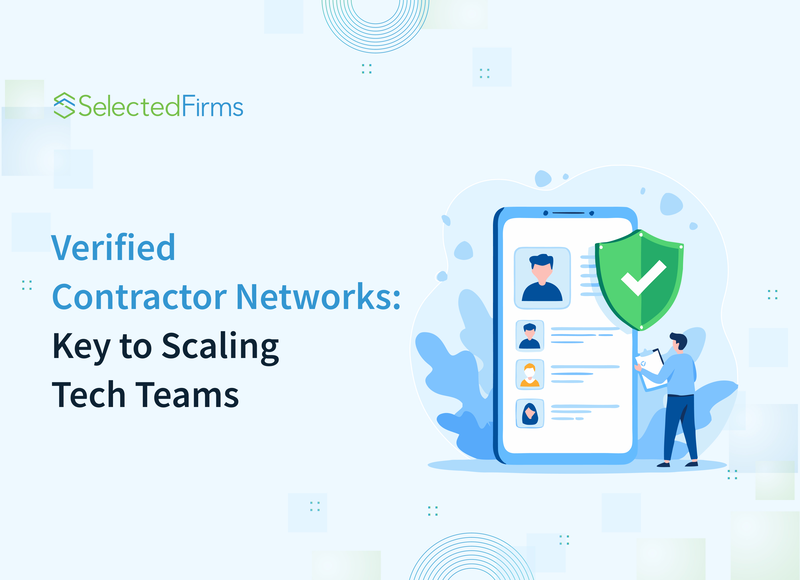
A verified contractor network is a pool of freelancers, agencies, or specialist teams whose identity, business details, and credentials are checked before you contact them, then checked again while they work for you. For most software companies, that second part is the one the hiring process skips.
Most engineering leaders have a story about a contractor who looked great on paper: strong portfolio, sharp technical interview, reasonable rate. Then the pull requests started to look odd, or the person on the daily standup didn't quite sound like the one who interviewed, or a former client mentioned an incident nobody had disclosed.
Scaling a product team now almost always means bringing in outside people: a staff-augmented backend developer, a QA agency, a specialist firm for a data migration. Each one gets some level of access to your code, your infrastructure, or your customers' data. The question isn't whether to use external talent anymore.
This guide argues that software teams should borrow a verification model other industries already rely on. It lays out a four-layer framework for vetting tech vendors and contractors, compares the main ways to run it, and ends with a 30-day plan you can start this month.

Why Informal Vendor Vetting Breaks Down As Teams Scale
The short version: you're granting more access to more outside people, and attackers have noticed.
Verizon's 2026 data breach report found that third-party involvement reached 48% of all confirmed breaches, up 60% in a single year. One of the three patterns it describes is a vendor connected directly to your environment. A contractor with repository access and a VPN profile fits that description exactly.
Identity fraud is the sharper version of the same problem. The FBI has warned that North Korean IT workers hired under false identities have stolen source code and used it to extort employers. It specifically asked companies to confirm that third-party staffing firms run solid hiring checks. In other words, the contract route is often the easiest way in.
Here's what that looks like day to day. When your usual agency is booked for six weeks, you go further down the list. Further down the list means less familiar. Less familiar means more checking. And checking is exactly where informal systems fail, in three predictable ways:
- Verification is a snapshot. A background check, a reference call, and a coding test happen once, at onboarding. Nobody looks again in month four.
- Knowledge sits with one person. If your engineering manager leaves, so does their mental map of which vendors delivered and which ones cut corners.
- There's no shared signal. Every company re-vets the same freelancer from scratch, and nobody benefits from anyone else's work.
None of this is an argument against outside talent. IT staff augmentation is often the fastest way to add skills you can't hire for in time. It's an argument for treating vendor verification as an engineering process with inputs, owners, and alerts, rather than a favor someone does during hiring.
What "Verified" Should Actually Mean For A Tech Contractor
A "verified" badge is only worth what's behind it. Before trusting any network, internal list, or platform, check it against four layers.
Layer 1: Identity And Business Legitimacy
Is this a real person or a registered business with an address, an owner you can identify, and a tax ID or company number that matches public records? For individual developers, that means a live ID check with a face match, not a passport’s picture sent by email. It also means confirming that the person who passed the interview is the person who shows up on day one.
Remote work makes this harder because most of the usual trust signals are missing. Coruzant's piece on how digital identity builds trust in remote-first workplaces argues that verified credentials and consistent online history now do the job of a handshake. If you can't confirm identity, nothing in the next three layers matters.
Layer 2: Credentials, Contracts, And Coverage
For individuals, check claimed certifications directly with the issuer. Most cloud and security certifications have a public verification page, and it takes two minutes.
For agencies, ask for a current SOC 2 Type II report or ISO 27001 certificate if they'll touch production data. Confirm professional liability and cyber insurance at the limits your contracts require. Make sure IP assignment, confidentiality, and a data processing agreement are signed before access is granted, not after the first sprint.
Layer 3: Delivery Track Record
Credentials tell you what someone is allowed to do. History tells you what they're likely to do. Look for references from businesses (not friends or former colleagues), shipped work you can actually inspect, and ideally a short paid trial on a scoped task.
If you've ever worked through a commercial due diligence checklist for an acquisition, the logic is identical. Paperwork tells you what's permitted. Track record tells you what's probable.
Layer 4: Continuous Monitoring
This is the layer most internal systems skip. Verification at onboarding is a snapshot, and you need a live feed. Expiring insurance, a SOC 2 report past its coverage period, a lapsed certification, or a contract end date that passed without anyone revoking access should all trigger alerts before the next deployment, not after something goes wrong.
A simple test: if a network only covers Layers 1 and 2, it's a directory with a filter, not a verified network.
Your Options: Spreadsheets, Compliance Software, Or A Verified Network
There's no single right setup. Here's how the main approaches compare.
Building It In-House
A shared spreadsheet or a custom field in your HR or project management tool gives you full control and costs nothing upfront. It works for teams with a small, stable bench of maybe 10 to 15 contractors. Past that, someone ends up spending part of every week chasing expired documents and access reviews by email.
Vendor Risk And Compliance Software
Tools like Vanta, Drata, Whistic, and OneTrust handle vendor security questionnaires, document collection, and audit evidence, mostly for companies working toward SOC 2 or ISO certification.
They're strong if your main problem is documenting the vendors you already use. They're less focused on helping you find new ones, and many are built for software vendors rather than individual contractors.
Verified Contractor And Talent Networks
This category combines verification with sourcing. Instead of vetting someone after you've found them, you search a pool where everyone has already passed checks. Toptal and Arc screen freelance developers, while broader B2B networks such as Sublynk apply similar pre-listing checks to service contractors.
Each network screens for different things, so compare their criteria against the four verified layers rather than simply trusting the label.
Whether a network suits you also depends on the shape of the work. These trade-offs in an agency vs freelancer decision for marketing still apply when deciding on a tech contractor, because agencies and individuals carry different risks and need different checks.
How The Three Approaches Compare
|
Criteria |
Spreadsheets / In-House |
Compliance Software |
Verified Networks |
|
Upfront cost |
None |
Annual subscription |
Varies by network and pricing model |
|
Identity and business checks |
Manual, depends on reviewer |
Collected from vendor, often self-reported |
Done before listing |
|
Credential and insurance checks |
Manual |
Document upload and review |
Done before listing |
|
Track record data |
Internal notes only |
Limited |
Reviews, ratings, or screening results |
|
Continuous monitoring |
Calendar reminders at best |
Strong for documented vendors |
Varies, ask before joining |
|
Helps you source new talent |
No |
No |
Yes |
|
Audit trail |
Weak |
Strong |
Moderate to strong |
|
Best fit |
Fewer than 15 stable contractors |
SOC 2 / ISO programs, known vendors |
Overflow, new skills, fast scaling |
|
Example tools |
Google Sheets, Notion, Airtable |
Vanta, Drata, Whistic, OneTrust |
Toptal, Arc |
In practice, most teams combine these approaches. They keep compliance software for long-term strategic vendors and use a verified network for overflow, new skill sets, and sudden scaling needs.
Building Verification Into Your SaaS Workflows
Verification only reduces risk if it's connected to access. A contractor who passed every check but still has production credentials three months after their contract ended is a bigger problem than one who was never checked at all.
A few practical ways to wire it in:
- Tie access to verification status. Provision contractors through SSO and SCIM so that removing them from one system removes them everywhere. If their verification lapses, access should lapse with it.
- Set expiry dates on every account. Every contractor account gets an end date that matches the contract. Extensions require a fresh review, not a quiet renewal.
- Use least privilege by default. Start contractors in a scoped environment with no production data. Grant more only when a task needs it, and log the request.
- Watch for unusual behavior. Bulk repository cloning, logins from new countries, or access outside agreed hours should trigger an alert. The FBI has reported fraudulent IT workers copying company repositories to their own accounts, so code exfiltration deserves its own alert.
- Re-verify identity on a schedule. A short live video check every quarter is a small cost compared with discovering that the person committing code isn't the person you hired.
Who Gets The Most Out Of A Verified Network
Startups Scaling Through Staff Augmentation
Early-stage teams often add contractors faster than they add security staff. A pre-verified pool lets a CTO bring in a senior engineer in days without skipping the identity and contract checks that investors will later ask about in due diligence.
Agencies That Subcontract Work
Many development agencies hand overflow or niche work to other agencies or freelancers. The client still holds the original agency responsible. Verified subcontractors with monitored credentials make that chain of responsibility easier to defend.
Platforms And Marketplaces Onboarding Third-Party Developers
If your product lets outside developers build integrations, plugins, or client projects, you're already running a contractor network. Borrowing the four-layer model gives your trust and safety team a clear standard instead of case-by-case judgment.
Procurement And Security Teams
For procurement, the benefit is mostly about auditability. When finance, legal, or an auditor asks why a vendor was approved, a verification record with timestamps is a much better answer than "they came recommended."
A 30-Day Plan For Moving To Verified Sourcing
You don't need to rebuild your vendor list overnight. Here's a weekly phased approach that keeps your existing relationships intact.
- Week 1: Audit what you have. Export every external account from your identity provider, code host, and cloud console. Match each one to a contract, an owner, and an end date. You'll probably find accounts with no active contract and a few vendors whose documents expired months ago.
- Week 2: Define your minimums. Write down the non-negotiables: identity checks for individuals, SOC 2 or equivalent for agencies touching customer data, insurance limits, and required contract clauses. This becomes the standard you hold every source to, whether that's your spreadsheet, a compliance platform, or a network.
- Week 3: Invite your trusted contractors into the new system. Ask your best partners to verify through whichever platform you've chosen. Explain why: a documented standard protects them as much as you if an incident is ever traced back to an outside account. Most good contractors will accept that.
- Week 4: Route new sourcing through verified channels only. From here on, any new contractor has to come from a verified pool or pass your internal checks first. Track time-to-onboard and compliance gaps, and connect the results to your identity provider so access and verification stay in sync.
Questions To Ask Before You Onboard Any Network
Not every platform that calls itself "vetted" holds up. Before you sign on, ask:
- What exactly is checked, and by whom? Self-reported data isn't verification. Ask whether identity checks include a live face match.
- How often is it rechecked? If the answer is "at signup," Layer 4 is missing.
- Who pays, and how? Pricing tied to each lead or hire can reward volume over fit. Ask how the network earns money and what that encourages it to prioritize.
- Can I bring my existing contractors in? A network that only works with its own pool will split your records across systems.
- What happens when something expires? You want an alert before the next sprint, not a report afterward.
- Can I export the verification history? If an auditor or customer asks, you need the timestamps, not a screenshot of a badge.
Conclusion
Bringing in outside engineers used to be about portfolios first and paperwork second. Portfolios still matter, but there's now too much access, too much turnover, and too much identity fraud to keep vetting informal.
The software teams that scale safely aren't necessarily the ones with the biggest freelancer contact lists. They're the ones that can confirm, in a few minutes, that whoever is pushing code today is who they claim to be, is properly contracted and covered, and has a real delivery record.
Whether you build that in-house, buy compliance software, or join a verified network, the standard is the same: verification has to be continuous, shared, and auditable. Start with the Week 1 audit. It will quickly show you how many people with access to your systems you can actually vouch for.
About the Author
Geetanshu Gaur is the Operations Lead at Sublynk, a B2B network that verifies contractors and service partners before businesses hire them. [Author Name] works on onboarding standards, document monitoring, and compliance workflows for companies that rely on outside specialists. Teams building a verified bench can find vetted contractors with Sublynk.

Marketing Manager
Recent Blogs
Elia Martell
UX Mistakes That Make Digital Products Lose Users in the First Week
-
25 Nov 2026
-
9 Min
-

38

Jane Hart
How to Evaluate a Vendor Before Outsourcing Data Engineering Work
-
23 Nov 2026
-
9 Min
-
86

Elia Martell
Best SEO Agencies Helping Independent Retailers Compete Online
-
20 Nov 2026
-
10 Min
-
129
