


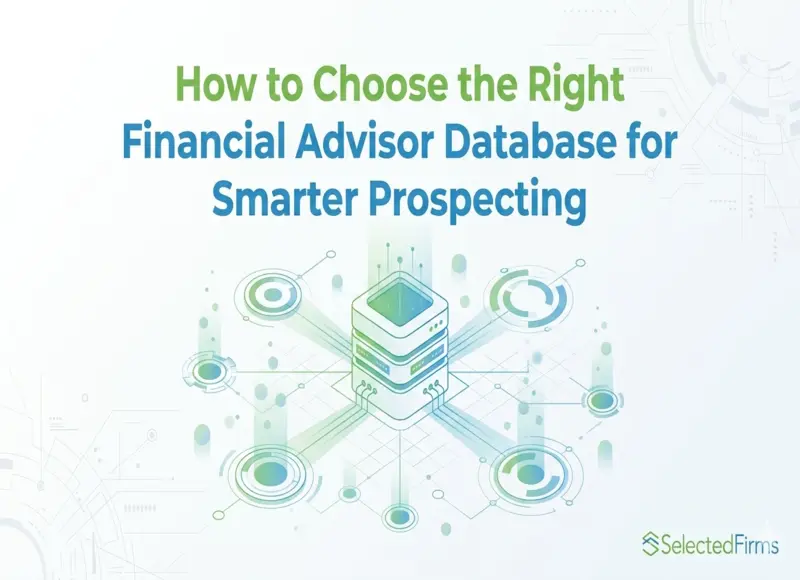
How to Choose the Right Financial Advisor Database for Smarter Prospecting
-
Last Updated:

14 Apr 2026
-
Read Time:

7 Min Read
-
Written By:
 Isha Choksi
-
1138
Table of Contents
Choosing the right financial advisor database can transform your prospecting efforts. This guide explains how to evaluate data quality, segmentation, CRM integration, and workflow fit to ensure your sales and marketing teams reach the right advisors at th
Revenue teams spend real money on advisor data every year. And yet, somehow, the problems stay the same: stale contacts, weak segmentation, outreach that goes nowhere, and hours burned chasing leads that went cold six months ago.
B2B contact data decays fast. Some industry estimates put annual decay close to 70%, which means a database you bought in January could be meaningfully outdated by summer. That is not a small operational risk.
The good news is that choosing the right financial advisor database changes everything. This guide skips the vendor sales talk and gets straight to how you should actually evaluate your options, so you end up with something that supports real prospecting workflows instead of creating more cleanup work in your CRM.
What a Good Financial Advisor Database Should Actually Do
A financial advisor database is not just a big list of names and firms. The right one becomes a core part of how your team selects, filters, and reaches advisors with precision.
Here is the thing: anyone can pull regulatory disclosures from the public Investment Adviser Public Disclosure (IAPD) system for free. But there is a significant gap between a raw Form ADV filing and something your sales rep can actually use on a Monday morning.
A public disclosure gives you things like total AUM and firm ownership. A purpose-built financial advisor database takes that same underlying information and structures it for outbound sales use, translating regulatory filings into actionable advisor intelligence.
Decision-making authority inside advisory firms shifts constantly. People change roles, leave, and join all the time. So a good database needs to do more than hand you an email address. You also need it to:
- Track job changes and role movements automatically
- Surface timing signals so you know when and why to reach out, not just who exists
Why a Static Contact List Is Not the Answer
A flat contact list looks like a bargain upfront. It rarely is.
Title churn, email changes, and phone updates happen constantly across advisory firms. A large chunk of business contact records change meaningfully within a single year. That means a list you buy today starts decaying almost immediately.
Static lists limit your filtering options, reduce how personalized your outreach can be, and push more data cleanup work onto your sales team. Research on sales productivity suggests reps can lose roughly a quarter of their working time chasing bad leads, which adds up to hundreds of hours and tens of thousands of dollars per rep every year in wasted effort.
Finding the RIA database is a living intelligence layer, not a one-time export.
Start With How Your Team Actually Uses the Data
Before you even look at vendors, spend time defining your actual operational use cases. The right database for a sales-heavy team looks different from the right one for a marketing team or a RevOps function.
Sales Prospecting Teams
If your primary use case is direct outbound prospecting, your evaluation should focus on filtering capabilities, territory management, and rep-level workflows. You want tools that solve for "callability" first: which accounts are actually reachable, and are there any overlap concerns with other parts of your organization?
Look for features that support the criteria your best reps already use to qualify accounts quickly, and the ability to model new targets that look like your best existing customers.
Marketing and Segmentation Teams
Marketers tend to think at the audience level rather than the individual lead level. You are not just targeting contacts; you are reaching buying groups, which means you need to separate two types of attributes cleanly:
- Fit attributes: Things like AUM tier, advisory service type, geography, and client profile. These tend to be relatively stable.
- Engagement signals: Behavioral intent data and campaign response activity. These shift more frequently and indicate timing.
CRM and RevOps Teams
RevOps professionals evaluate data tools differently. They care about sync behavior, data routing, governance, and whether the tool will actually get adopted across the team.
A common failure mode here is architecture incompatibility. Platforms that do not align with how your CRM objects are structured create messy integrations that only a handful of people can maintain. You want a database that maps cleanly into your existing motion, not one that forces you to build workarounds.
What Else to Evaluate Before You Decide
Think of your evaluation as an operational checklist, not a feature comparison spreadsheet, especially once you understand how financial advisor fees and value actually stack up in practice.
Here is what actually matters in daily use:
Data Freshness and Integrity
Data quality is measurable. Look for accuracy, completeness, consistency, timeliness, validity, and uniqueness. Platforms that pull from multiple enrichment sources tend to perform better than single-source databases, though this varies by provider.
Advisor and Firm Coverage
Does the platform cover your actual ICP? Not just firm names, but the specific roles and contacts within those firms that matter to your team.
Family Office Visibility
If single-family offices are part of your market, make sure the database can isolate them properly. SFOs typically operate above a significant asset threshold, and they often behave differently from registered advisory firms. A database that lumps them together with standard RIAs creates noise.
Segmentation and Filters
What filters can you use every single day, not just during initial list setup? You want the ability to filter by AUM ranges, location, business model, client types served, compensation structure, and the other details disclosed in Form ADV.
CRM Integration and Workflow Support
The best databases act as a data service layer that auto-syncs with your CRM, handles job change updates, deduplicates records, and maps cleanly into your existing workflow. Anything that requires significant manual work to maintain is a hidden cost.
Data Accuracy Is the Foundation of Everything Else
Every other feature on this list depends on the underlying data being correct. Start your evaluation here.
The practical approach is to request a sample batch that reflects your real ICP and verify it against what you know. Since financial advisor databases often draw from public RIA regulatory filings, you can cross-check things like:
- Does this firm actually fall within the AUM tier it is tagged under?
- Are these contacts still at the firm?
- Are the roles listed the ones you would actually target?
Invalid emails are one of the biggest contributors to data decay and deliverability problems. They inflate bounce rates and hurt campaign performance over time. A more accurate database costs more upfront, but it reduces the total cost of ownership by cutting down on systems maintenance, rep time, and the compounding damage of bad outreach.
Look for a Platform That Fits Your Workflow
Generating a list of target advisors is just step one. The real value shows up in how cleanly that data flows into the hands of the people doing the outreach.
When you are evaluating options, look for:
- Deep CRM sync that writes back to your system of record rather than creating a parallel data silo
- Fast search and filtering that a rep can use as part of their daily routine, not just during quarterly planning
- Account prioritization logic that routes activities based on actual strategy, not whoever made the most noise in Slack
- Less manual work between data and outreach, not more
One often-overlooked feature is score decay: the ability to automatically lower the priority of prospects that have not been acted on in a while. Without it, your top queue fills up with ghost prospects, and good accounts get buried.
Questions to Ask Before the Demo
Vendor demos are designed to look good. Your job is to cut through that. Here are the questions that actually matter:
- How often is the underlying data refreshed, and does it update automatically in my CRM?
- Which specific fields are verified, and how do you define "accuracy" in your methodology?
- What filters can I use right now to segment my ICP without additional manual research?
- How does the platform handle mapping conflicts, duplicate records, and contact job changes?
- Can I run a pilot or sample test against my actual ICP before signing?
- After I build a list, what does the actual execution workflow look like for routing, assigning, and tracking activity?
How to Shortlist the Right Tool
Compare two or three options side by side. Judge them on three things:
- Data fit: Does it cover your market and persona with enough depth to be useful?
- Workflow fit: Does it remove steps from your process or add new admin overhead?
- Adoption fit: Will your reps trust it enough to rely on it daily?
Data quality is ultimately contextual. A database is only as good as how well it works inside your actual prospecting motion, not how impressive it looks in a demo environment.
Next Step: Test It in the Real World
Stop reading, start testing.
Pick your shortlist of two or three financial advisor database vendors. Have a few of your actual sales reps try segmenting and contacting a batch of firms that match your ICP. Check contact quality, see how the filters hold up, watch how smoothly it syncs with your CRM, and pay attention to the daily user experience.
Then collect honest rep feedback. If they stop manually verifying contacts and just start using the tool directly, you have found something worth keeping.

Head of SEO Operations
Recent Blogs

Elia Martell
5 Virtual Recruiting Support Operations for Tech and Healthcare Teams
-
09 Oct 2026
-
8 Min
-

462

Jane Hart
Why LinkedIn Campaign Optimization Requires More Than CPC and CTR
-
09 Oct 2026
-
8 Min
-
149
Jane Hart
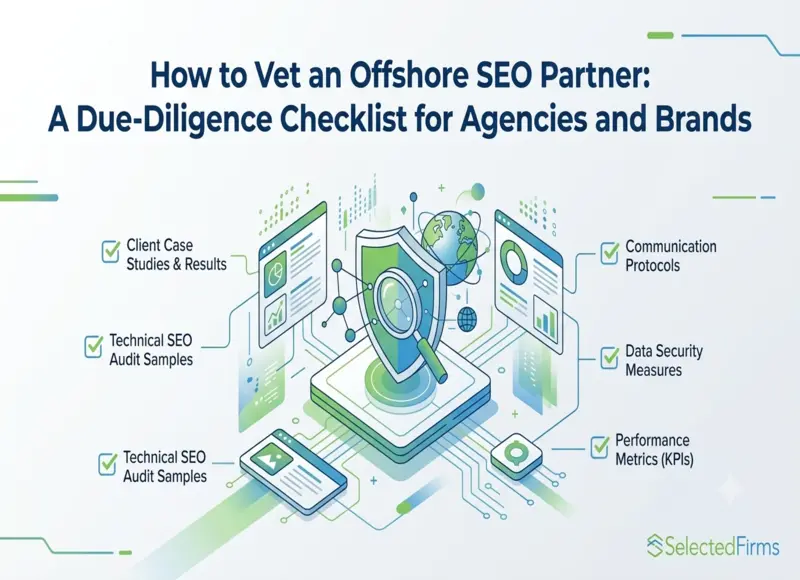
How to Vet an Offshore SEO Partner: A Due-Diligence Checklist for Agencies and Brands
-
08 Oct 2026
-
8 Min
-
249
Jane Hart
Benchmarking GPU Providers: A Practical Guide to Comparing Cloud Compute Options
-
07 Oct 2026
-
6 Min
-
171
