


Custom Ecommerce Development: Cost Guide & How to Choose a Partner (2026)
-
Last Updated:

06 Oct 2026
-
Read Time:

7 Min Read
-
Written By:
 Isha Choksi
-
37
Table of Contents
Get a detailed breakdown of custom ecommerce development pricing by complexity tier, including integrations, catalog requirements, timelines, and platform comparisons.
Ask five agencies what custom ecommerce development costs, and you'll get five different answers, ranging anywhere from $15,000 to over $1 million. That's not a pricing inconsistency. It's a scope problem: most quotes are answering different questions. Once a project is placed correctly within a complexity tier, the number is no longer a mystery and becomes a planning input.
This blog breaks down 2026 custom ecommerce development costs by project tier, the technical factors that most affect price, how custom development compares to Shopify Plus and BigCommerce, and what to verify before signing with a development partner.
Market Context: Why This Decision Carries More Weight in 2026
Digital commerce has become the dominant B2B sales channel rather than a supplementary one. B2B commerce is projected to generate 80% of B2B sales digitally by the end of 2025, and 73% of businesses now operate on headless commerce architecture, a substantial increase over recent years. This shift changes what a typical custom ecommerce development quote actually includes.
Fewer projects today are fully bespoke platforms built from zero; more are composable commerce stacks, where pricing logic, catalog architecture, and system integrations are custom-engineered even when the underlying frontend framework is not. Procurement and marketing leadership evaluating vendors should expect this distinction to appear explicitly in proposals.
What Counts as "Custom" Ecommerce Development
Custom ecommerce development refers to bespoke storefront architecture, backend systems built or substantially modified for a specific catalog and workflow, and integrations engineered to specification rather than installed as pre-built connectors. This differs from platform customization, which applies configuration and app-layer extensions within a fixed commerce architecture such as Shopify or BigCommerce.
Evaluation criteria that typically indicate a true custom development requirement, rather than platform customization, include:
- Headless or MACH (microservices, API-first, cloud-native, headless) architecture
- Custom pricing engines with account-specific or contract-based logic
- Deep ERP or PIM (product information management) integration
- Order management system (OMS) synchronization across multiple sales channels
This distinction is what determines which cost tier — and which vendor category — applies to a given project.
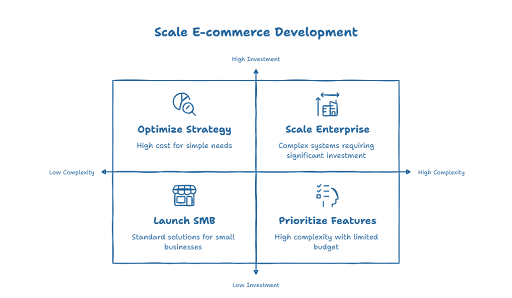
Custom Ecommerce Development Cost by Complexity Tier
Custom ecommerce development costs range from $15,000 to over $750,000+ across the market. The variance is driven primarily by architecture complexity, integration scope, and catalog scale, not vendor markup alone.
|
Tier |
Typical Cost |
Scope |
Timeline |
|
Small/SMB custom |
$15,000 – $40,000 |
Custom storefront architecture, 1–2 system integrations, standard catalog structure |
6–10 weeks |
|
Mid-market |
$80,000 – $250,000 |
Custom checkout and pricing logic, multi-system integration (CRM, ERP, payment gateway), moderate catalog complexity, multi-region support |
3–6 months |
|
Enterprise/B2B |
$250,000 – $750,000+ |
Headless or composable architecture, ERP/PIM/OMS integration, contract and tiered pricing engines, multi-currency and multi-entity support |
6–12+ months |
Platform-specific data supports the enterprise-tier range: a typical Adobe Commerce (Magento) implementation runs $150,000–$500,000 for initial build, plus $50,000–$150,000 annually for maintenance and hosting. Annual maintenance cost is a material line item that most vendor-authored cost guides exclude from headline figures, which understates true total cost of ownership.
What Drives Ecommerce Website Development Cost Up or Down
Four technical variables account for most quote variance at the mid-market and enterprise tiers.
Catalog architecture and SKU complexity. A flat catalog structure of several hundred SKUs is a materially different engineering scope than a high-SKU catalog with configurable variants, technical specifications, or compatibility matrices. Spec-driven or part-number search requires custom search infrastructure rather than standard faceted filtering.
ERP, PIM, and OMS integration. System-of-record integration is where cost estimates diverge most sharply, and where integration failure carries the highest downstream cost. Manual data entry costs organizations an average of $28,500 per employee per year, based on a study of over 500 U.S. professionals — a figure that should be weighed against integration budget, not treated as a separate operational line item.
Pricing engine complexity. Flat, single-SKU pricing is inexpensive to implement. Contract pricing, volume-tiered pricing, and account-specific pricing are not. Most commerce platforms are architected around a single list price per SKU with limited customer segmentation, while B2B and manufacturing sellers typically require pricing models with far greater complexity than that default supports natively.
Multi-region and multi-currency requirements. Tax computation, currency conversion, and localized checkout logic add engineering scope, particularly across multiple legal entities or region-specific regulatory requirements.
Custom Development vs. Shopify Plus / BigCommerce
|
Factor |
Shopify Plus / BigCommerce |
Custom Development |
|
Platform cost |
$2,300+/month base fee |
N/A (one-time development cost) |
|
Application layer spend |
$2,000–$5,000+/month for a full app stack |
Minimal recurring app spend; logic is owned, not licensed |
|
First-year total cost of ownership (mid-market) |
$40,000–$150,000 including apps, theme, and implementation partner |
Comparable or higher upfront; ownership reduces recurring cost |
|
Pricing and checkout logic |
Constrained by platform architecture; extended via third-party apps |
Engineered to specification |
|
ERP/PIM/OMS integration depth |
Available via connectors and middleware, with app-layer overhead |
Native integration, engineered for the specific system stack |
|
Best use case |
D2C or SMB catalogs without complex pricing logic |
B2B, high-SKU, or integration-intensive operations |
A 2026 total cost of ownership analysis places typical annual Shopify Plus TCO — inclusive of apps, theme, and implementation partner support — at $40,000 to $150,000, with application-layer spend alone commonly running $2,000 to $5,000 or more per month for a fully featured Plus implementation.
Custom development becomes cost-competitive once recurring platform and application spend approaches the cost of owned, custom-engineered logic, a threshold most B2B operations reach before the enterprise tier. Refer directly to Shopify Plus's published pricing, as rates vary by contract term and revenue volume.
How to Choose a Custom Ecommerce Development Partner — Vetting Checklist
Choosing the right ecommerce development company matters as much as pricing it correctly. The following criteria separate a defensible shortlist from a list of agencies that simply responded to an RFP:
1. Relevant project and vertical experience
Ask for examples involving a similar business model, catalog size, pricing complexity, customer workflow, and integration environment. General ecommerce experience does not automatically demonstrate expertise with B2B pricing or ERP synchronization.
2. Platform and architecture expertise
Evaluate experience across the technologies relevant to your requirements, such as Shopify, Adobe Commerce/Magento, BigCommerce, WooCommerce, Shopware, headless commerce, APIs, and composable architectures.
3. Integration capability
Ask the agency to explain its experience with ERP, PIM, OMS, CRM, payment, tax, shipping, and middleware integrations. Request examples of comparable integrations rather than accepting a general capability statement.
4. Delivery, QA, and change management
Understand how milestones, testing, acceptance criteria, scope changes, and production releases are managed. Integration-heavy projects should have clear responsibility boundaries and escalation procedures.
5. Post-launch support
Review SLA response times, support hours, maintenance scope, monitoring, security responsibilities, and escalation procedures before signing the contract.
6. Verifiable references
Request references or live implementations at a comparable scale. References should match project complexity, not merely industry category.
Partner Evaluation Checklist
|
Evaluation Area |
What to Verify |
|
Relevant Experience |
Comparable catalog size, workflows, and industry requirements |
|
Technical Expertise |
Relevant platform, architecture, API, and integration experience |
|
Portfolio |
Live projects with demonstrable outcomes |
|
Integrations |
ERP, PIM, OMS, CRM, payment, tax, or shipping experience |
|
Delivery Process |
Milestones, QA, acceptance testing, and change control |
|
Support |
SLA, maintenance, monitoring, and escalation process |
|
Ownership |
Code, IP, documentation, and access rights |
|
References |
Comparable clients willing to validate delivery experience |
Contract Due Diligence: Questions to Ask Before Signing
- Who retains code and IP ownership post-delivery, and is this explicit in contract terms?
- What is the post-launch SLA — response time, included support hours, and the definition of a billable change versus a defect fix?
- What is the process and cost structure for mid-project scope changes?
- Can the vendor provide two live implementations at comparable catalog size and integration complexity?
- What is the escalation and remediation timeline if a system-of-record integration (ERP, PIM) fails post-launch?
Architecture Trends Affecting Total Cost of Ownership
Two developments are worth building into a multi-year commerce architecture budget, not only the initial build.
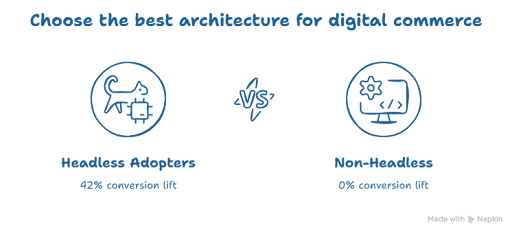
1. Composable and headless commerce architecture is now a standard evaluation criterion.
73% of businesses currently operate headless architecture, a 14-percentage-point increase since 2021, and approximately 98% of remaining non-adopters plan to evaluate it within 12 months.
Organizations that migrate to headless architecture report a 42% average conversion rate increase, with individual cases reaching gains of up to 100% in competitive verticals. Vendor architecture that cannot accommodate a future headless frontend represents a real constraint on long-term total cost of ownership.
2. AI-driven personalization and search are shifting from differentiator to baseline requirement.
Approximately 90% of surveyed B2B buyers report that AI-enabled features are now standard in the solutions they procure, and organizations combining personalized customer experience with generative AI capability are 1.7 times more likely to grow market share.
Vendor proposals should specify current architectural support for AI-driven recommendation, search, and pricing tooling to avoid a separate integration project within 12–18 months of launch.
FAQs
Custom ecommerce development cost ranges from $15,000 for small-scale projects to $750,000+ for enterprise B2B implementations, with mid-market builds typically ranging from $80,000 to $250,000 depending on integration depth and catalog complexity.
Generally not, unless pricing logic or catalog complexity already exceeds native platform capability. Most small businesses are better served by platform customization until those thresholds are reached.
SMB-tier custom projects typically require 6–10 weeks. Mid-market builds require 3–6 months. Enterprise or headless implementations with deep ERP integration typically require 6–12 months or longer.
Platform implementations apply configuration and app-layer extension within fixed commerce architecture. Custom development involves bespoke backend logic, engineered system integrations, and pricing/checkout systems built to specification rather than platform constraints.

Head of SEO Operations
Recent Blogs

Elia Martell
How Much Does Custom Software Development Really Cost in the US?
-
06 Oct 2026
-
12 Min
-

20

Elia Martell
The Business Value of Investing in Custom Mobile Applications
-
30 Sep 2026
-
6 Min
-
95

Elia Martell
How to Build a Compliant iGaming Platform: A Dev blueprint for software agencies and startups
-
29 Sep 2026
-
9 Min
-
192
