


How to Build a Compliant iGaming Platform: A Dev blueprint for software agencies and startups
-
Last Updated:

29 Sep 2026
-
Read Time:

9 Min Read
-
Written By:
 Elia Martell
-
283
Table of Contents
Most iGaming builds break at compliance. See how software agencies and startups can design a compliant iGaming platform that scales to new markets.
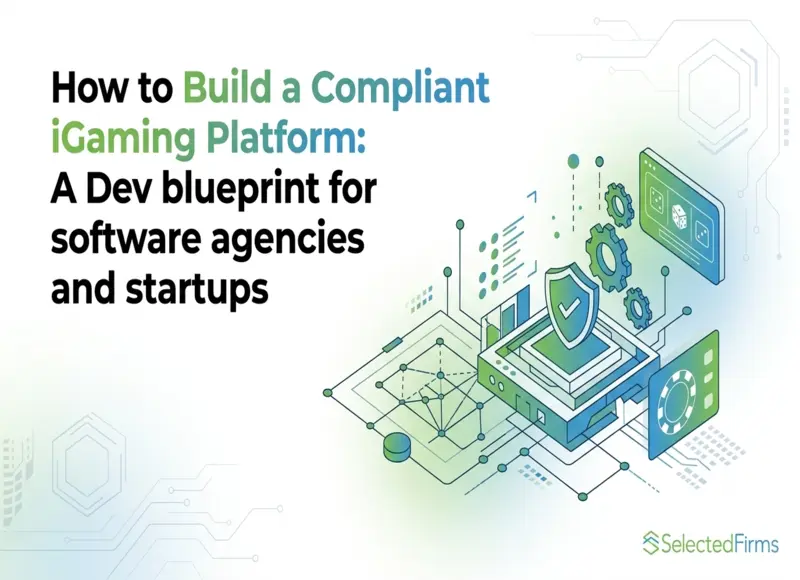
An iGaming platform usually starts as a product idea: a clean interface, fast registration, smooth payments, stable games, good retention, and an admin panel that lets the team manage everything without drowning in tickets.
Then the legal and compliance questions arrive, and the project suddenly looks very different. The platform is no longer just a website or app.
It becomes a regulated system that has to prove who users are, where they are, how money moves, what the operator must report, what the admin team can change, and what gets recorded when something goes wrong.
For software agencies, this stage is where many projects become expensive. The client asks for speed, but the product needs rules.
The design team wants a short onboarding flow, but compliance needs age checks, identity verification, applicable location controls, player limits, transaction history, and audit logs.
The development team can build almost anything, but if licensing requirements are considered too late, the same team may have to rebuild core flows after launch.
Start with licensing before the first feature sprint
A software agency does not need to act as the client's law firm, but it does need to understand that licensing affects the product. Early research into gaming licenses helps define what the platform must support before developers lock the architecture.
Depending on the jurisdiction, the requirements can influence onboarding, payments, reporting, responsible-use tools, advertising controls, data retention, technical testing and certification, and even the structure of the admin panel.
The agency should translate the client's regulatory requirements into technical requirements, while the operator and its legal or compliance advisers remain responsible for determining which rules and licenses apply.
That means discovery should go deeper than colors, screens, and launch dates.
The agency should ask where the platform will operate, which user groups it will serve, whether it is B2C, B2B, or both, what payment methods are planned, and whether the business expects to expand into more jurisdictions later.
A platform built for one market can be simpler. A platform built for expansion needs flexible rules.
Hardcoding everything for the first launch may feel faster, but it often creates trouble when the client adds another gaming license, payment provider, or reporting duty.
Compliance should feel like product logic, not paperwork
The best compliance features are the ones users barely notice because they sit naturally inside the product. Age checks happen during onboarding. Where required, location controls run before restricted access appears.
Payment checks happen before withdrawal delays become support problems. Limits are visible in the account area. Admin actions are logged in the background.
This is product logic, not decoration.
A weak build treats compliance as a folder of PDFs outside the platform. A stronger build turns those requirements into flows, permissions, alerts, and records.
That helps the operator, but it also helps the user. Clear steps create less confusion, fewer failed payments, and fewer manual reviews.
|
Platform area |
What the agency should build in early |
Why it matters |
|
Onboarding |
Age, identity, applicable location, and account checks |
Prevents unsupported users from entering the wrong flow |
|
AML and KYC |
Sanctions and PEP screening, source-of-funds checks, transaction monitoring, and suspicious activity workflows |
Reduces license and banking risk |
|
Game integrity |
RNG and RTP configuration, version control for game builds, and support for independent lab testing |
Avoids failed certification and launch delays |
|
Responsible gambling |
Deposit limits, cooling-off periods, self-exclusion, and reality checks, with national register integration where required |
Protects users and meets operator duties |
|
Payments |
Deposit, withdrawal, refund, and review records, with PCI DSS scope and player fund handling defined |
Gives finance and compliance teams a clean trail |
|
Admin panel |
Role-based access and action history |
Reduces internal mistakes and misuse |
|
Risk rules |
Alerts for unusual account or transaction behavior |
Helps the team react before small issues grow |
|
Reporting |
Exportable data by market, user status, and period |
Makes audits and partner reviews easier |
|
Data protection |
Retention rules and data residency by market, aligned with GDPR or local equivalents |
Avoids conflicts between jurisdictions |
|
Security |
MFA, encryption, session control, and monitoring |
Protects sensitive data and internal tools |
Build for the staff who will run the platform
Many iGaming builds focus too much on the front end and too little on the people who will operate the business every day.
A good-looking user interface matters, but the admin team also needs tools that are clear, safe, and difficult to misuse.
Support staff should see only the information they need. Payment staff should not need developer help to understand a withdrawal problem.
Compliance staff should be able to review account activity, risk flags, documents, limits, and previous decisions in one place. Managers should know who changed what, when it happened, and why.
This is where audit logs become a real product feature. A serious platform should record admin actions, user status changes, payment decisions, document reviews, limit changes, and security events.
Good engineering practice also points to a few recommended controls. Make logs searchable, readable, tamper-evident, and time-synced. Keep them for the period each jurisdiction requires.
If every internal review requires a custom database query, the platform is not ready for regulated operations.
The agency discovery checklist
Before writing production code, the agency should slow down long enough to ask practical questions. These answers will save time later.
- Which jurisdictions are planned for the first launch?
- Will the platform serve users directly, other operators, or both?
- What identity, age, and AML screening checks are required before account activation?
- Which payment methods, currencies, and withdrawal rules are planned?
- What limits, exclusions, and responsible-use settings should users control, and does any market require a national self-exclusion register?
- Who can access the admin panel, and what can each role change?
- What reports will compliance, finance, and management need every month?
- What data must be kept, and for how long in each target jurisdiction, given GDPR or local data protection rules?
- Which third-party tools will handle verification, payments, games, analytics, or support?
- How will the platform add another market without a rebuild?
Payments are where weak architecture shows first
Payment flows expose rushed platform design quickly. Deposits, failed payments, withdrawals, refunds, chargebacks, manual reviews, account ownership, and transaction limits all create operational pressure.
If the system cannot connect payment activity to user status, risk rules, and support history, the team ends up solving problems in spreadsheets and chat messages.
Payment architecture should be connected to verification status, market rules, fraud checks, AML monitoring, and clear approval paths.
A withdrawal should not become a mystery. Staff should be able to see why it is pending, what rule triggered review, who touched it, and what action happens next.
Card handling also brings PCI DSS scope into the design. Your scope depends on the payment setup and the systems that touch card data.
Depending on the jurisdiction and licence, player funds may need to be segregated from operating funds. Decide both early.
For startups, clean payment records also help with banks and payment providers. Partners want to know that the platform can explain activity, handle disputes, and monitor unusual behavior.
A polished front end will not compensate for messy financial operations behind it.
Building custom game titles instead of licensing them? Then the game client and its supporting systems become part of the compliance and testing scope. Game outcomes should be controlled by an appropriately secured and auditable authoritative system. Game versions should remain traceable for required testing and audit purposes. Where practical, manage market-specific settings through configuration instead of separate code forks. Before you commit, vet game developers for relevant certification, testing, and backend integration experience.
Security cannot wait until launch week
Security should be planned while the platform is still being designed. iGaming systems handle identity data, account data, payment activity, staff decisions, and commercial records.
That makes basic access control too weak on its own.
A practical security setup should include strong authentication for admin and back-office access, with MFA where required or appropriate. Add role-based permissions, encrypted sensitive data, protected API endpoints, secure session handling, logging, monitoring, and a clear process for removing access when staff or contractors leave.
The most common problems are ordinary ones: shared admin logins, too many permissions, exports sent through email, old contractor accounts, missing logs, and support agents seeing more data than they need.
These are not glamorous failures, but they are exactly the kind that create real damage.
Design the first version so the second market is possible
Many startups launch in one jurisdiction and plan to expand later. That plan should influence the first build.
The platform does not need every future feature on day one, but it should not lock every rule inside custom code written for a single market.
A better structure uses configurable market settings. Onboarding rules, payment limits, reporting fields, responsible-use tools, content access, language settings, data retention rules, and admin permissions can then change by jurisdiction without tearing apart the platform.
This matters for agencies because it protects the relationship with the client. A system that can grow makes the agency look careful and experienced.
A system that breaks when the client expands makes the original build look cheaper than it really was.
A compliant platform should still feel good to use
Compliance does not have to ruin the product. In fact, a well-built platform often feels better because the rules are clear.
Users know what documents are needed. Payment steps are understandable. Limits are easy to find. Support can answer questions with context. The account area does not feel like a maze.
The mistake is hiding compliance until it interrupts the user at the worst possible moment.
A better product explains requirements early, collects data only when needed, and avoids forcing users through the same checks repeatedly.
For developers and product managers, the challenge is balance. The platform has to be fast enough to feel modern, built to satisfy applicable regulatory and operating requirements, and flexible enough to change when the business enters a new market.
The blueprint for 2026
A compliant iGaming platform in 2026 needs more than clean code and attractive screens.
It needs licensing-aware planning, user verification, AML monitoring, game integrity controls, responsible gambling tools, payment controls, data protection, reporting, audit logs, staff permissions, security monitoring, and market-specific configuration.
These pieces should be part of the build from the first planning stage, not added after the legal team reviews the finished product.
For software agencies, the strongest position is to ask better questions early. For startups, the smartest move is to treat compliance as part of the product, not as an obstacle beside it.
When the architecture supports the rules, the business can launch with fewer surprises and expand without rebuilding the same foundation twice.
FAQs
It is a gaming platform built to meet the licensing, verification, payment, reporting, and security rules of its target jurisdictions. The software itself enforces those rules through flows, permissions, and records.
It needs to understand how regulation affects architecture. The operator and its legal advisers decide which rules apply. The agency translates them into technical requirements.
Start with licensing research. The target jurisdiction shapes onboarding, payments, reporting, and data retention, so settle it before the first feature sprint.
Use configurable market settings instead of hardcoded rules. Onboarding, limits, reporting, and permissions should change by jurisdiction without a rebuild.
Audit logs record admin actions, payment decisions, and security events. They give compliance teams clear evidence during audits and partner reviews.

Marketing Manager
Recent Blogs

Elia Martell
5 Virtual Recruiting Support Operations for Tech and Healthcare Teams
-
09 Oct 2026
-
8 Min
-

627


Jane Hart
Why LinkedIn Campaign Optimization Requires More Than CPC and CTR
-
09 Oct 2026
-
8 Min
-
189
Jane Hart
How to Vet an Offshore SEO Partner: A Due-Diligence Checklist for Agencies and Brands
-
08 Oct 2026
-
8 Min
-
323
Jane Hart
Benchmarking GPU Providers: A Practical Guide to Comparing Cloud Compute Options
-
07 Oct 2026
-
6 Min
-
187
