


Table of Contents
A comprehensive buyer’s guide to third-party risk management (TPRM) tools for SaaS teams, covering key features, evaluation criteria, and top platforms to help you automate vendor risk and stay audit-ready.Select 68 more words to run Humanizer.
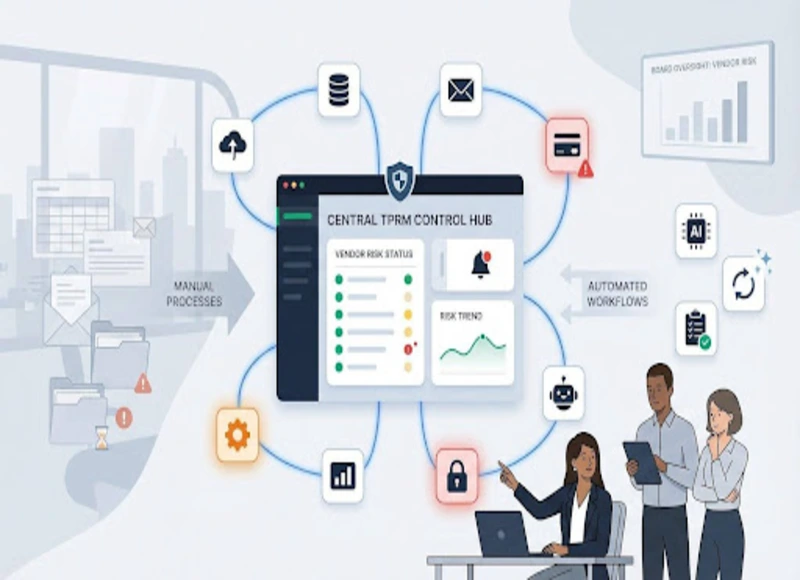
A single weak link can topple even the most secure stack. According to Verizon’s 2025 Data Breach Investigations Report, third-party involvement in breaches doubled year-over-year and now drives roughly 30 percent of all incidents. That spike has pushed vendor security from a checkbox to a board-level priority.
Research from top TPRM tools shows 57 per cent of companies cut at least one supplier for security lapses in 2026. When a partner slips, you pay.
Most fast-growing SaaS firms still juggle vendor questionnaires in spreadsheets and email threads. The process drags, data goes stale, and audits stall. Teams are turning to purpose-built third-party risk management (TPRM) platforms that automate reviews, surface live alerts, and keep auditors happy.
In this guide, we’ll show you how the leading tools work, what sets them apart, and which options fit companies from scrappy start-ups to global enterprises. First, let’s unpack why the pressure is rising—and what “good” vendor risk management must deliver in 2026.
Why third-party risk demands your attention today.
Customers love the speed of SaaS. Regulators, attackers, and auditors notice that speed too because every integration creates a new opening. When a vendor slips, your data, uptime, and brand take the hit.
Supply-chain attacks keep piling up. High-profile exploits like SolarWinds and the 2023 MOVEit breach proved that even security-mature companies can be blindsided when a supplier’s code goes rogue. Verizon’s most recent breach report shows the same pattern: vendor incidents now account for one in three cases.
The legal stakes climbed quickly. In the United States, the SEC’s cybersecurity disclosure rules require public companies to report material breaches and document a board-level plan for vendor risk. Across the Atlantic, Europe’s DORA framework sets a similar bar for financial services. Miss the mark and fines follow.
Lost deals hurt even more than fines. Enterprise buyers embed 100-question vendor surveys in every contract. Fall short and the sale stalls.
Mid-market SaaS teams feel the squeeze hardest. They juggle hundreds of cloud tools but lack Fortune 500 headcount. Manual spreadsheets cannot keep pace. Reviews drag for weeks, then sit untouched while a vendor’s posture changes overnight.
Automation, continuous monitoring, and airtight evidence trails are now table stakes. The right TPRM platform turns a chore into an advantage: faster onboarding, cleaner audits, and fewer 3 a.m. breach alerts. With the urgency established, let’s see how we evaluated the tools that promise to solve it.
How we compared the leading platforms.
Choosing a TPRM tool is not guesswork. We built a scoring model that mirrors the pressures SaaS teams face: lean headcount, strict auditors, and zero tolerance for surprises. We awarded points across seven weighted criteria.
First, we value automation and AI above all. If the software fails to slash manual work—auto-scoring questionnaires, summarizing SOC 2 reports, pushing tickets to Jira—it misses the point.
Next comes continuous monitoring. Annual surveys feel safe until a vendor appears in a breach feed two weeks later. We looked for live security ratings and instant alerts.
Third, framework coverage. A strong tool maps vendor answers to SOC 2, ISO 27001, HIPAA, and newer mandates like DORA without extra spreadsheets.
Ease matters too. Integrations and usability counted for 15 percent. Busy teams need Slack pings, API hooks, and dashboards that make sense at a glance.
We also weighed scalability and flexibility—can the platform grow from ten vendors to a thousand without chaos?
Cost transparency counts, so pricing and segment fit earned its own slice. SMB-friendly tiers scored higher than “call for quote.”
Finally, we credited tools that offer a vendor security network. Reusing a supplier’s existing profile saves everyone days of back-and-forth.
With the rubric in place, we ranked five standout platforms. Now let’s meet the contenders, starting with the option built for growing SaaS teams.
1. Vanta: unified compliance + vendor risk for fast-growing teams
Vanta is a trust platform that brings third-party risk management (TPRM) into the same system you use for GRC and audit readiness. Teams that adopt Vanta third-party risk management report cutting vendor security review time by up to 50 percent, a major win if you already track SOC 2 or ISO 27001 controls and need a repeatable way to assess vendors without adding another point solution.
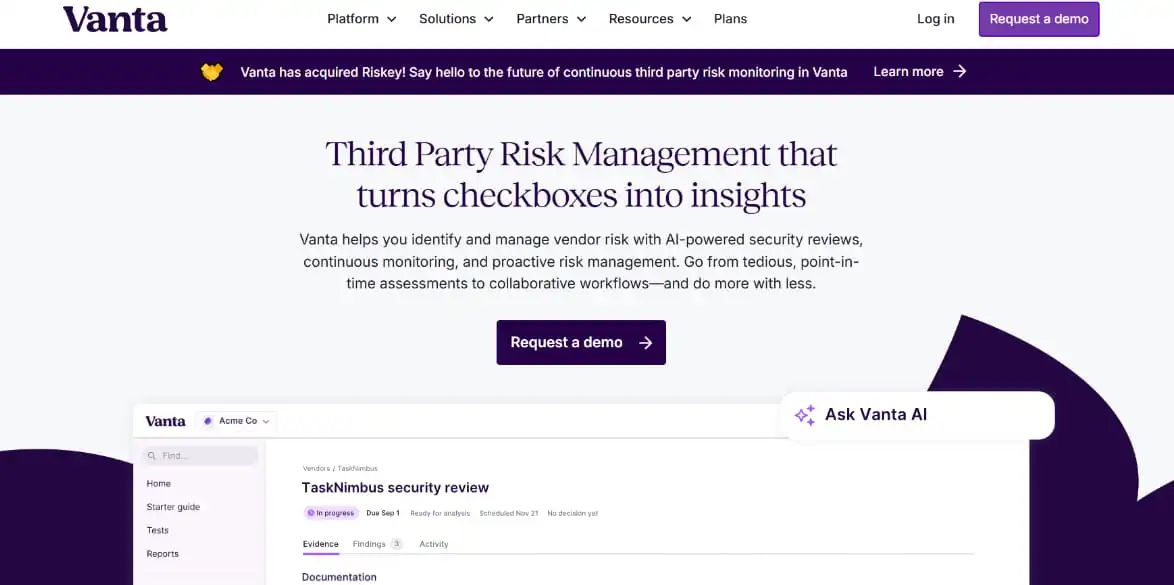
Where Vanta stands out is automation across the full workflow. You can discover vendors automatically (including shadow IT) through SSO, MDM, and browser-based signals, then run AI-powered security reviews that analyze vendor documents like SOC 2 reports and ISO certificates and pull out risk findings. Those findings can tie back to a central risk register, so vendor risk does not live in a separate spreadsheet.
Vanta is a strong fit for:
- SaaS security and compliance teams (often 1–5 people) juggling audits and vendor reviews at the same time
- Organizations that want one platform for compliance frameworks plus vendor assessments
- Teams that need to reduce review cycle time without giving up audit-quality evidence trails
Vendor onboarding and intake
Auto-discovery helps surface untracked vendors, and customizable intake forms let you route reviews earlier in procurement.
Assessments and evidence review
Trust Center and Private Links support exchanging security information, and AI-powered security reviews can extract and summarize findings from uploaded vendor documentation.
Continuous monitoring that you can tune
After acquiring Riskey, Vanta offers built-in third-party risk scoring and continuous monitoring. “Intelligent alerting” lets you set rules, for example only alerting on critical issues for high-inherent-risk vendors, which helps reduce noise.
AI and workflow automation
Vanta AI Agent supports tasks like searching across controls and documents, checking evidence, generating or importing policies, tracking SLAs, and mapping controls to policies. For inbound security questionnaires, QAuto can automate responses with up to ~95% accuracy.As AI-driven workflows become more common in security and compliance, understanding how AI detectors work is increasingly important for evaluating the accuracy and reliability of automated assessments.
Framework coverage
35+ pre-built frameworks, with cross-mapping so work completed for one framework accelerates others.For teams looking to standardize knowledge and learn anything efficiently, structured resources like study systems and documentation frameworks can significantly improve how security practices are adopted across the organization.
Integrations and audit operations
375+ integrations, automated compliance tests running hourly, and integrations into tools like Slack and Jira so issues and reminders land where your team already works.
Pricing and packaging
Vanta offers tiered plans (Essentials, Plus, Professional, Enterprise) with VRM/TPRM available as an add-on. Pricing is published on its website, although per-vendor pricing is not disclosed publicly and typically requires a demo. AI-powered security reviews are also positioned as an add-on.
Limitations to understand up front
- Vanta does not position a single, native outside-in security rating grade (like an A–F or 0–900 score). External monitoring signals come through its Riskey-based monitoring capabilities rather than a standalone “scorecard” product.
- It does not include a managed assessment service where analysts chase vendors for you. If you want the tool vendor to run the outreach and collection process, you will need a provider that offers managed services.
- Reporting depth improves in higher tiers (Professional and above), but teams that want highly customized, board-ready templates out of the box may still compare reporting carefully during a pilot.
2. OneTrust: the enterprise command center for vendor risk
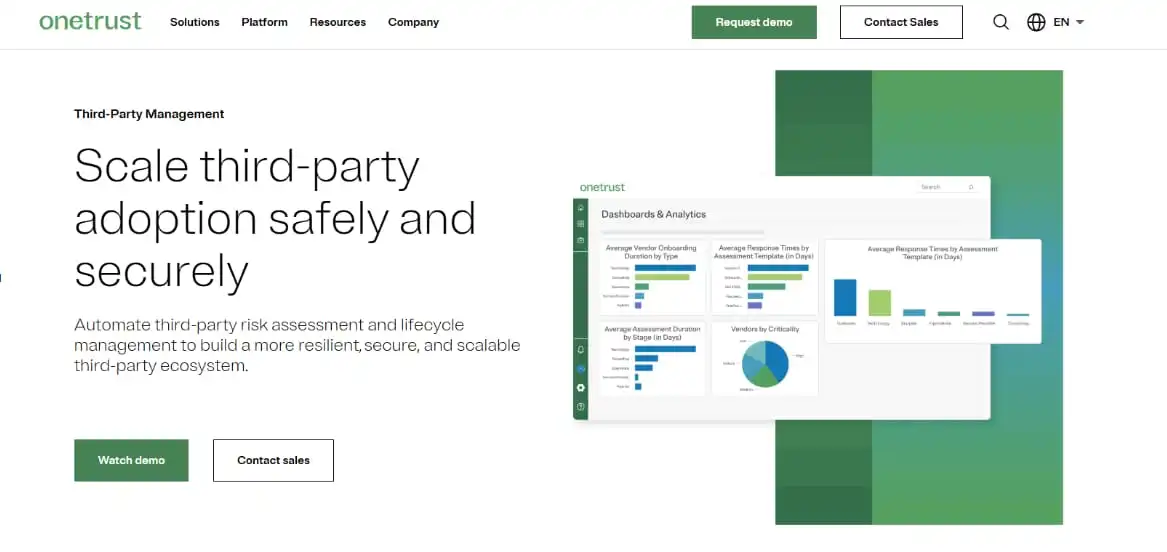
OneTrust is built for organizations where vendor risk is not owned by one team. If legal, privacy, security, and compliance all need to weigh in, OneTrust’s strength is breadth. Its Vendorpedia module sits inside a larger platform that spans privacy, GRC, and third-party risk, which is why it shows up most often in complex, highly regulated environments.
OneTrust is a strong fit for:
- Large enterprises with dedicated legal and privacy teams, plus separate security and compliance functions
- Organizations managing multiple subsidiaries, geographies, and overlapping regulatory obligations
- Teams that need deep workflow configuration and role-based routing across stakeholders
What it does well for TPRM
Vendorpedia gives you a central vendor record with structured onboarding workflows and customizable intake forms. From there, OneTrust supports a wide library of pre-built questionnaires, including common standards and formats like GDPR, ISO 27001, SIG, and CAIQ, plus custom templates when your process is unique.
Continuous monitoring and external signals
OneTrust can pull in ongoing risk signals, but it typically does this through integrations with external security ratings providers like BitSight and SecurityScorecard, rather than through a native monitoring engine. In practice, that often means additional vendor contracts and added program cost if continuous monitoring is a must-have for your team.
Compliance coverage and reporting
Because OneTrust spans privacy and GRC, it supports broad multi-framework needs and can roll up reporting across business units. For executives and auditors, its dashboards, heat maps, and evidence trails are designed for board-level visibility and regulatory defensibility.
Integrations and ecosystem
OneTrust integrates with major enterprise systems and rating providers and offers API access. The ecosystem tends to be oriented toward enterprise governance and legal or procurement workflows, more than deep DevOps and cloud evidence automation.
Pricing and implementation realities
OneTrust pricing is custom and not published. Contracts are typically six figures annually, and implementation services are often a separate line item. The same depth that makes OneTrust powerful can also make it slow to stand up. Many teams should expect a months-long implementation and ongoing administrative overhead.
Key limitations to weigh
- High complexity and longer time-to-value, especially for lean SaaS teams that primarily want vendor security reviews
- Continuous monitoring usually requires separate third-party ratings subscriptions
- The platform’s privacy-first breadth can feel like extra surface area if your core problem is vendor security risk, not a unified privacy plus GRC program
3. UpGuard: outside-in vendor monitoring with strong executive reporting
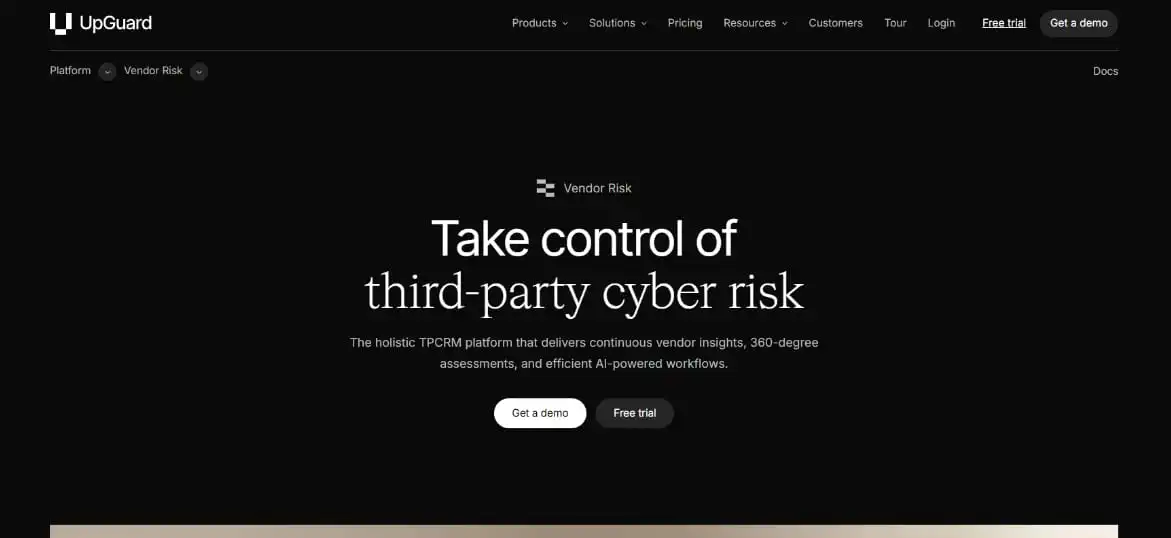
UpGuard is built for teams that want fast, continuous visibility into supplier security posture, without adopting a full GRC suite. It focuses on outside-in monitoring, assigns vendors a proprietary security rating, and updates those ratings multiple times per day so you can spot posture changes quickly and prioritize follow-up.
UpGuard is a strong fit for:
- Mid-market and enterprise security teams that prioritize continuous vendor monitoring over audit automation
- Organizations that already run SOC 2 or ISO work in a separate compliance tool, and want a dedicated TPRM layer
- Teams that need board-ready reporting to summarize vendor risk without building custom dashboards
What you get
UpGuard’s core value is continuous monitoring. It evaluates vendors across categories like website security, IP and domain reputation, encryption, vulnerability management, network and email security, data leakage, DNS health, and brand reputation. You also get a 12-month historical trend view, plus alerts when scores change or new issues are detected.
When you need more than a rating, UpGuard supports deeper assessments. You can run quick automated scans, or move into more structured workflows that combine scans, questionnaires, and evidence collection. It includes 25+ pre-built questionnaire templates and supports custom questionnaires, plus an AI-powered Vendor Security Profile that analyzes submitted evidence and evaluates controls against ISO 27001 and NIST CSF. UpGuard also offers 4th party risk visibility, which helps you understand downstream dependencies beyond your direct supplier list.
Operational visibility
UpGuard keeps remediation visible. It includes in-platform remediation request tracking and a remediation planner, which can reduce the “we found it, now what?” gap that slows many vendor reviews.
AI, integrations, and workflow fit
AI shows up in the assessment experience through Vendor Security Profiles, AI-assisted evidence analysis, and AI auto-fill for questionnaires. On the integration side, UpGuard provides API access and SSO across all tiers, and supports common workflows through integrations like Slack and Jira. Its integration ecosystem is designed to complement an existing stack, not replace it.
Pricing
UpGuard publishes pricing. The Standard plan is $1,750 per month billed annually and includes monitoring for 50 vendors, with additional vendors priced at $79 per month. Higher tiers (Professional, Corporate, Enterprise) move to contact-sales pricing and increase vendor limits.
Key limitations to weigh
- UpGuard is not a GRC or compliance automation platform. If your program depends on SOC 2, HIPAA, PCI DSS, or broader framework workflows, you will likely need a separate solution.
- Compliance mapping is limited to ISO 27001 and NIST CSF, which can be a real constraint for SaaS teams managing multi-framework requirements.
- Some customers report friction building complex questionnaires, especially when logic gates are needed, and support response times have been cited as slower than expected.
- Trust Exchange, its vendor-sharing workflow, is more basic than a dedicated Trust Center experience, especially if you want deeper buyer-facing workflows.
4. Mitratech: lifecycle TPRM plus managed services for regulated programs
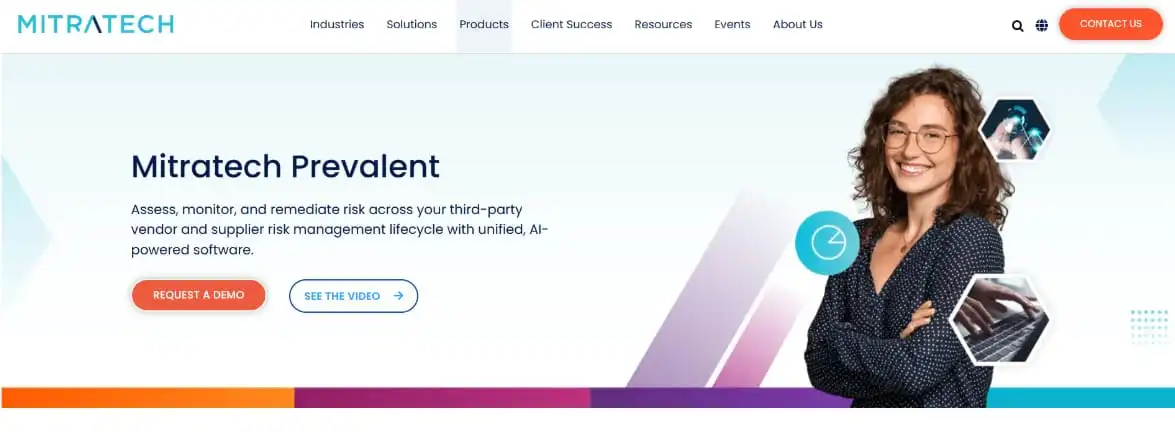
Mitratech is designed for organizations that need a documented, auditable third-party risk program from intake through offboarding. It is not just a questionnaire tool. It is a full lifecycle platform with an important differentiator: the option to offload work to a managed service team. Since being acquired by Mitratech in October 2024, it also sits within a broader legal and compliance portfolio.
Mitratech is a strong fit for:
- Mid-market and enterprise organizations in regulated industries with formal vendor governance requirements
- Teams that need a mature, end-to-end process, including remediation tracking and offboarding workflows
- Security or risk programs that want managed services to supplement limited internal bandwidth
Core capabilities
Mitratech covers vendor lifecycle management end to end, including intake and onboarding, inherent risk scoring using a likelihood × impact model, assessments, remediation workflows, and termination and offboarding. It also supports SLA and performance management with KPI and KRI tracking, which helps when your program is judged on consistency and timeliness, not just whether assessments happened.
A major accelerant is its assessment library. Mitratech offers 800+ pre-built assessment templates, which can reduce the time it takes to stand up a repeatable program across many vendor types and regulatory contexts.
Vendor intelligence and monitoring
Mitratech’s Vendor Intelligence Networks provide on-demand access to pre-completed, standardized risk reports on thousands of companies. That can cut down on back-and-forth when you are assessing common suppliers and need a faster starting point than a brand-new questionnaire.
For continuous monitoring, Mitratech pulls in cyber and business risk signals through integrations, including external rating providers, plus inputs like financial, regulatory, and reputational data. The value is breadth of signal, but the monitoring is not driven by a single native scanning engine.
Automation and AI
Mitratech supports AI-assisted auto-completion of new assessments and provides remediation recommendations for common risk scenarios. It can also summarize and help map evidence, but it is not positioned as offering AI-powered security reviews that analyze full vendor documents end to end.
Integrations
Mitratech integrates with external data sources for monitoring and is noted for CLM (contract lifecycle management) integrations, which can matter if your vendor risk process is tightly coupled to contracting workflows. Its ecosystem is not focused on vendor auto-discovery through SSO or MDM, and discovery typically starts with manual intake.
Pricing
Pricing is custom and not published. Costs typically land in the $30K–$100K+ per year range depending on vendor volume, modules, and whether you add managed services. Managed services can be high leverage for small teams, but they also increase total cost of ownership.
Key limitations to weigh
- No automated vendor discovery, so shadow IT can slip through unless procurement and intake are tightly enforced.
- Not a GRC or compliance automation platform, so you still need a separate solution for SOC 2, ISO 27001, HIPAA, or similar internal compliance programs.
- No AI-powered vendor security reviews that analyze full documents like SOC 2 reports end to end.
- Smaller vendor footprint than some perceived peers (51–200 employees, ~$30–50M revenue), and the Mitratech acquisition adds potential integration and packaging uncertainty as the product evolves.
5. SecurityScorecard: board-friendly ratings for large vendor portfolios
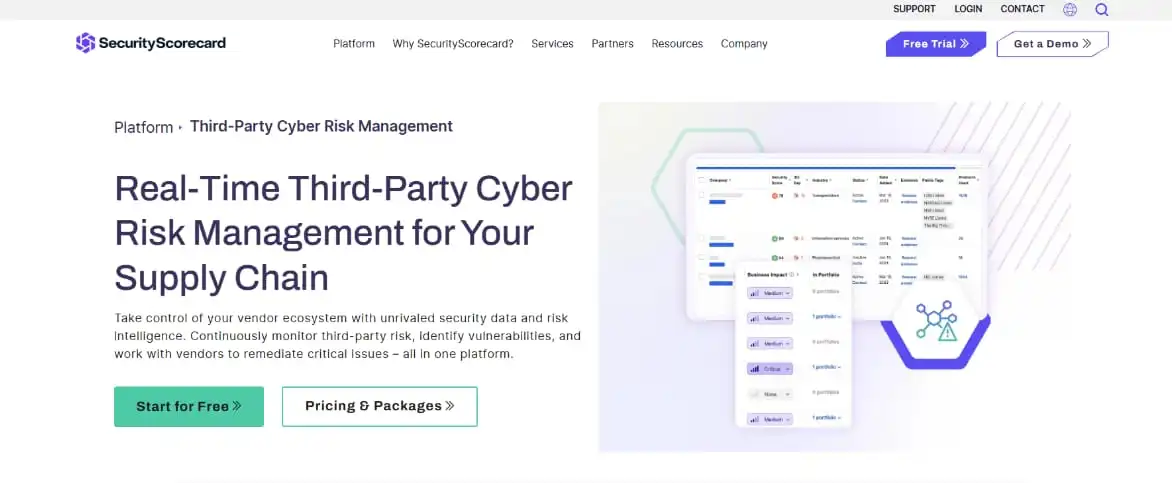
SecurityScorecard is best known for one thing, security ratings. It assigns vendors an easy-to-read A-to-F grade and refreshes scores daily based on what it can observe from the outside. For large organizations managing hundreds or thousands of suppliers, that simple grading model makes it easier to prioritize follow-ups and brief executives without translating raw findings into a narrative.
SecurityScorecard is a strong fit for:
- Enterprise risk and security teams that want an industry-recognized vendor rating to drive prioritization
- Programs that need executive-friendly reporting and portfolio-level visibility
- Teams that plan to pair ratings with deeper assessments, either internally or through managed services
Core TPRM capabilities
SecurityScorecard monitors vendors’ internet-facing assets and scores risk across 10 factors, including network security, DNS health, patching cadence, endpoint security, IP reputation, application security, cubit score, hacker chatter, information leak, and social engineering. On top of ratings, it supports portfolio management so you can group vendors, tier them, and track changes over time.
For active vendor management, modules like Action Plans and Incidents and Breaches support remediation collaboration and real-time breach alerts. Digital Footprint helps identify vendor attack surface visibility, and hierarchy views can help with parent and subsidiary monitoring.
Discovery and onboarding
SecurityScorecard can discover vendor relationships through Automatic Vendor Detection (AVD), but it is an add-on available in Enterprise and MAX tiers, not a default capability. Many teams still start by importing or manually adding vendors and then organizing them into portfolios.
Questionnaires and assessments
Atlas pairs ratings with vendor questionnaires and includes auto-validation that checks for mismatches between what a vendor claims and what the rating data suggests. SecurityScorecard also acquired HyperComply in late 2025 to strengthen questionnaire automation, but as of early 2026, the experience is described as fragmented between legacy Atlas workflows and the newer HyperComply capabilities.
That fragmentation shows up in real-world feedback. One SecurityScorecard customer described the native assessment and questionnaire experience as “not great” and said they did not return after an initial attempt to build a questionnaire. The same customer also said the Trust Center was “not very good.” They also noted uncertainty after the HyperComply acquisition about what the combined platform does and how pricing will work.
Continuous monitoring and what to watch for
SecurityScorecard’s strongest value is continuous, outside-in monitoring. The tradeoff is that outside-in scanning can misrepresent a vendor’s real security posture if the scanned environment is not the same as the vendor’s production platform. For many programs, that means ratings should be treated as a prioritization signal, not the final answer.
AI, integrations, and reporting
SecurityScorecard offers AI and analytics as part of its scoring and threat detection approach, plus automation such as questionnaire auto-validation. It also has an ecosystem of 80+ marketplace partners. Slack and Jira integrations are included in the Business tier, with premium integrations in Enterprise tiers.
Reporting is a consistent strength. The A-to-F format is built for board consumption, and the platform supports summary reporting, trend analysis, and exportable outputs for stakeholders.
Pricing and support
SecurityScorecard offers a Free tier (self-scorecard). Paid tiers include Business (monitor up to 5 vendors) and Enterprise, plus MAX for managed services. Paid pricing is not published and generally requires a custom quote. Cyber Risk Quantification is offered as an add-on across tiers. Support response times differ by tier, with Free listed at 15 days and paid tiers at 2 days.
Key limitations to weigh
- It is a point solution for vendor risk, not a GRC or compliance automation platform for frameworks like SOC 2 or ISO 27001, so most SaaS teams still need a separate compliance system.
- Questionnaire and Trust Center experiences have been criticized by customers, and HyperComply integration is still evolving.
- Outside-in ratings are valuable for triage, but they can over- or under-state risk depending on what infrastructure is visible to scanners.
- Pricing for paid plans is opaque, which can slow down budgeting and procurement.
Conclusion
When one tool consistently feels like it reduces work and increases confidence, the decision gets much easier.The top TPRM platforms do not only check the box in compliance, they accelerate the vendor onboarding and provide visibility while protecting margins by avoiding delays in security approvals. As your SaaS business scales, the choice of a tool must be aligned with the maturity and workflow of the team to turn vendor risk management from a bottleneck into strengths that create competitiveness.
FAQs
Invest when vendor reviews start consuming more hours than your team can spare, or when a delayed assessment puts revenue at risk. For most SaaS firms, that inflection point shows up around 10 to 20 critical suppliers or your first SOC 2 audit, whichever comes first.
No. Ratings show what scanners can observe from the outside. Questionnaires surface policies, incident response plans, and compliance evidence that never appears on the public internet. Use both to get a complete view.
Start with efficiency, not enforcement. Explain that a one-time profile reduces repeated spreadsheets in future deals. If they still push back, accept their existing evidence pack, upload it internally, and set a follow-up once the relationship is established.
Entry-level SaaS options often start in the low five figures per year. Enterprise suites can exceed six figures once you scale to thousands of vendors and add advanced modules. The right comparison is total return, including hours saved and deals protected, not sticker price alone.
Some platforms can flag subprocessors or concentration risk, but none map the entire chain perfectly. For mission-critical dependencies, ask vendors how they identify downstream relationships, and keep a manual backstop for the highest-risk parts of your stack.


Head Of Digital Marketing
Recent Blogs

Elia Martell
5 Virtual Recruiting Support Operations for Tech and Healthcare Teams
-

09 Oct 2026
-

8 Min
-

477
Jane Hart
Why LinkedIn Campaign Optimization Requires More Than CPC and CTR
-
09 Oct 2026
-
8 Min
-
155
Jane Hart
How to Vet an Offshore SEO Partner: A Due-Diligence Checklist for Agencies and Brands
-
08 Oct 2026
-
8 Min
-
263
Jane Hart
Benchmarking GPU Providers: A Practical Guide to Comparing Cloud Compute Options
-
07 Oct 2026
-
6 Min
-
173
