


Table of Contents
React, Angular, and Vue can all build powerful business websites. The right choice depends on what you need from your website today and where you plan to take it next.
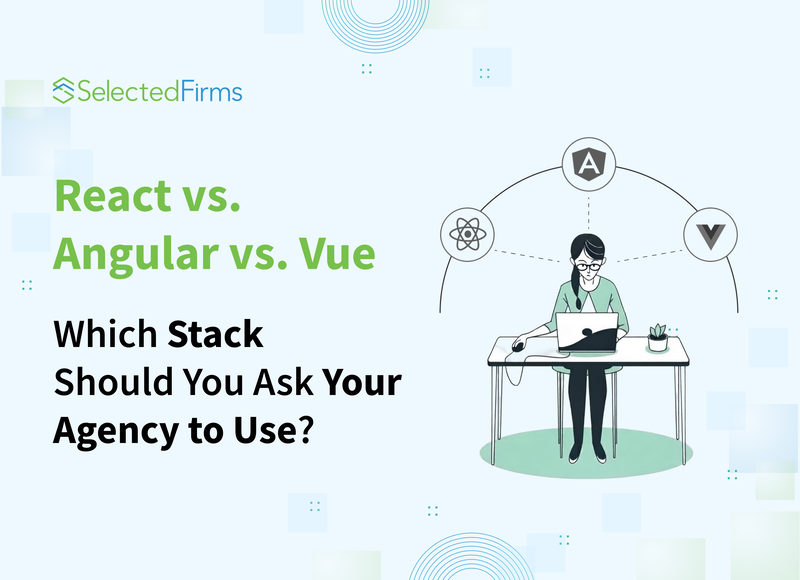
Your developer says React. Another agency recommends Angular. A freelancer tells you Vue will be easier and faster.
Now you have three recommendations and no clear way to judge them.
This is a common problem for business owners hiring a web development agency. The decision gets framed as a technical debate.
The real question is simpler: Which technology fits your website, your team, your budget, and your plans for the next few years?
There is no universal winner.
The bigger decision is who will build and maintain the website. A capable agency can make any of these choices work. A poorly matched agency can turn even a sensible technology decision into a costly problem.
You're Hiring an Agency, Not Just Choosing a Framework
When you hire an agency, you are not simply buying a website.
You are choosing the team that will make decisions about architecture, performance, integrations, security, maintenance, upgrades, and future changes. That makes the technology recommendation part of the vendor evaluation.
Suppose two agencies recommend different frameworks for the same project. That does not automatically mean one of them is wrong.
They may have different experience, development processes, team structures, or assumptions about your future requirements.
This is why React vs. Angular vs. Vue should not be treated as a simple popularity contest.
Ask a better question:
Why does this technology make sense for my particular project?
A good agency should be able to answer that in business terms, not just list technical features. This is where working with a vetted ReactJS development company, rather than a generalist shop, tends to pay off. Specialists have already made these trade-offs on prior projects and can explain their reasoning rather than defaulting to a preferred stack.
React, Angular, and Vue: What's New in 2026?
The technologies themselves continue to evolve, so an agency's knowledge should not stop at the version it used on its last project.
React 19.2 shipped activity, a new API for hiding and restoring UI and internal state, along with partial pre-rendering support and performance tracking tools in browser devtools. React Compiler 1.0 also became stable in October 2025, and the React team reported initial page loads and navigation improving by up to 12%, with some interactions running over 2.5 times faster and no added memory cost.
|
Technology |
2026 position |
What businesses should know |
|
React |
19.2 line |
Flexible ecosystem with extensive tooling and framework options |
|
Angular |
Current enterprise-focused releases |
Structured approach suited to large applications and teams |
|
Vue |
3.5 line |
Lightweight and approachable option for many web projects |
The exact version is less important than whether your agency actively maintains and upgrades the projects it builds.
That makes version currency a fair question during vendor discussions:
Which version will you use, and why?
Which Frontend Framework Is Right for Your Business Website?
The three options can all support modern websites and applications. Their strengths become clearer when you look at the type of team and project involved.
React for Flexible Web Development
React gives development teams considerable freedom in how they structure an application. That flexibility is useful when a website needs custom functionality, third-party integrations, complex interfaces, or room for future expansion.
Its ecosystem is also a major advantage. Developers can choose supporting tools based on the project's requirements instead of working within one rigid structure.
The trade-off is that flexibility puts more responsibility on the development team.
Two agencies can build very different React applications. One may create a clean, maintainable system. Another may introduce unnecessary libraries and complexity.
That makes agency experience especially important when you choose this route.
Angular for Structured Enterprise Applications
Angular takes a more structured approach.
It provides many of the conventions and tools teams need to build large applications within one broader framework. That can make it attractive when multiple developers need to work consistently across a complex codebase.
This structure can be valuable for enterprise applications, internal systems, dashboards, and products with substantial business logic.
The downside is that it can be more than a small website needs.
If an agency recommends it for a simple brochure site, ask why.
Vue for Simpler, Faster Development
Vue is known for being approachable and progressively adoptable. Teams can use it for smaller interfaces or expand its role as the application becomes more sophisticated.
That can make it attractive for businesses that want a straightforward development experience without committing to a heavier structure at the beginning.
The main consideration is the available talent pool in your target market.
A framework can be technically suitable but still become difficult to maintain if finding experienced developers later is challenging.
What Actually Changes for Your Business?
Technical comparisons are useful only when they affect something you care about.
|
Factor |
React |
Angular |
Vue |
|
Learning curve |
Moderate |
Higher |
Generally easier |
|
Flexibility |
High |
More structured |
High |
|
Best suited for |
Custom and evolving products |
Complex enterprise applications |
Lean and adaptable projects |
|
Team requirements |
Flexible |
Works well with larger structured teams |
Often approachable for smaller teams |
|
Hiring availability |
Broad |
Broad |
Comparatively smaller |
|
SSR options |
Strong through frameworks such as Next.js |
Available |
Strong through Nuxt |
|
Governance |
Depends heavily on team |
Strong conventions |
Flexible |
|
Long-term consideration |
Ecosystem choice and architecture |
Upgrade planning and team consistency |
Talent availability and project growth |
The table gives you a starting point. It should not replace a project-specific recommendation.
If an agency tells you that one option is always better, ask what evidence supports that claim.
How to Choose the Right Framework for Your Website
The best choice often becomes clearer when you stop asking which framework is best and start asking what the website needs to do.
Imagine four businesses.
A company building a five-page corporate website does not need the same frontend architecture as a company building a complex client portal.
An e-commerce business may care more about page performance, integrations, conversion paths, and content management.
A growing SaaS company may need a frontend that can support increasingly complex dashboards and user workflows.
The project should drive the recommendation.
|
Project type |
Possible fit |
Main consideration |
|
Brochure website |
React or Vue |
Avoid unnecessary complexity |
|
Marketing website with CMS |
React or Vue |
Content flexibility, SEO, performance |
|
Legacy website modernization |
Depends on existing codebase |
Migration strategy matters |
|
E-commerce frontend |
React or Vue |
Performance and commerce integrations |
|
Client portal |
React or Angular |
Application complexity |
|
Enterprise dashboard |
Angular or React |
Structure, scalability, team size |
|
Fast MVP |
Vue or React |
Development speed and future direction |
These are starting points, not fixed rules.
A strong agency should first understand your business requirements and then recommend the technology.
What Real Businesses Can Teach You About Framework Choice
Framework names alone do not explain why a project succeeds.
Large businesses use different technologies because their products, teams, infrastructure, and requirements differ.
React has become widely used for commerce and consumer experiences where teams need flexibility across complex interfaces.
Angular's structured approach can be useful for large applications where consistency across teams matters.
Vue has also been used for large-scale products and modernization projects where development teams need a more approachable frontend environment.
The lesson is not that one technology wins.
The lesson is that implementation quality matters.
Architecture, development practices, testing, hosting, performance optimization, security, and ongoing maintenance all influence the final result.
When an agency shows you a successful project, ask what it actually did.
Do not stop at:
"We built this using React."
Ask:
"What problem did the technology solve, and what results did the project achieve?"
That answer tells you much more about the agency's expertise.
How Your Framework Choice Affects SEO and Website Performance
A fast framework does not automatically create a fast website.
Performance depends on how the application is rendered, how assets are delivered, how images are handled, how much JavaScript reaches the browser, how the backend responds, and how the site is hosted.
The same applies to SEO.
How SSR Supports SEO and Faster Page Experiences
Server-side rendering can send useful HTML to the browser before the full application becomes interactive.
React projects can use frameworks such as Next.js. Vue projects commonly use Nuxt. Angular also provides server-side rendering capabilities.
The important point is that your agency should choose the rendering approach based on your website.
A public marketing website may have very different requirements from a logged-in dashboard.
React 19.2 also introduced partial pre-rendering and additional server-side rendering capabilities, showing how rendering continues to evolve within the ecosystem.
What Makes a Marketing Website Fast and Search Friendly?
Ask your agency how it plans to handle:
- Core Web Vitals
- Image optimization
- JavaScript delivery
- Server response time
- Caching
- Structured content
- Mobile performance
- Internal linking
- Metadata
- Server-side rendering where appropriate
The framework is only one part of that equation.
What Will Your Choice Cost Over Time?
The initial development quote can make one option look cheaper than another.
That is not enough to make the decision.
Your long-term cost can also include developer availability, maintenance, upgrades, testing, infrastructure, third-party tools, and future changes.
-
Developer Availability Affects the Bill
A technology with a large talent pool can give you more options when hiring or changing vendors.
That does not mean you should automatically choose the most popular option.
A smaller but highly capable specialist team may be a better fit for your project than a large agency with shallow experience.
Look at the agency's actual team rather than relying on the popularity of the technology.
-
Build Cost Isn't the Whole Cost
A lower initial quote can hide a higher total cost.
The number on the proposal is not the full price. It is the price of writing the code.
Ask what the quote actually includes.
- Testing
- Documentation
- Deployment
- Post-launch support
- Security updates
- Bug fixes
- Framework upgrades
Two proposals can list the same price and mean completely different things.
One agency builds the price of ownership into the quote. The other builds only the price of delivery.
You will not see the difference on the invoice. You will see it six months later, when one of those line items turns out not to be included.
-
Why a Cheap Build Can Become Expensive Later
Technical debt rarely appears on the first invoice.
It appears later when a small change takes weeks, a new developer struggles to understand the code, or a business discovers that its original agency is the only team capable of maintaining the system.
The cheapest proposal is not always the lowest cost option.
When Your Agency Is Overengineering the Website
A sophisticated technology stack is not automatically a better one.
Watch for these warning signs:
- The agency recommends a complex architecture without explaining why you need it.
- The proposed technology does not match the size of your website.
- The team cannot explain the business benefit of its recommendation.
- Multiple tools are being added before your requirements are understood.
- The agency relies on its preferred technology for every project.
- Nobody discusses maintenance or future ownership.
- The proposal focuses heavily on technical features but barely mentions business outcomes.
A five-page website does not need enterprise architecture simply because an agency has enterprise developers.
Good technical decisions should solve real problems.
Not sure whether your current proposal fits your project? Compare it against reviewed agencies on a web development directory before you sign anything. It takes a few minutes to check team size, technology expertise, and past project scope against what you have been quoted.
Can You Switch Agencies Without Rebuilding Your Website?
This is one of the questions businesses often ask too late.
You may be happy with your development partner today. Five years from now, you may need a different team because your requirements have changed, costs have increased, or the agency no longer supports your needs.
Your technology choice should not lock you into a single vendor.
Why Code Ownership Matters When Hiring an Agency
Make sure your contract clearly explains who owns the source code, designs, documentation, infrastructure accounts, databases, and other project assets.
Do not assume ownership is obvious.
Ask before development begins.
Why Documentation Matters for Agency Handover
A new agency should not need to reverse engineer your entire website.
Request documentation covering the architecture, deployment process, integrations, environments, credentials management, dependencies, and important business logic.
Good documentation reduces the risk of a painful transition.
Keep Your Options Open for the Next Vendor
Ask yourself one simple question:
Could another qualified agency take over this project if necessary?
If the answer is no, find out why.
The problem may not be the framework. It may be poor documentation, proprietary processes, unclear ownership, or an overly dependent relationship with the current vendor.
8 Questions to Ask Before Choosing a Development Agency
Take these questions into your next agency call.
- Why are you recommending this technology for my project?
- How many developers on your team actively work with it?
- Can you show me comparable projects built with it?
- What are the limitations of your recommendation?
- How will you handle SEO and performance?
- What is your plan for upgrades after launch?
- What happens if I change development partners?
- Who owns the source code, documentation, and infrastructure?
Pay attention to how the agency answers.
A strong team will not be defensive about limitations. It should be able to explain why its recommendation fits your requirements and where another option might be better.
That is a much stronger sign of technical maturity than simply claiming expertise in multiple technologies.
What to Do After Your Website Goes Live?
The technology decision does not end when the website goes live.
Your agency should also have a plan for keeping the application secure, stable, and compatible with future dependencies.
How Often Will Your Framework Need an Upgrade?
Release schedules differ across technologies. Your agency should monitor major releases, security advisories, dependency changes, and compatibility issues.
You do not need to manage every update yourself.
You do need to know who is responsible for them.
Will You Be Able to Find Developers Later?
Think beyond your current agency.
If your business expands into another market, needs a new feature, or decides to bring development in-house, you may need additional talent.
A technology decision should leave you with reasonable options.
What Happens When Your Website Outgrows the Original Build?
Growth can change the technology requirements.
A marketing site may become a customer portal.
A simple store may become a complex commerce platform.
An MVP may turn into a full SaaS product.
Ask your agency whether the proposed architecture gives you room to grow without forcing a complete rebuild.
How to Find an Agency With the Right Framework Expertise
Choosing the right technology is only half the job.
You also need evidence that the agency recommending it has delivered similar work successfully.
That means looking beyond a technology badge on an agency website.
Review its:
- Relevant portfolio
- Client feedback
- Industry experience
- Team size
- Technology expertise
- Project budgets
- Service capabilities
- Previous work with similar business models
- Post launch support
This is where an agency comparison platform can make the research process easier.
SelectedFirms' web development agency directory lets businesses compare reviewed agencies and filter options based on services and technology expertise. Its listings include information such as reviews, SF Scores, team size, hourly rates, minimum budgets, portfolios, and service capabilities.
For example, its technology listings include dedicated categories for ReactJS Development, AngularJS Development, and VueJS Development, making it possible to start the search based on the technical requirements of your project rather than relying on one agency's recommendation.
The goal is not to choose an agency simply because it claims expertise in your preferred framework.
It is to compare agencies and determine which team has the strongest evidence that it can deliver what your business actually needs.
Why Agency Expertise Matters More Than the Framework
React is a strong option when flexibility, ecosystem depth, and broad hiring availability matter.
Angular can be a better fit when your application needs structure, consistency, and enterprise scale.
Vue can make sense when simplicity, speed, and easier onboarding are important.
None of those statements makes one technology universally better.
The right decision depends on your website, your users, your internal team, your budget, and your plans for the next few years.
More importantly, the agency should be able to explain its recommendation without hiding behind technical language.
Before approving a stack, ask three things:
- Does it fit the project?
- Can the agency prove it has the right experience?
- Could another qualified team maintain it later?
If the answer to all three is yes, you are making a technology decision based on evidence rather than preference.
And that is the kind of decision that is much easier to defend when the website needs to grow.
FAQs
Not necessarily. React is often a good fit when flexibility is important, while Angular is often better suited to structured, complex applications. The better choice depends on the website and the team building it.
There is no fixed winner. Development rates, project complexity, developer availability, architecture, and maintenance requirements can affect the total cost more than the framework itself.
No. Several technologies can support e-commerce. The decision should consider performance, integrations, content management, checkout requirements, scalability, and the agency's experience with your commerce platform.
Ask the agency to explain why the technology fits your requirements. If it cannot connect the recommendation to project complexity, performance, integrations, team needs, or future growth, ask for a second opinion.
You can, but migration can be expensive and disruptive. A better approach is to choose an architecture that supports your expected growth and maintain clear ownership and documentation from the beginning.


Head Of Digital Marketing
Recent Blogs


Jane Hart
Best B2B Review Sites for Finding Trusted Digital Service Agencies
-

26 Oct 2026
-

14 Min
-

41


Elia Martell
5 Virtual Recruiting Support Operations for Tech and Healthcare Teams
-
09 Oct 2026
-
8 Min
-
1047

Jane Hart
Why LinkedIn Campaign Optimization Requires More Than CPC and CTR
-
09 Oct 2026
-
8 Min
-
336
