


Why Healthcare Organisations Need a Private AI Foundation
-
Last Updated:

27 Apr 2026
-
Read Time:

5 Min Read
-
Written By:
 Isha Choksi
-
973
Table of Contents
Healthcare providers are rapidly adopting AI, but without secure infrastructure, patient data is at risk. A private AI foundation ensures compliance, data control, and predictable costs.
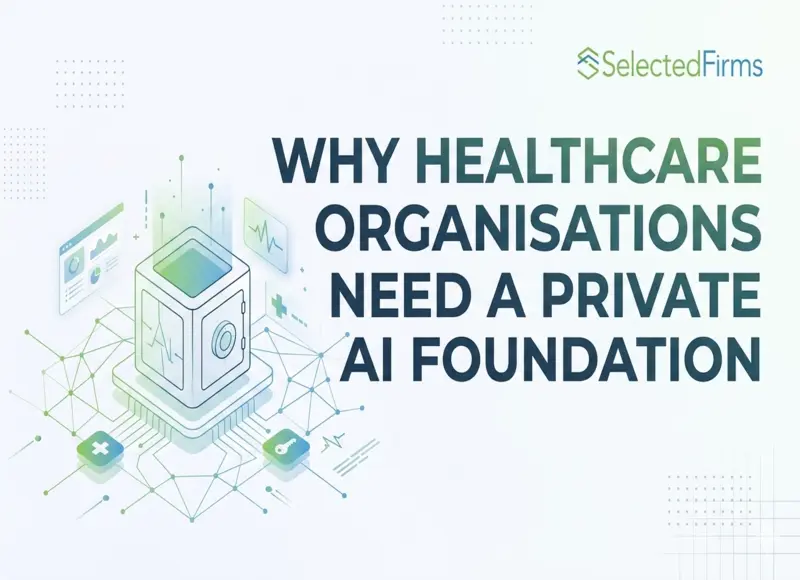
AI adoption in healthcare has moved faster than anyone in compliance anticipated. Generative tools are already in daily use for documentation, triage, patient messaging. Often before anyone has written a governance policy to cover them. For organisations managing protected health information across multiple sites, the question is no longer whether to adopt AI but where it runs. Deploying a private AI foundation gives clinics control over that answer from day one.
Staff are already using AI daily. Most organisations haven't formally approved a single tool. That mismatch won't close with a policy memo. It needs an infrastructure decision.
The Data Control Problem Is Getting Worse
Every time a clinician pastes a patient summary into a public AI tool, that data crosses the organisation's boundary. Gone. It sits on shared infrastructure, gets stored by a third party (even if they say "temporarily"), and there's no telling whether it ends up in someone's training pipeline.
How common is this? More than you'd think. A Wolters Kluwer survey from late 2025 found that over 40% of healthcare workers had encountered unauthorised AI tools at work. Nearly one in five admitted to using one personally. The motivation was rarely carelessness. Half cited faster workflows. A third said approved alternatives simply didn't exist.
For small and mid-sized clinics, this creates a compliance exposure that's hard to quantify and harder to contain. You can't govern data that's already left your systems.
Why Public Cloud AI Doesn't Fully Solve It
Major cloud providers now offer enterprise AI tiers with Business Associate Agreements, SOC 2 certification, and HIPAA-aligned data processing terms. For non-sensitive use cases, these work well enough. Staff scheduling, anonymised analytics, marketing content, training materials. None of these involve PHI, and public AI handles them efficiently.
The calculus shifts when clinical workflows enter the picture. Documentation, referral letters, billing queries tied to patient records, intake triage. These all involve PHI by definition. Every API call to a cloud-hosted model means patient data transiting external infrastructure.
A BAA covers some of the regulatory risk. But it doesn't eliminate the data flow itself. And in a compliance audit or breach investigation, the question "where was this data processed?" becomes considerably harder to answer when the honest response involves a third party's compute environment.
What a Private AI Foundation Actually Provides
Private AI means the model runs inside your own environment. An isolated virtual private cloud under your control, or a dedicated tenant with no shared resources. The patient data never crosses an organisational boundary.
In practical terms, this gives a healthcare organisation four things public cloud AI cannot.
First, full data sovereignty. Nothing leaves your infrastructure. No data transits to an external API. No third-party processing at all. If your clinic operates under HIPAA and GDPR simultaneously, or you're running against the NHS Data Security and Protection Toolkit, you already know how painful cross-border data questions get. Private deployment takes that entire category of compliance headache off the table.
Second, audit control. You own the complete trail. Which model version processed which input, what output it generated, who reviewed it, when. Public AI providers offer their own logs, but those logs live on someone else's infrastructure and may not capture what your compliance team needs.
Third, cost predictability. Public AI pricing is per-token. At low volumes, it barely registers. At scale, thousands of clinical documents per month across multiple locations, the bill compounds fast. Private deployment has a higher upfront cost but a flat operational profile. Some organisations report cost reductions of 10x or more per million tokens after switching to local inference.
Fourth, model control. You choose what runs. You decide which model handles clinical documentation versus administrative tasks. You set guardrails, prompt policies, and output filters without depending on a provider's configuration options. When a model needs updating or replacing, you control the timeline.
The Regulatory Pressure Is Real and Accelerating
In the US, HHS has proposed the first major HIPAA Security Rule update in over twenty years. The draft treats AI-processed patient data, including model inputs, outputs, and training data, as fully within HIPAA scope. The distinction between "required" and "addressable" safeguards is being removed. Civil penalties now exceed $2 million per violation category per year.
At state level, Texas requires written AI disclosure to patients as of January 2026. California, Illinois, and several other states are pursuing similar rules.
In the UK, the MHRA has established a National Commission on clinical AI regulation, tasked with publishing a framework this year. The Sovereign AI Unit launched in April 2026 with £500 million in dedicated funding and an explicit focus on domestic data processing. Meanwhile, 5.5 million patients have exercised the National Data Opt-Out, a signal that tolerance for loose data handling is running thin.
None of this is future-tense speculation. These are regulatory actions already underway.
Who This Matters for Most
Large hospital systems can handle this differently. They have governance committees, deep IT budgets, staff whose entire job is managing vendor relationships and audit trails. That kind of overhead absorbs complexity.
Mid-market clinics cannot. A regional practice group with five to fifteen locations, two hundred staff, and a small IT team faces the same regulatory obligations as a major health system but without the infrastructure. Every hour spent reconciling data processing agreements or responding to compliance queries about third-party AI vendors is an hour not spent on patient care.
For these organisations, a private AI deployment isn't a luxury decision. It's the simplest path to compliance certainty. The data stays local. The audit trail is yours. The cost is predictable. And when regulators come asking questions, the answers are straightforward.
The Infrastructure Choice That Shapes Everything Else
Getting AI governance right in healthcare starts with one architectural decision: where does the data get processed? Everything downstream, compliance posture, cost structure, audit readiness, clinical safety, follows from that answer.
For clinics that take patient data privacy seriously, a private AI foundation for healthcare organizations is what makes the rest of the AI strategy viable. Getting a private AI foundation in place early is what makes the difference. Governance baked in. Cost control from week one. Regulatory alignment that doesn't need to be retrofitted after someone flags an audit finding.
The clinics making real progress in 2026 didn't start by chasing the newest AI tools. They started by answering the infrastructure question. Everything else followed from that.

Head of SEO Operations
Recent Blogs

Elia Martell
5 Virtual Recruiting Support Operations for Tech and Healthcare Teams
-
09 Oct 2026
-
8 Min
-

462

Jane Hart
Why LinkedIn Campaign Optimization Requires More Than CPC and CTR
-
09 Oct 2026
-
8 Min
-
150
Jane Hart
How to Vet an Offshore SEO Partner: A Due-Diligence Checklist for Agencies and Brands
-
08 Oct 2026
-
8 Min
-
249
Jane Hart
Benchmarking GPU Providers: A Practical Guide to Comparing Cloud Compute Options
-
07 Oct 2026
-
6 Min
-
171
