


Table of Contents
Still running a monolithic TMS? Discover how microservices and API-first architecture modernize legacy logistics platforms, enabling scalable, cloud-ready systems that support real-time global operations, faster integrations, and smarter automation across
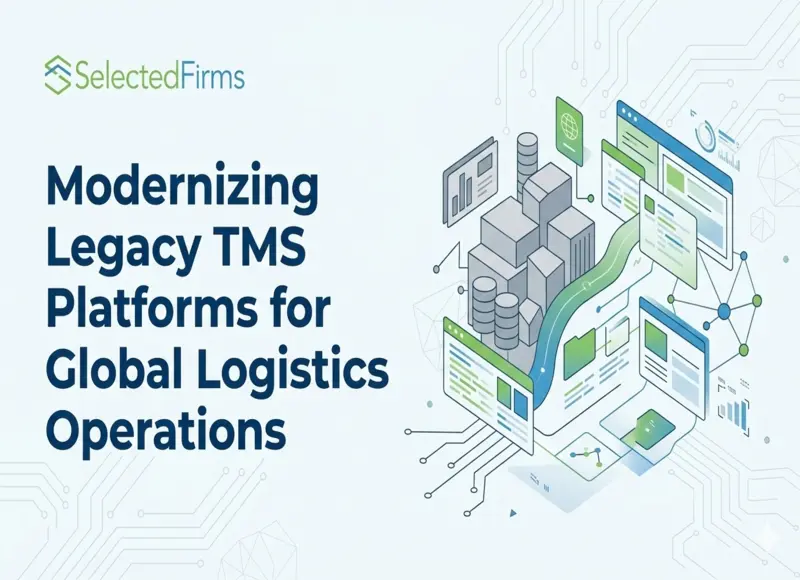
For software architects and engineering leads in the logistics space, the "Status Quo" is no longer just an operational hurdle; it is a critical architectural failure point. Most legacy TMS modernization projects fail because they attempt to "skin the cat" by adding a modern React or Angular frontend onto a 20-year-old monolithic architecture.
When your core business logic is buried in thousands of lines of stored procedures and tightly coupled database triggers, your "modern" UI is just a mask for deep-seated technical debt.
In 2026, transportation management system modernization requires moving beyond simple patches. It demands a shift toward microservices TMS architecture and event-driven design. If your current global logistics TMS relies on a single, massive code base where a change in the "Rate Query" module can unintentionally crash the "Freight Settlement" engine, you are hitting an architectural ceiling.
Real TMS digital transformation isn't about "digitizing" old habits; it’s about refactoring the underlying modern transportation management system frameworks to support high-concurrency, multi-region workloads.
The Shift from "Monolithic Debt" to "API-First Orchestration"
To achieve true logistics software modernization, we must address the "Technical Debt Trap." Historically, these systems were built as a "System of Record," essentially a massive digital filing cabinet. But modern global logistics operations require a "System of Intelligence."
This transition necessitates an API-first TMS strategy where every functional component from carrier selection to real-time logistics tracking is exposed as a discrete, stateless service. This software-centric approach allows for scalable TMS solutions that can handle the "bursty" nature of global trade without requiring a total system reboot.
The Growing Complexity of Global Logistics Operations
Running global logistics operations in 2026 isn't just about moving freight; it’s about managing a massive, unruly firehose of data. Most enterprise logistics platforms were built for a world that was predictable and localized. Today, that world is gone.
Why global carrier networks break monolithic TMS
A monolith expects every carrier to speak the same digital language. But when you’re dealing with a multi-region logistics management setup, your team in Rotterdam might use advanced APIs while a local partner in Southeast Asia still relies on manual entry or old-school EDI. A legacy system tries to force these into one bucket, causing the "Process Bottleneck" that kills your operational efficiency.
Cross-border data exchange complexity
Every country has its own "Red Tape" regarding tax laws, customs documentation, and data residency. In a monolithic environment, trying to hard-code these rules for every new region is a nightmare. You end up with "if-else" statements that are miles long, making your international logistics software impossible to update without breaking the core engine.
Why Legacy TMS Platforms Struggle in Global Environments
The fundamental issue is that a legacy logistics system modernization project usually uncovers a "Rigid Logic" problem. Older systems were designed as a "System of Record," essentially a digital filing cabinet. But modern trade demands a "System of Intelligence."
When you try to run a global logistics TMS on a legacy stack, you face the "Global Latency Tax." If your central server is in New York, your team in Singapore is going to deal with agonizing lag every time they query a rate.
Without a cloud-based TMS that supports distributed data, your international logistics software becomes a frustration point rather than a tool for growth. This is the primary driver for logistics software modernization.
Why Legacy TMS Patching Is Failing Modern Logistics?
Many CTOs fall into the trap of thinking they can "API-enable" a 20-year-old monolith by simply wrapping it in a REST layer. While this might look like transportation management system modernization on paper, the underlying architecture remains a "Big Ball of Mud."
In a legacy logistics system modernization context, patching a monolith usually leads to tight coupling, where changes in the carrier contract logic ripple through to the billing engine, causing regression errors that are a nightmare to debug.
This is where logistics software modernization becomes a requirement for survival. When you are forced to scale the entire monolithic stack just to handle a surge in TMS for freight management queries in one specific region, you are wasting cloud resources and ballooning your infrastructure costs.
A modern transportation management system must be built on the principle of separation of concerns. By moving toward modern TMS solutions, you move away from a brittle, "all-or-nothing" deployment cycle and toward an architecture that supports continuous delivery and high availability.
Transitioning Legacy TMS to an API-First Logistics Architecture
By 2026, if your platform isn't talking to the outside world in real-time, it’s already obsolete. A winning TMS platform modernization strategy has to kill off the old-school reliance on brittle EDI and point-to-point "spaghetti" code.
An API-first TMS isn't just a handful of endpoints; it’s a robust API Gateway architecture that manages the chaos, handling auth, rate limits, and routing across a massive network of carriers.
This is where the TMS system integration finally gets smart. Instead of your system constantly "polling" for data, a modern transportation management system should be built on an Event-Driven Architecture (EDA). Using Message Brokers like Kafka or RabbitMQ, the system becomes reactive.
Imagine an IoT sensor on a reefer container triggers a "Temperature Breach" event. In an old system, you might not know for hours. In a true microservices TMS architecture, that event automatically triggers re-routing logic for the perishable cargo, with zero manual queries required. That’s the level of automation in logistics operations that defines a real-world TMS digital transformation. It moves you away from "managing software" and toward "orchestrating logistics."
Breaking Down the Monolithic TMS into Microservices
The real headache behind legacy TMS modernization is what we call the "Fragility Problem." In most older enterprise logistics platforms, everything is glued together. When your rate shopping, freight settlement, and real-time logistics tracking are all living in the same massive codebase, you have zero fault isolation. One tiny bug in the billing script shouldn't be able to take down your entire shipping line, yet in a monolith, that’s exactly what happens.
To actually roll out scalable TMS solutions, you must tear that monolith apart and move toward a microservices TMS architecture. It’s about creating clean boundaries.
- Stop the Database Wars: You need a "Database Per Service" model. This kills the nightmare where every module is fighting over the same table locks and crashing the system during peak hours.
- Polyglot Persistence: Why use one database for everything? You can use a high-speed NoSQL store to handle the firehose of real-time logistics tracking data while keeping a rock-solid relational DB for your financial settlements.
- Update Without the Outage: With a decoupled international logistics software setup, you can patch your "Customs Compliance" module on a Tuesday afternoon without knocking the entire global operation offline.
Cloud-Native TMS for Global Low-Latency Operations
Many firms mistake cloud migration for TMS as simply moving their virtual machines to a different server. But for global logistics operations, you need a cloud-based TMS that is truly cloud-native. This means leveraging serverless functions and container orchestration (Kubernetes) to ensure high availability across multiple regions.
A modern transportation management system designed with this software-first mindset provides:
- Elastic Load Balancing: Automatically handling "Peak Season" traffic spikes without over-provisioning hardware.
- Distributed Caching: Using tools like Redis to ensure that a user in Singapore sees the same real-time logistics tracking data as a user in Chicago with sub-second latency.
- Infrastructure as Code (IaC): Ensuring that your international logistics software environment is reproducible and secure through automated Terraform or Ansible scripts.
Modern Software Frameworks for Transforming Legacy TMS Infrastructure
To move toward modern TMS solutions, we must ditch the "all-in-one" mindset. We’re seeing a shift toward the "Composable TMS." By using freight forwarding software development services, you can build a stack where the "Rating Engine," "Tracking Module," and "Billing Hub" are all independent microservices.
By utilizing TMS system integration with an API-first TMS gateway, you can "strangle" the legacy monolith. You don't replace everything at once; you replace it piece by piece, using microservices TMS architecture to ensure that your new scalable TMS solutions can talk to your old database while you slowly migrate the data. This is the only way to achieve a digital logistics transformation without a total system blackout.
Building a “System of Intelligence” for Transportation Decisions
In a modern transportation management system, supply chain visibility isn't just a dashboard; it’s a high-performance data pipeline. To move beyond the basic "tracking number," the underlying software architecture must support the ingestion of massive telemetry streams from IoT sensors, GPS providers, and port authorities.
This requires a shift from batch processing to real-time stream processing. By leveraging intelligent document processing and machine learning models directly within the microservices TMS architecture, enterprises can transform raw data into a "System of Intelligence." Instead of looking at where a shipment was, the system uses predictive analytics to calculate where it will be, accounting for weather patterns, port congestion, and historical carrier performance. This is the technical core of TMS digital transformation, turning real-time logistics tracking into a proactive tool for logistics cost optimization.
Event-Driven Automation in Modern TMS Platforms
The real-world ROI of TMS platform modernization is found in automation in logistics operations. However, we’re moving past simple, rigid "if-then" scripts. In a modern transportation management system, the goal is an Event-Driven Architecture (EDA) where a "software brain" handles millions of micro-decisions in real-time.
By leveraging intelligent document processing, the system can autonomously reconcile messy freight invoices against digital contracts the second they hit the portal. When a "Proof of Delivery" (PoD) event is verified via secure webhooks, the system triggers Autonomous Freight Settlement without a human ever touching a keyboard.
This isn't just about speed; it’s about logistics cost optimization and letting your best engineers stop playing "data janitor" and start focusing on high-level strategy.
A Phased Roadmap to Modernizing Legacy TMS Platforms
Trying a "rip and replace" on a global engine is a death wish for business continuity. Instead, successful legacy TMS modernization relies on the "Strangler Fig" approach, wrapping the old monolith in a modern service layer until the legacy code is phased out.
Step 1: The Cloud Foundation. Start by shifting your heavy lifting to a cloud-based TMS. Moving legacy databases to managed instances like AWS RDS provides the scalable TMS solutions you need for disaster recovery. We also deploy Redis caching here to kill the performance lags typical of legacy logistics system modernization, where the database is the main throttle.
Step 2: The API Integration Layer. Before touching core logic, deploy an API-first TMS gateway. This acts as a proxy, handling the "heavy lifting" like TLS termination and rate limiting while exposing legacy functions as RESTful APIs. It lets your logistics software development services team build new features immediately, without waiting for a full internal refactor.
Step 3: Decoupling via Microservices Next, we pull out the "brittle" parts like the rating engine or TMS for freight management and move them into a microservices TMS architecture. This gives you fault isolation; a bug in tracking won't crash your invoicing. Using "Polyglot Persistence," we can use NoSQL for high-speed real-time logistics tracking while keeping relational DBs for the money.
Step 4: Event-Driven Automation. Finally, we move from "polling" to a reactive modern transportation management system. By using Kafka or RabbitMQ, we trigger automation in logistics operations based on real-time events. An intelligent document processing alert from customs now fires off workflows instantly, turning your stack into a self-optimizing engine and completing your TMS digital transformation.
While this technical roadmap provides a clear "how" for the transition, many organizations still get stuck on the "what," specifically, whether to undertake this massive journey in-house or look for external expertise. Navigating a TMS digital transformation requires more than just code; it requires a high-level decision on your long-term operating model.
Build vs. Buy vs. Modernize: Strategic Decisions for Global Logistics Enterprises
In the middle of a TMS digital transformation, most leaders fall into a binary trap: do we build from scratch or buy a shiny new box? For global logistics operations, the reality is usually found in the "Composable" middle ground. It’s about being pragmatic with your legacy TMS modernization rather than chasing a "magic bullet" solution.
- The Problem with Building: Going fully custom gives your total control over the software architecture, but it’s a black hole for your logistics software development services budget. If you aren't careful, you’ll spend three years building a "new monolith" that’s just as brittle as the one you’re replacing.
- The "Buy" Headache: Off-the-shelf modern TMS solutions look great in a demo, but they rarely survive the "real world" of multi-region logistics management. You end up burying the software in "System Shims," those ugly layers of custom code needed to force a generic tool to fit your specific workflow.
- The "Modernize" Strategy: This is the "Buy the Core, Build the Edge" play. By leveraging freight forwarding software development services, you keep the legacy logic that works while ripping out the "guts" to install a microservices TMS architecture. You don't reinvent the wheel for basic rating engines; instead, you focus your energy on building high-value automation in logistics operations that gives you a genuine edge.
By choosing this hybrid path, you get the scalable TMS solutions you need without the "all-or-nothing" risk of a total system swap. It’s the most efficient way to turn an aging global logistics TMS into a modern, reactive engine.
Conclusion
By 2026, the divide between "Digital Leaders" and those left behind in the logistics world is no longer a gap; it’s a chasm defined by software architecture. Legacy TMS modernization is far more than a simple IT patch or a UI refresh; it is about giving your business the lungs to breathe in a market that demands sub-second agility and total supply chain visibility.
When you commit to a software-first strategy and embrace cloud-based TMS frameworks, you stop viewing your logistics as an expensive "cost center" and start using it as a high-octane competitive weapon. You move from a state of "guessing" based on stale, monolithic data to a state of "knowing" through real-time intelligent automation.
The journey toward a full digital logistics transformation is an engineering challenge that requires deep expertise in TMS platform modernization, but the price of staying anchored to a monolithic past is significantly higher. It is time to leave the "green screens" of the 1990s behind and build a modern transportation management system that can lead the next decade of growth. Whether your immediate need is for targeted logistics software development services or a massive enterprise-wide overhaul, the technical roadmap remains the same: decouple, automate, and scale.


Head Of Digital Marketing
Recent Blogs

Elia Martell
5 Virtual Recruiting Support Operations for Tech and Healthcare Teams
-

09 Oct 2026
-

8 Min
-

477

Jane Hart
Why LinkedIn Campaign Optimization Requires More Than CPC and CTR
-
09 Oct 2026
-
8 Min
-
155

Jane Hart
How to Vet an Offshore SEO Partner: A Due-Diligence Checklist for Agencies and Brands
-
08 Oct 2026
-
8 Min
-
263
Jane Hart
Benchmarking GPU Providers: A Practical Guide to Comparing Cloud Compute Options
-
07 Oct 2026
-
6 Min
-
173
