


How to Avoid Technical Bottlenecks in AI Development Projects
-
Last Updated:

29 Apr 2026
-
Read Time:

2 Min Read
-
Written By:
 Isha Choksi
-
1044
Table of Contents
AI projects often slow down due to hidden technical bottlenecks like poor data quality, scalability issues, and disconnected workflows. This guide explains how to identify and resolve these challenges using structured processes, automation, and better col
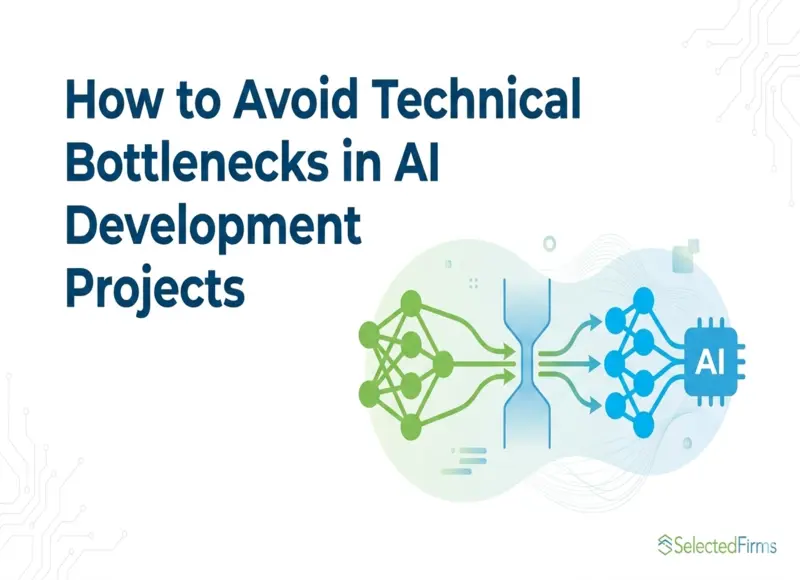
AI projects rarely stall due to a lack of ideas. More often, they get bogged down by subtle technical bottlenecks. That is, either data comes in different formats, models train slowly, or environments conflict with each other, and teams spend time on manual operations. At the start, these issues may seem like minor details. But over time, they eat into the budget and delay the release. They also undermine confidence in the outcome.
The good news is that you can anticipate most bottlenecks. They are not random. This is the result of decisions regarding architecture, processes, and communication. Teams that build AI systematically usually don’t avoid difficulties entirely. But they overcome them faster and more cost-effectively.
Start with the Data, Not the Model
The most common cause of delays in AI isn’t a weak algorithm, but poor-quality data. If data sources are duplicated, incomplete, or contain errors, even the most advanced model will reproduce these issues in its predictions. That is why the first technical priority is to create a reliable data pipeline with:
- validation rules,
- version control,
- a clear access scheme.
It is telling that an equivalent principle applies in everyday technology. Before treating a symptom, try to find the root cause. For instance, when a background process is overloading the system, don’t just terminate the task—first figure out what exactly is triggering that process. To do this, check out specialized resources on how to remove NSURLSessionD from your Mac to learn how to check for suspicious browser extensions, clear the cache, or stop the process via Activity Monitor or Terminal.
In other words, how to eliminate the source of the problem, not just the symptom. For teams implementing AI, this is a good example of how efficiency improvement practices work in real-world scenarios. That is, diagnosis first, then targeted action.
Data quality standards. Define them
Before training begins, the team must agree on what constitutes a “high-quality” record. These may include:
- acceptable omissions,
- date formats,
- annotation rules,
- acceptable value ranges.
Without this, different specialists will evaluate the data differently, and disputes will replace progress.
Validation? Automate
Manual audits are useful, but they aren’t scalable. Automated data tests help quickly identify:
- broken fields,
- abrupt changes in distributions,
- conflicts between sources.
This is one of the most valuable examples of workflow automation in today’s AI teams.
Design Your Infrastructure with Scalability in Mind
Many solutions work well in a prototype. But they fail under load. A model that handles a thousand requests a day may not be able to scale to a million. If you don’t architect for scalability in advance, your team could spend months reworking core components.
Plan resources in advance
GPUs, storage, and network resources must be available not only for today’s tasks. They can be so for future experiments. Capacity planning helps avoid situations where a promising initiative waits weeks for available computing power.
Modular architecture
Splitting services into independent modules simplifies updates. It also reduces the risk of widespread failures. For instance, the inference service, feature store, and monitoring system can evolve separately. This means you can replace a single component without completely rebuilding the platform.
Incorporate system optimization into every stage
Optimization doesn’t start after release. It’s needed during:
- Choosing data storage formats,
- Building task queues,
- Caching results,
- Routing requests.
The sooner the team thinks about efficiency, the fewer costly reworks lie ahead.
Time from Experiment to Production. Shorten It
In many companies, a model may be ready but doesn’t make it into the product for months. The reason is the disconnect between data science and engineering. The experiment code isn’t maintainable. Dependencies aren’t documented. It’s difficult to reproduce the results.
Implement reproducibility
Every run must be reproducible. To achieve this, record:
- data versions,
- model parameters, libraries,
- runtime environment.
If the model shows good results, the team must be able to reproduce them without guesswork.
Standardize CI/CD for ML
Traditional development pipelines are useful for AI as well, but with the following additions:
- Model quality testing,
- Feature drift monitoring,
- Latency control.
This is where MLOps best practices work well, as they shorten the path from the researcher’s laptop to a stable service.
Use containerization
Containers eliminate the classic “it works on my machine, but not on yours” problem. A consistent environment for local development, staging, and production does the following:
- Saves hours of debugging,
- Lowers the risk of unexpected library conflicts.
Build Strong Workflows Among Teams
Even a technically robust stack won’t save a project if teams work in isolation. AI products are typically built by data scientists, ML engineers, backend developers, product managers, and domain experts. Without a shared context, they end up pulling in different directions. Therefore:
-
Align goals and metrics.
Model accuracy does not always equal business value. If one team is chasing an F1 score while another is chasing response time, a conflict of priorities usually arises. Instead, jointly defined KPIs will help make decisions faster.
-
Document decisions.
Architectural trade-offs, data constraints, and the reasons behind model choices shouldn’t remain solely in the minds of a few individuals. Good documentation does the following:
- Reduces reliance on specific experts,
- Speeds up onboarding for new team members.
-
Minimize manual task handoffs.
When artifacts are passed back and forth via spreadsheets, chats, and endless emails, delays often occur. Instead, practical workflow automation—which eliminates unnecessary pauses—involves formalized processes for transferring models, datasets, and specifications.
Post-release Monitoring as Part of Development, Not an Add-on
Many bottlenecks only become apparent after launch. User data changes, latency increases, and accuracy drops. If the system doesn’t monitor itself, the team often discovers the problem too late.
That’s why you should incorporate post-release monitoring during the architecture design phase, rather than waiting for the first complaints to appear. Teams that work proactively respond to system signals before the problem affects users.
Track performance and quality
- Monitor not only CPU or memory, but also business metrics, forecast accuracy, error rates, and response times. This way, you can distinguish between an infrastructure failure and model degradation.
- Set thresholds and automatic alerts so the team doesn’t waste time manually checking dashboards. The sooner a deviation is detected, the cheaper it is to fix.
Detect data drift
Even a well-trained model becomes outdated if user behavior or the market changes. Drift detection signals when it’s time to retrain or review features. Regularly comparing new data with training samples will help you understand exactly which changes have affected the results. That way, you can update the model based on facts, not assumptions.
Plan safe updates
- Canary deployments, rollback mechanisms, and A/B testing reduce the risk of major incidents. It’s better to detect a problem on 5% of traffic than on the entire audience at once.
- Define rollback scenarios in advance so you can act without delay during a failure. This approach maintains service stability, especially during periods of active changes.
Technical Debt. Invest in It Before It Becomes a Crisis
In fast-paced AI projects, people often put off what they consider to be non-essential:
- refactoring,
- cleaning up pipelines,
- updating dependencies.
But technical debt accumulates quietly and comes back as costly downtime. So:
-
Review the architecture regularly.
A solution that was right a year ago may be holding back scaling today. Architecture reviews will help you spot outdated components before they halt development.
-
Set aside time for stabilization.
Not the entire roadmap should consist of new features. Part of the cycle should be dedicated to improving tests and simplifying code. And also, to eliminate performance bottlenecks.
-
Foster engineering discipline.
Strong processes and measurable standards. Code reviews and a culture of accountability. All them are often more valuable than trendy technology. This is how the long-term sustainability of an AI product is built.
Conclusion
Technical bottlenecks in AI projects don’t disappear on their own. They arise where data is uncontrolled and infrastructure isn’t ready for growth. And also where processes depend on manual work and ad-hoc agreements. This can be avoided through mature approaches:
- clean data,
- scalable systems,
- automation,
- transparent collaboration,
- continuous monitoring.
The most successful AI teams are those that identify limitations early and respond to them quickly. When the technical foundation is reliable, innovations cease to be chaotic experiments. They become predictable product development.

Head of SEO Operations
Recent Blogs


Elia Martell
5 Virtual Recruiting Support Operations for Tech and Healthcare Teams
-
09 Oct 2026
-
8 Min
-

462


Jane Hart
Why LinkedIn Campaign Optimization Requires More Than CPC and CTR
-
09 Oct 2026
-
8 Min
-
150

Jane Hart
How to Vet an Offshore SEO Partner: A Due-Diligence Checklist for Agencies and Brands
-
08 Oct 2026
-
8 Min
-
249
Jane Hart
Benchmarking GPU Providers: A Practical Guide to Comparing Cloud Compute Options
-
07 Oct 2026
-
6 Min
-
171
