Table of Contents
GPU servers provide the processing power required for modern AI applications, including machine learning, real-time recommendations, image processing, generative AI, and business automation. Learn why businesses are increasingly adopting GPU-powered infra
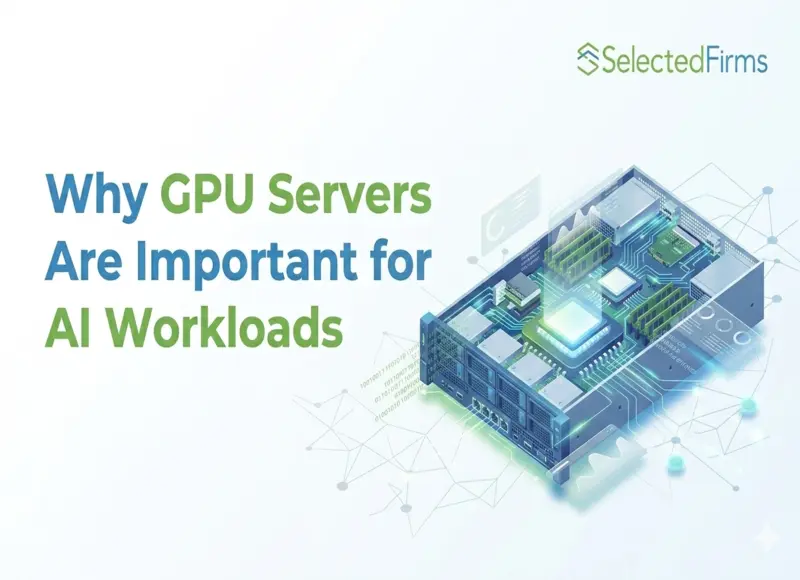
Let’s say you run an e-commerce site. And the CPU does a good job of taking care of everything at first. Robust and reliable system, ideal for customer requests and changing workflows. But as your business grows, you start adding AI tools, product recommendations, help with automation, and a ton of image processing.
Traffic grows, features expand, and suddenly your CPU is unable to handle the surge of users hitting your site all at once. Everything starts lagging, and latency starts creeping up. And this scenario is where you need a GPU dedicated server. A GPU can handle thousands of tasks simultaneously. A CPU was simply not designed to do that. A GPU is designed for high-volume AI workloads specifically.
What is a GPU server?
A GPU server is a very powerful machine that is able to run lots of advanced AI applications. The CPU can perform a few complex operations. The GPU is loaded with thousands of cores that can perform their operations in parallel. So, this type of server is really efficient for running deep learning models and neural networks.
GPU servers are incredibly efficient in training AI applications where the amount of data to be processed is too much for normal processing. Besides, their applications go beyond the use of training data. Generative AI applications, data science projects, bots, real-time analytics, and even automation applications are possible because of GPU servers.
Why GPU Servers Are Important for AI Workloads
Artificial Intelligence: No Longer a Dream for Big Corporations, Businesses of all sizes are now leveraging AI to work smarter, to serve customers better, and to automate what used to take hours of manual work. But you can’t do any of that without the right infrastructure behind it.” This is where GPU servers really make an impact.
-
Training AI Models
To train an AI model, you need to feed it tonnes of data so it can learn the patterns and make predictions. The process is to run billions of calculations again and again until the model is accurate enough to use. A CPU could, but it would take days or even weeks. On a GPU server, the same work can be done in hours, with thousands of calculations going on at the same time.
-
Real-Time Recommendations
An example of AI in real-time is when a customer visits your e-commerce site and sees products suggested just for them. Real-time processing of every click, search, and purchase history generates that recommendation. GPU servers can handle this kind of real-time data processing at scale, with no lag, even when thousands of users are browsing at the same time.
-
Image & Video Processing
Image and video processing require huge amounts of processing power, whether it’s recognizing faces, scanning product images for quality control, or processing video feeds for security systems. GPU servers can analyze visual data much faster than traditional servers, which makes real-time image and video AI applications practical for businesses.
-
Generative AI and Bots
Generative AI tools and chatbots that intelligently respond in real time depend on large language models doing complex calculations with every single interaction. These models run on GPU servers, which lets them do all that efficiently and keep response times low and conversations smooth even when many people are using them simultaneously.
-
Automation Procedure
We need robust, high-performance infrastructure for AI-powered automation workflows that connect multiple apps, process live data, and trigger actions in real time. This workflow flows smoothly and efficiently with GPU servers running your business automation fast, reliably, and seamlessly as the number of tasks increases.
Who Should Consider a GPU Server?
GPU servers are not for every business, but for the right use case, they make an enormous difference. Here is who benefits most.
-
Growing e-commerce platforms
If your e-commerce business is adding AI-driven features like product recommendation engines, image recognition, or personalized search, a GPU server gives you the processing power to run these features smoothly at scale. As your traffic grows, your AI performance grows with it.
-
AI Startups and Developers
Working on an AI model, recommendation system, or computer vision application involves repeatedly manipulating huge training datasets. GPU servers are well-suited to these workloads, reducing training times and providing developers with the performance they need to build and test AI models faster.
-
Automation-Focused Enterprises
Businesses need AI-powered automation workflows, data analytics, or real-time reporting, and they also need consistent computational power behind-the-scenes. GPU servers can meet the demands of growing automation and will not slow down as the workloads increase.
-
Media & Creative Teams
Video rendering, 3D designing, animation, AI-generated graphics, and high-resolution image processing are all GPU-intensive tasks. A GPU server offers the speed and reliability that a regular server just cannot provide, which is why creative teams that work with large visual files and real-time rendering need a GPU server.
-
Not a Tech Person? Want the Benefits of AI?
For businesses that are interested in taking advantage of AI technologies but don’t have a tech department that can handle complicated infrastructure, fully managed VPS hosting with dedicated GPU resources could be a reliable solution. The technical requirement will be handled by the hosting company, and you can focus on using AI-based tools to grow your business.
Conclusion
AI and automation are no longer optional for businesses that want to grow. But adopting AI is only half the equation. The infrastructure behind it determines whether that AI actually performs or falls apart under pressure. A GPU server gives your business the power to handle that growth without hitting a ceiling.
Even small and emerging businesses have an advantage here. You don’t need to be a large corporation to reap the benefits of GPU performance. As your business expands, so can your AI workflows, automation tools, and data processing, with the right infrastructure in place. And if you are running automated trading systems, then the best forex VPS in India makes sure your bots execute with low latency and zero downtime around the clock. The question is not whether your business needs AI. The question is whether your hosting environment can handle it.

Head Of Digital Marketing at SelectedFirms
Recent Blogs


Trends

Isha Choksi
How to Choose an AI Workflow Automation Platform for Enterprise Operations
-

25 May 2026
-

6 Min
-

151

Trends
Jane Hart
How Hiring the Right Salesforce Developers Prevents Data Breaches
-
25 May 2026
-
7 Min
-
68