


Table of Contents
How much businesses may need to invest in an eCommerce website in Qatar and what contributes to the total cost, from development and customization to payments, integrations, hosting, and maintenance.
Building an ecommerce presence in Qatar, whether you are shifting your local business online for the first time as a Young entrepreneur or scaling your business from medium size to enterprise, the first question is usually, “How much does ecommerce website development cost in Qatar? ”
The answer isn't as straightforward as a single development quote, because the scope behind that website can vary dramatically from one business to another.
What Are The Pricing Ranges Based On The Type Of Site?
In Qatar, a template-based eCommerce website can start around QAR 8,000–20,000, while a B2B eCommerce website may cost around QAR 20,000–50,000+. A standard eCommerce website can range from QAR 10,000–20,000+, while custom eCommerce development can start at QAR 50,000 and exceed QAR 100,000, depending on your requirements.
The cost can look very different depending on what you're actually building. A simple business website and a custom eCommerce platform may both be called a “website,” but the work behind them is not always the same.
Here’s a quick look at what you can expect to pay for each type of website.
1. eCommerce Website
Cost Range: QAR 10,000–20,000+
Once you're selling online, the website has a lot more to handle. Products, customers, orders, payments, inventory, and delivery all need to work together rather than simply sitting on separate pages.
Qatar's eCommerce guidance specifically highlights local payment integration, QAR pricing, Arabic and English content, mobile access, delivery, and clear purchase and return information as important parts of the experience, which requires local partner assistance.
You can expect:
- Product catalogue and smart search filters
- Secure local Payment Gateway processing
- Live inventory and customer order panels
- Local/Global shipping pricing integration
- Customer accounts and checkout
- Arabic and English storefront, if required
- Basic product and order management
The price can move quickly when you add payment gateway integrations, third-party integrations, multi-currency support, custom checkout logic, or live inventory updates.
For example, connecting the store with your ERP or CRM can save your team from managing orders and stock in different places, but that connection also adds development work. The same applies when your shipping rates, delivery areas, or inventory need to update automatically.
2. B2B Ecommerce Website
Cost Range: QAR 4,000–15,000
A B2B ecommerce website usually needs more than just the basic pages. You may want a stronger brand presence, several service sections, a CMS your team can manage, blog and team pages, and forms that make it easier for visitors to enquire about your services.
If your business serves both Arabic- and English-speaking customers in Qatar, you may also need the website to work properly in both languages, including the Arabic right-to-left layout.
The budget can also change depending on whether you're bringing your own content and images or need new copy, photography, and a design built specifically around your brand rather than adapting a standard theme.
You can expect:
- Custom UI/UX design architecture
- Multiple service categories
- Full blog functionality
- Team profiles
- Lead generation and enquiry forms
- CMS for managing website content
- Arabic and English versions, if required
The more pages, languages, content, and custom design work involved, the more the project can move toward the upper end of this range.
3. Custom ecommerce development
Cost Ranges: QAR 20,000–50,000+
This is where you're no longer looking for a standard website with a few additional features. You may need the website to handle a business process that doesn't fit neatly into an existing platform.
That could mean a customer portal where users manage their own requests, a booking system with different rules, an internal dashboard for your team, or an application that connects several systems and automates work that would otherwise be handled manually.
You can expect:
- Custom Client Portals & booking engines
- Complex ERP, CRM or API integrations
- Bespoke corporate automation tools
- Custom dashboards and workflows
- Business-specific database and user requirements
Here, the number of pages matters less than what you want the application to do. Complex features, different user accounts, database work, integrations, security, and testing can all increase the cost.
If your business has a specific process that needs to be automated, a custom application can be worth the extra cost. It can help reduce manual work and make different parts of your business work together.
What Actually Defines the Cost of an eCommerce Website?
Cost for the ecommerce development differs based on your selection of platform, design, catalogue, compliance requirements, and how much custom development your store needs. A bespoke design instead of a theme-based build, for example, can also affect the overall development cost.
What you also need to think about for a Qatar-based ecommerce website store is payment gateway integration, third-party integrations, multi-currency support, and custom checkout logic. If your store needs to connect with an ERP, CRM, shipping provider, or inventory system, the additional integration and development work can also increase the cost.
That's why two businesses can ask for essentially the same thing—“an eCommerce website”—and end up with quotes that differ by tens of thousands of Qatari riyals.
So, the better question to ask is “what should an eCommerce website cost for your specific business?”
That's the question founders often overlook, which often pushes the budget up or down.
Thus, before you compare your business-specific quotes from an eCommerce development company in Qatar, let's look at what default pricing ranges you need to keep in mind.
Which eCommerce Platform Should You Choose in Qatar?
All the above-discussed factors can affect your eCommerce website budget, but how much they actually cost will also depend on the platform you choose.
When you see requirements like local payment gateways, Arabic and English, shipping, inventory, and custom checkout, you might usually rush to jump straight into custom development.
But for a small or growing business, that can quickly push your budget much higher than needed.
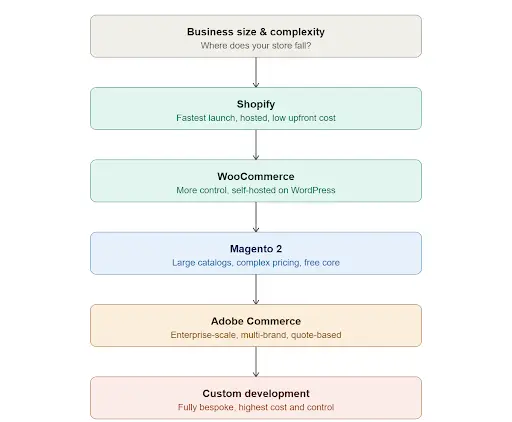
So, before you spend more on customization, let's compare Shopify, WooCommerce, Magento, Adobe and custom development to understand which one makes sense for your business.
Shopify
Best for: Small to medium businesses that want to launch quickly.
For a small Qatar-based store with 100–200 products, Shopify can cover payments, shipping, inventory, and checkout without building everything from scratch. Hosting and basic security are handled for you.
Platform cost: Starts at around QAR 106/month for Basic, while Grow costs around QAR 289/month, Advanced QAR 1,092/month, and Shopify Plus QAR 8,405/month.
WooCommerce
Best for: Small to medium businesses that want more control.
Already have a WordPress website? WooCommerce lets you turn it into a full-fledged online store. The software is free, but you'll need to budget for hosting, extensions, development, security, and maintenance.
Magento 2
Best for: Businesses with complex eCommerce operations.
Thousands of products, multiple stores, customer groups, pricing rules, or multi-currency requirements? Magento 2 gives you more flexibility for these setups.
Platform cost: Magento 2 Open Source is free, but hosting, development, extensions, security, and maintenance add to the overall cost.
Adobe Commerce
Best for: Large businesses and enterprise-level eCommerce.
Managing multiple brands, B2B customers, stores, languages, currencies, or complex pricing? Adobe Commerce brings these requirements into one enterprise-level setup.
Platform cost: Pricing is quote-based, with licensing, development, integrations, hosting, and maintenance adding to the total investment.
Custom Development
Best for: Businesses with highly specific requirements.
Custom development makes sense when your ordering process, pricing, integrations, or checkout cannot be handled well by standard platforms.
Development cost: Starts around QAR 50,000 and can exceed QAR 100,000, depending on the scope.
One-Time vs. Ongoing eCommerce Costs
Getting your eCommerce website live is only the first expense. Your first development quote covers the work needed to build the store, but you'll still have some costs to pay as you run and grow it.
If you're planning custom ecommerce development, these upfront costs can be higher because more of the store is built specifically around your business needs.
What are the common one-time costs?
These are the costs you usually pay while planning, building, and launching your store.
|
Cost area |
Planning range |
|
Discovery and planning |
QAR 2,000–8,000 |
|
UX/UI and visual design |
QAR 4,000–20,000+ |
|
Store development |
QAR 10,000–70,000+ |
|
Initial payment integration |
QAR 2,000–8,000+ |
|
ERP/CRM/PIM integration |
QAR 5,000–30,000+ |
|
Product/data migration |
QAR 2,000–15,000+ |
|
Testing and launch |
QAR 2,000–8,000 |
You may not need every item separately. A small store may include several of these costs in one development package, while a larger project may price each part separately.
You can also treat this as your initial website cost calculation, but your final cost will still depend on the ecommmerce platform selection, features requirement, system integrations, and level of customization you choose.
What are the ongoing costs?
Once your store is live, some costs keep coming back. These can be monthly, yearly, or based on how much you use a particular service.
|
Recurring expense |
What it covers |
|
Platform or hosting |
Store software, servers, updates, and infrastructure |
|
Payment processing |
Fees charged on successful transactions |
|
Apps and extensions |
Reviews, subscriptions, search, marketing, and other features |
|
Website maintenance cost |
Updates, bug fixes, monitoring, security, and technical support |
|
Marketing |
SEO, paid ads, email, social media, and conversion work |
|
Content |
Product photos, descriptions, videos, and landing pages |
|
Support |
Ongoing development and troubleshooting |
You can also choose a website maintenance package, which usually costs around QAR 600–1,500 per month in Qatar, and is still negotiable if you talk to the ecommerce development company.
Basic plans cover updates, backups and security, while going for the higher plans may include performance monitoring, content changes, technical support and priority fixes.
And don't forget these costs once your store is live. If you're taking orders every day, you'll need regular updates, backups, security checks, monitoring, and fixes to keep everything working properly.
What Additional Costs Should You Plan For?
If you are one of those small business owners who searches “How much does it cost to make a website on Google” and gets an answer in the AI Overview, thinking that your starter plan would be limited to QAR 3,000, and thinks, “Okay, that's all I need to get my website online.”
Then here is the reality check: that is not what it is going to be.
That may cover the basic development, but if you're taking your offline business and turning it into a proper online eCommerce store, there are several other things you'll need to budget for.
Your domain, hosting, content, photography, Arabic version, payment fees, apps, maintenance, and other services can all add to the final cost.
Some are one-time expenses, while others keep coming back every month or year.
These are planning ranges, not fixed Qatar market prices. Your actual cost can be lower or higher depending on what you already have, what your development partner includes, and how complex your store is.
Domain and Hosting
Your domain is the address customers use to find your business online, while hosting is what keeps the website running. A typical domain may cost around QAR 150–500 per year, while hosting can range from roughly QAR 500 to QAR 3,000 per year depending on the setup.
A small website with limited traffic won't need the same hosting setup as a busy online store. If you expect high traffic, large product catalogues, or need managed hosting and stronger performance, the cost can move up.
Content and Product Photography
Your website may be ready to launch, but someone still needs to provide the words and images.
If you already have product descriptions, brand copy, and good-quality photos, you can keep this part of the budget lower. If you need new product descriptions, banners, professional photography, or lifestyle images, the cost can increase quickly depending on how much content you need.
For an eCommerce store with hundreds of products, adding product details and taking product photos can take much more time than expected.
Arabic and English Content
If you're selling to both Arabic- and English-speaking customers in Qatar, you may need more than simply translating a few pages.
The Arabic version may need its own content review, right-to-left layout, navigation changes, and product information. The cost will depend on how many pages and products need to be handled in both languages.
Payment Gateway Fees
There are two different costs to keep in mind here.
First is the cost of integrating the payment gateway into your website. Second is the transaction fee charged when a customer actually makes a payment.
The transaction cost can vary based on the provider, payment method, transaction volume, and your business arrangement with the gateway. Qatar's eCommerce guidance also recommends comparing payment gateway providers based on the needs of your online business.
So don't compare two development quotes only by asking whether “payment integration” is included. Check which gateway, which payment methods, testing, and what happens after integration.
Apps and Third-Party Tools
Your ecommerce online store may need extra tools for reviews, loyalty, email marketing, advanced search, subscriptions, analytics, or other features.
Some are free, while others charge monthly or annual fees. A store that starts with five paid tools can therefore have a very different monthly running cost from one that uses only the features already available on its platform.
Website Maintenance
Launching the website is not the end of the expense.
You may need regular updates, security checks, backups, bug fixes, technical support, or small changes as your business grows. Published Qatar pricing guides put standard maintenance around QAR 600–1,500 per month, although the actual amount depends heavily on the level of support you need.
Qatar's 2026 eCommerce Licensing Framework
If you're moving an offline business online, licensing is another point to check before launch.
Under Qatar’s 2026 framework, Ministerial Decision No. 25 of 2026 requires covered businesses operating through websites without physical locations to obtain an eCommerce license, commercial registration, and pay the applicable fees.
Licensed businesses also need to offer electronic payments and show details such as registration information, contact details, product or service information, and return and exchange policies.
This means some of the work needed to make your store ready for launch isn't limited to design and development.
Multi-Currency and International Selling
Planning to sell outside Qatar? Then it is not just adding another currency to your website; it requires more than that.
You may need different payment methods, international shipping, currency handling, and changes to how prices and checkout work for customers in different markets.
If you're starting with Qatar only, you may not need all of this from day one. But if international expansion is already part of your plan, it is worth discussing before development starts rather than rebuilding the checkout later.
What Makes an eCommerce Website More Expensive in Qatar?
Running a business in Qatar or setting one up here comes with a few additional things you need to consider when building an eCommerce website. The cost isn't only about the number of products, catalogues, custom design, or multi-currency support. These can increase the cost in almost any country.
What makes Qatar a little different is the need to consider Arabic and English, local payment gateway integration, shipping and delivery, ERP/CRM and inventory systems, and the checkout experience.
These factors can add more development work depending on how your business operates and what you want your website to handle.
Bilingual Content Creation – Arabic and English
Estimated additional cost: QAR 500–5,000+
Adding Arabic isn't just about translation. You may also need RTL design and adjustments across product pages, navigation, forms, and checkout.
Payment Gateway Integration
Estimated cost: QAR 1,000–5,000+
Qatar-based stores may need to integrate local payment options such as Dibsy, SADAD, UBL ,TESS, QPay , and NAPS, along with Visa, Mastercard, or Apple Pay(Ipay), and it operates under Qatar Central Bank regulation. Supporting multiple payment methods means more integration and testing, which can increase the development cost.
Shipping and Delivery Integration
Estimated cost: QAR 1,000–5,000+
Qatar-based stores may use providers such as Qatar Post, Snoonu, Rafeeq, Aramex, DHL, or Pick n Drop for local deliveries.
If your website needs to connect with these providers for delivery rates, same-day delivery, order dispatch, tracking, or delivery status updates, you may need additional API integration. The cost goes up further if you want to connect more than one delivery provider or automatically select the right provider based on the order.
Qatar's eCommerce guidelines also specifically cover domestic delivery, same-day delivery and tracking.
ERP, CRM and Inventory Integration
Potential extra development cost: QAR 3,000–15,000+
As your store grows, you may need more than an eCommerce platform to manage products, orders, customers, and stock.
For ERP, Odoo is one of the good option. It brings tools such as CRM, accounting, inventory, POS, purchasing, and eCommerce into one system. Odoo's plans start at QAR 91/user/month when billed annually, while the Custom plan starts at QAR 179/user/month. Implementation and custom development are separate costs.
For product information, you can use a PIM such as Pimcore. It helps manage product details, images, specifications, and other product data in one place before sending that information to your eCommerce store or other channels.
Pimcore's current Professional plan starts at around QAR 36,150 per year, while the Enterprise plan starts at around QAR 109,135 per year.
If your store needs to connect Odoo, Pimcore, your eCommerce platform, warehouse, or POS, the integration work will increase your overall development cost.
Custom Checkout
Potential extra cost: QAR 2,000–10,000+
Qatar's checkout may need to handle multiple payment methods, COD, local delivery options, Arabic/English, discounts, and specific delivery rules. If you want all of these instead of a standard checkout, the ecommerce development cost goes up. Qatar's eCommerce data also shows COD remains an important payment preference among local shoppers.
How to Reduce eCommerce Development Costs?
You don't always need to spend more to build a good eCommerce store. A few smart choices can help you control your eCommerce website cost without affecting the things that matter.
- Use a proven theme: Go custom only where it adds real value.
- Launch in phases: Start with essential features and add more later.
- Choose the right platform: Don't pay for features you don't need.
- Reuse existing systems: Connect your ERP, CRM, or PIM instead of replacing them.
- Hire a consultant or business analyst: Get a clear roadmap to include only essential features and make the website budget-friendly.
FAQs
Yes. Under Ministerial Decision No. 25 of 2026, covered businesses selling through websites need an eCommerce license, along with commercial registration and required approvals. The exact requirements depend on the type of business.
The cost depends on your setup. A home-based business can get a license for around QAR 300, while an online business may spend QAR 1,500–5,500 on registration, licensing, and approvals. You can operate without a physical store, but each online platform may require a separate license and must display the required business and return information.
Qatar-based ecommerce website cost can increase with requirements such as Arabic and English support, QAR and multi-currency payments, local payment gateway integration, eCommerce licensing, delivery integration, ERP/CRM/PIM connections, and custom checkout rules. Number of Products , customised design, and ecommerce platform choice also affect the final cost.
SADAD, Dibsy, SkipCash, and Noqoody are among the payment gateways Qatar-based eCommerce stores can consider. Their supported payment methods vary, with options including NAPS, Visa, Mastercard, and digital wallets such as Apple Pay, depending on the provider and integration.
A small business website in Qatar typically costs QAR 5,000–12,000. Template-based websites can start around QAR 2,000–7,000, while custom websites may range from QAR 10,000–50,000+, depending on features and complexity.


Head Of Digital Marketing
Recent Blogs


Elia Martell
The Business Value of Investing in Custom Mobile Applications
-

30 Sep 2026
-

6 Min
-

16
Elia Martell
How to Build a Compliant iGaming Platform: A Dev blueprint for software agencies and startups
-
29 Sep 2026
-
9 Min
-
63

Jane Hart
Account-based Marketing in Insurance: Multi-Channel Strategies for Corporate Policy Sales
-
29 Sep 2026
-
6 Min
-
46
Elia Martell
How to Read LMS Pricing Before Choosing a Long-Term Platform
-
25 Sep 2026
-
7 Min
-
107
