


Table of Contents
Poor site architecture stops search engines from finding your products. Learn how duplicate content, crawl waste, and orphaned pages cost ecommerce brands 30 to 60% of organic revenue and how to fix it.
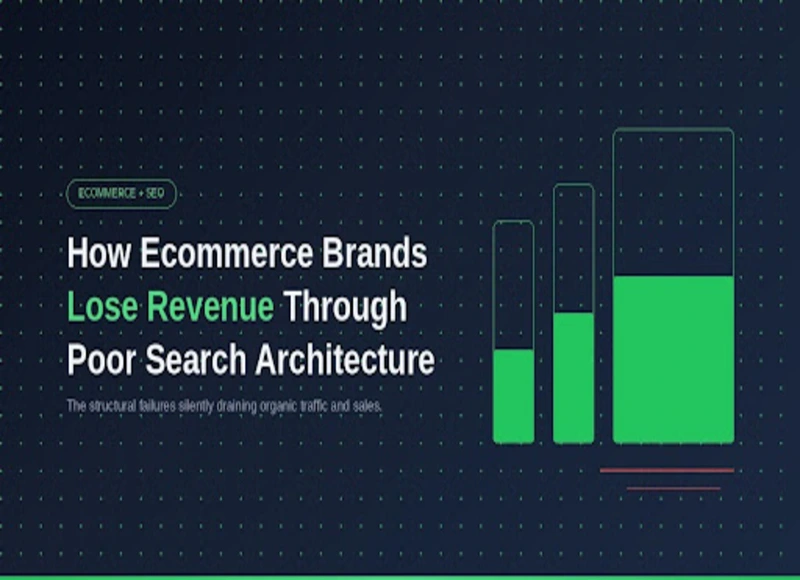
You can have great products and happy customers and still be hemorrhaging revenue. The problem usually isn't visible to anyone on your team. It's buried in your site's technical foundation — URL structure, server settings, site architecture. When search engines can't crawl or index your site properly, thousands of potential buyers simply never find you.
This isn't just theory. Ecommerce sites with poor architecture lose 30–60% of organic search revenue compared to well-optimised competitors. For a business making £500k a year from organic search, that's £150k–£300k walking out the door annually.
Why Product Quality Doesn't Guarantee Search Visibility
A lot of ecommerce owners assume: good products + good UX = good rankings. Not quite.
Before Google even thinks about content quality, it needs to do two things first:
Crawl your site. Google's crawler (Googlebot) has a limited budget for each site. If your architecture sends it in circles or makes it revisit the same content repeatedly, it burns through that budget fast — and never finds your actual products.
Index your content. Google can only store so many pages from your site. If it's wasting index space on duplicate or redundant pages, fewer of your real product pages make the cut.
Poor architecture breaks both steps. Your competitors with identical products but cleaner sites show up. You don't.
The Duplicate Content Problem In Ecommerce
Filters and faceted navigation are great for users. But without a proper technical setup, they're a nightmare for SEO.
Here's why: every filter combination can create a new URL. A red medium shirt might live at:
- /products/red-shirt
- /products/shirts?colour=red
- /products/shirts?colour=red&size=medium
- /products/shirts?size=medium&colour=red
- /products/red-shirt?tracking-id=123
Those all look like different pages to Google. Now multiply that across 500 products, 5 colours, 3 sizes, 10 brands, and 4 price ranges. You can end up with 20,000 crawlable URLs from a 500-product catalogue. Google crawls all of them, gets confused about which one to rank, and often picks the wrong one.
Pagination, Parameters, And Indexation Bloat
Pagination is necessary — nobody wants 200 products on one page. But when every paginated page is treated as a unique, independently indexable URL, you've got a problem.
Page 2 and Page 3 of a category are almost identical to Page 1. Google wastes crawl budget visiting them all. And that's before you add tracking parameters.
Every UTM tag, session ID, and referral code creates a new URL variant. One product page can end up existing in hundreds of parameter combinations within a year. Google's index fills up with near-duplicates. Your real pages get less attention. Organic visibility quietly collapses.
Category Depth And Orphaned Product Pages
Google discovers pages through links. If a product is buried six or seven clicks deep in a category hierarchy, Googlebot may never reach it — or barely bother.
Even worse: some products have no internal links at all. They're in your database, reachable by direct URL, but nothing on the site points to them. Google never finds them. They generate almost zero organic revenue, no matter how good they are.
If a product has no inbound links, it's essentially invisible to Google. Being in the database isn't enough.
Platform-Specific SEO Limitations
Shopify, WooCommerce, Magento, BigCommerce — these platforms are built for ease of use, not SEO perfection.
- Shopify handles pagination with rel=next/prev tags, but that doesn't stop Google crawling every paginated page.
- WooCommerce auto-generates canonical tags, but filter pages often aren't handled properly.
- Magento's default setup is particularly rough — faceted navigation creates loads of URL variations with no built-in fix.
- BigCommerce and Salesforce Commerce Cloud both need significant customisation to get right.
Most merchants stick with default settings. Most defaults aren't SEO-optimised. Revenue leaks quietly, year after year.
Canonical Tags, Meta Robots, And URL Parameter Directives
Canonical tags are your main weapon against duplicate content. They tell Google: "this is the main version of this page — ignore the others." Done right, they consolidate your rankings and crawl budget onto the URLs that actually matter.
Done wrong, they cause chaos. Common mistakes include category pages pointing to the homepage, paginated pages all pointing to page one, and self-referencing canonicals that create redirect chains.
Meta robots tags (noindex, nofollow) and Google Search Console parameter settings are also powerful tools — but most ecommerce sites never configure them. The result is ongoing index bloat that gets worse every year.
Quantifying The Revenue Impact
Here's the business case in plain terms:
A £500k/year organic revenue business that fixes its architecture typically sees a 35–50% revenue lift within 12 months. That's £175k–£250k in incremental annual revenue.
A specialist audit costs £3k–£10k. The ROI can be 1,700–8,000% in year one.
The improvements happen in stages: crawl efficiency picks up within weeks, indexation stabilises in 2–3 months, rankings improve over 6–12 months. It's not overnight, but it's predictable.
And every month you wait, competitors are pulling further ahead. That gap compounds.
Building An Ecommerce Search Architecture Audit Framework
A structured audit covers five areas:
- Crawl analysis — Map your full site structure. Find duplicate content, orphaned products, and pages buried too deep. Most sites find 20–30% of products are four or more clicks from the homepage.
- Indexation analysis — Cross-reference your crawl data with Google Search Console. A healthy site indexes 70–85% of product URLs. Poor architecture? You might be at 40–60%.
- Duplicate content analysis — Identify all the parameters, session IDs, and filter combinations creating duplicate URLs. Most problem sites have 2–4x more crawlable URLs than they have unique content.
- Canonical and meta robots review — Audit what's actually configured. Many sites have conflicting directives fighting each other.
- Revenue correlation — Connect technical findings to actual revenue data. Fix the things that affect your highest-value categories first.
When To Engage Ecommerce SEO Specialists
This stuff is technical. Most in-house teams and generalist agencies don't have the depth to diagnose and fix it properly.
Bringing in a specialist makes sense when your team lacks the expertise, when fixes require platform-level changes, or when the revenue at stake justifies the investment (it usually does). A specialist audit typically costs £2k–£5k and can unlock six to seven figures in incremental revenue over three years.
What to look for: detailed audit reports, prioritised recommendations, and business-focused projections. What to avoid: agencies promising quick fixes, guaranteed rankings, or pushing long contracts before they've even looked at your site.
Compounding Growth Through Foundation Excellence
The returns build over time:
Year 1: 30–50% revenue lift. Orphaned products surface. Duplicate content gets cleaned up. Link equity consolidates.
Year 2: Rankings deepen. Long-tail keyword coverage expands. Category authority grows.
Year 3+: Market position firms up. Backlinks accumulate. Organic revenue accelerates. Everything you do in SEO gets more effective because the foundation is solid.
Delay has the opposite effect — compounding losses, shrinking market share, and a widening gap with competitors who moved faster.
Search architecture is infrastructure. Like the foundation of a building, getting it wrong is far more costly to fix later than to get right early. No amount of content, ads, or CRO can fully compensate for an architecture that's throttling your search visibility.
The brands that invest in this early win compounding returns. The ones that don't watch revenue leak away quietly, year after year.


Head Of Digital Marketing
Recent Blogs


Elia Martell
5 Virtual Recruiting Support Operations for Tech and Healthcare Teams
-

09 Oct 2026
-

8 Min
-

477
Jane Hart
Why LinkedIn Campaign Optimization Requires More Than CPC and CTR
-
09 Oct 2026
-
8 Min
-
155
Jane Hart
How to Vet an Offshore SEO Partner: A Due-Diligence Checklist for Agencies and Brands
-
08 Oct 2026
-
8 Min
-
263
Jane Hart
Benchmarking GPU Providers: A Practical Guide to Comparing Cloud Compute Options
-
07 Oct 2026
-
6 Min
-
173
