


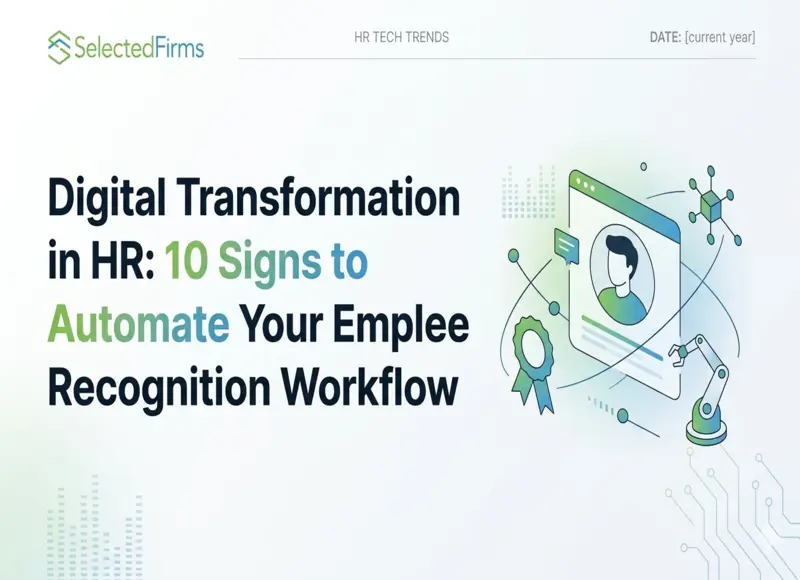
Digital Transformation in HR: 10 Signs to Automate Your Employee Recognition Workflow
-
Last Updated:

06 Apr 2026
-
Read Time:

8 Min Read
-
Written By:
 Isha Choksi
-
1123
Table of Contents
Find out when your organization should shift from manual to automated employee recognition to improve engagement, reduce administrative workload, ensure fairness, increase visibility, and build a more consistent, scalable, and effective HR recognition pro
Digital transformation in HR usually starts with the processes that are easiest to measure. Payroll, onboarding, benefits administration, and performance records tend to move to the front of the line. Employee recognition often stays informal for much longer, even in companies that care deeply about culture. It lives in manager habits, team customs, scattered reminders, and occasional HR campaigns. For a while, that can feel personal and flexible. As the organization grows, it often turns uneven.
The problem is not a lack of appreciation. The problem is inconsistency. Some employees are recognized quickly and often. Others do equally strong work and hear very little because the recognition workflow is loose, manual, and hard to scale. Once that starts to affect morale, visibility, and trust, automation becomes less a technology upgrade and more an HR necessity.
Sign 1: Recognition Depends on Whoever Happens to Remember
A manual recognition process usually works well right up to the point where the company gets busy. Then birthdays are missed, work anniversaries slip by, spot awards happen only after someone reminds a manager, and great work receives praise in some teams but not in others. The pattern is familiar. The problem is not that people do not care. The problem is that memory is a weak system.
This kind of setup creates risk quickly. Employees notice when recognition feels random. Some people get thanked often because their manager is naturally expressive. Others do equally strong work and hear almost nothing because their manager is overloaded or simply less verbal. When recognition depends too much on personality, culture becomes uneven from one team to the next.
Sign 2: The Process Lives in Inboxes, Chats, and Spreadsheets
Another warning sign is fragmentation. One manager uses email. Another uses Slack. HR keeps a spreadsheet for anniversaries. Finance tracks reward budgets in a different file. Nobody has a full view, and nobody is fully confident that the records are complete. This is where recognition starts feeling harder than it should.
Fragmentation creates two kinds of trouble. First, it increases admin work. Second, it weakens visibility. Recognition loses force when appreciation happens in private channels that disappear in a scroll or stay trapped in a manager’s inbox. A shared system creates a cleaner record and a more visible culture. This is the point where many organizations start to take employee recognition software seriously to centralize activity without turning every thank-you into a formal HR event.
Sign 3: Remote and Hybrid Employees Are Getting Less Visibility
Recognition problems become much easier to see in distributed teams. People who are physically present tend to get noticed more often. Their wins are easier to observe. Their extra effort is more visible. Their names come up naturally in day-to-day conversation. Remote employees can be doing equally important work while receiving far less informal credit.
That imbalance matters because it changes how fair the workplace feels. Employees do not judge recognition only by volume. They also judge it by access. If the system seems to favor people who happen to be near leadership, trust starts to erode. Automation helps here by creating shared prompts, consistent milestones, and broader visibility that do not depend on hallway exposure.
It also gives peers a clearer path to recognize one another across locations. That is especially useful in matrixed or hybrid organizations where employees collaborate often but do not work in the same space. Recognition becomes less local and more organizational.
Sign 4: Important Milestones Keep Getting Missed
Milestones are easy to underestimate because they look routine. Work anniversaries, onboarding completions, certifications, project launches, safety records, and years of service can all feel minor when viewed one by one. Yet employees often attach a lot of meaning to those moments, especially if the organization usually says it values people.
When those milestones are missed, the message lands harder than leaders expect. It suggests that recognition is optional, inconsistent, or reserved for the most visible achievements only. A strong automated workflow does not replace the personal touch here. It protects it. It ensures the moment appears on time, so the manager or team can respond in a way that still feels human and specific.
In practice, this is one of the easiest wins in HR automation. Dates and triggers are exactly the kind of thing systems handle well. The real question is what people do with that reliability once they have it.
Sign 5: Approvals and Reward Budgets Slow Everything Down
Recognition often loses momentum during the handoff from intention to execution. A manager wants to nominate someone. Then comes the approval path. Then the budget question. Then the uncertainty about reward tiers, policy rules, or who signs off. By the time the answer arrives, the moment has cooled off, and the recognition feels less meaningful.
This kind of delay is common in organizations that still treat every reward or nomination as a mini administrative project. The friction may look small in process maps, but it changes behavior fast. Managers start avoiding the system because it feels slow. HR gets dragged into low-value coordination work. Employees see fewer timely moments of appreciation.
Automation helps by standardizing thresholds, routing approvals quickly, and giving managers clearer rules upfront. That does not remove oversight. It reduces the drag that keeps recognition from happening when it should.
Sign 6: HR Cannot Tell What Is Working
A recognition program is difficult to improve if nobody can answer basic questions about it. Which teams use it regularly? Which managers rarely participate? Which moments drive the strongest response? Are peer-to-peer recognitions growing or fading? Are certain departments receiving recognition far more often than others? Without usable data, recognition becomes a culture initiative that people talk about warmly and manage vaguely.
This is where many organizations hit a ceiling with manual methods. They can see isolated examples of good recognition, but they cannot evaluate the system as a whole. That makes it much harder to coach managers, fix participation gaps, or justify continued investment.
Better reporting changes the conversation. It gives HR something more useful than anecdotes. It makes recognition measurable enough to improve without making it feel cold or overengineered.
Sign 7: Recognition Quality Depends Too Much on the Manager
Manager quality always matters, but recognition should not collapse when one manager is stronger than another. In many companies, that is exactly what happens. Some managers give timely, specific, motivating praise. Others go silent until the performance review season. Employees in one part of the business feel seen. Employees in another feel forgotten.
Automation does not solve poor management on its own, but it does create structure. Prompts, templates, milestones, and shared expectations help weaker managers do the basics more consistently. That alone can raise the floor. It does not make every message excellent, but it reduces the number of people who get nothing.
This matters more than it may seem. Research from Gallup points to the importance of frequent, authentic, and meaningful recognition, and SHRM continues to frame recognition as a key lever in engagement, inclusion, and retention.
Sign 8: Growth Has Made the Old Process Unrealistic
A small company can manage recognition informally for a while. Founders know people by name. Managers see most of the work directly. Milestones are easy to track because the employee count is still manageable. Growth changes that. What once felt personal starts feeling patchy. What once felt flexible starts feeling improvised.
This is a classic turning point in digital transformation. The process that got the company through its early stage is no longer strong enough for the current scale. Recognition becomes one more area where operational maturity is lagging behind organizational complexity.
A growing company should not wait for the system to fail loudly. If participation is already inconsistent and admin effort is already rising, the signal is clear. The workflow needs a stronger foundation before the company adds even more headcount and complexity.
Sign 9: Recognition Is Creating Admin, Tax, or Policy Headaches
Recognition is not only about messages and applause. In many organizations, it also touches gift cards, reward catalogs, taxable items, budget controls, audit trails, and internal policy rules. The more manual the process, the easier it becomes for details to slip. Someone gets a reward that should have been handled differently. A policy is applied unevenly. A manager uses an old template or approval path that no longer fits.
These are not the most inspiring parts of recognition, but they matter. Administrative friction can quietly drain confidence in the whole program. HR ends up cleaning up small problems that should have been prevented by design.
A more automated workflow helps by keeping rules clearer and records more consistent. That does not make recognition bureaucratic. It removes a layer of avoidable confusion around the parts employees should never have to think about.
Sign 10: Recognition Is Disconnected From Values and Performance
Recognition has more strategic value when it reinforces what the organization wants more of. If messages stay generic, disconnected, or purely reactive, the company misses that opportunity. “Great job” has a place, but it does not build much clarity on its own. Employees need to see what was valuable, why it mattered, and how it connects to the work culture the business says it wants.
This is another area where automation can help if it is well designed. Structured recognition fields, value tags, campaign themes, and category prompts can guide people toward more specific and more useful praise. The system should not write the message for them. It should make recognition easier to give.
Once that happens, recognition becomes more than morale support. It turns into a quiet cultural signal. People see what gets noticed, what gets repeated, and what the organization takes seriously.

Head of SEO Operations
Recent Blogs

Elia Martell
5 Virtual Recruiting Support Operations for Tech and Healthcare Teams
-
09 Oct 2026
-
8 Min
-

462

Jane Hart
Why LinkedIn Campaign Optimization Requires More Than CPC and CTR
-
09 Oct 2026
-
8 Min
-
150

Jane Hart
How to Vet an Offshore SEO Partner: A Due-Diligence Checklist for Agencies and Brands
-
08 Oct 2026
-
8 Min
-
249
Jane Hart
Benchmarking GPU Providers: A Practical Guide to Comparing Cloud Compute Options
-
07 Oct 2026
-
6 Min
-
171
