

Table of Contents
Understand how modern SEO agencies are evolving for AI search, prioritizing entity recognition, structured content, and citation visibility to stay relevant in a landscape where most queries are answered without clicks.
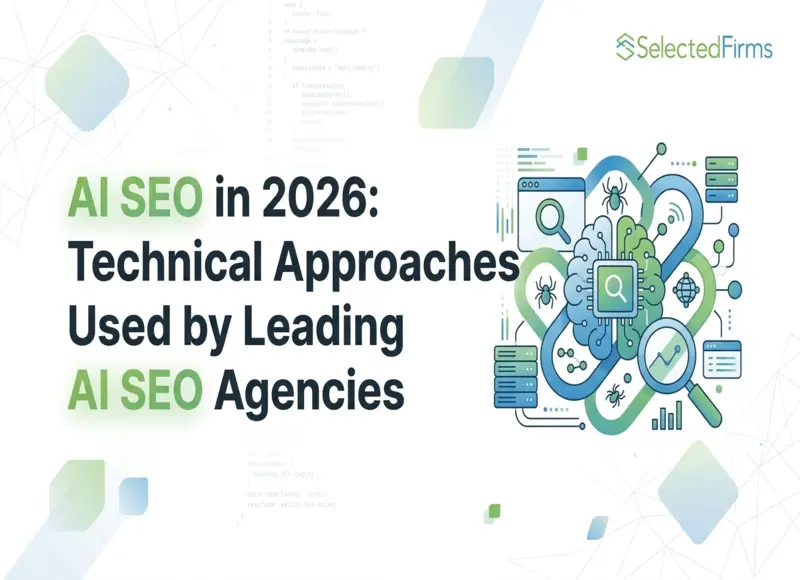
Every listicle right now will tell you which AI SEO agency uses the most tools, has the best tech stack, or runs the fastest audits.
That is not the question worth asking in 2026.
The real question is: which agencies have understood that the unit of SEO has fundamentally changed?
Not the tactics. The unit. What search actually rewards now.
The Numbers That Most SEO Agencies Are Ignoring
Before we talk about agencies, look at what is actually happening in search right now.
|
61% Drop in organic click-through rates for queries with AI Overviews present (Seer Interactive, Sept 2025) |
|
80% Of URLs cited in AI answers do not rank in Google's top 100 results (Ahrefs, Aug 2025) |
|
93% Of Google AI Mode searches end without a single click (Semrush, Sept 2025) |
|
44.2% Of all LLM citations come from the first 30% of your text — your introduction (Growth Memo, Feb 2026) |
Read those again. Especially the third one. 93% of searches in AI Mode end without a click. Yet most SEO strategies are still built around ranking for clicks.
That is the disconnect. And most AI SEO agency have not bridged it yet.
|
The uncomfortable truth: you can rank #1 on Google and still be invisible to the 1.5 billion monthly users who read AI Overviews without clicking anything. Ranking and visibility are no longer the same thing. |
What Actually Changed (And Why It Is Deeper Than "AI SEO")
Search used to be a directory. You asked, Google listed, you chose.
Search now is a synthesizer. It reads everything, forms a view, and presents a conclusion.
That means the game has moved from:
- Keywords to entities and semantic authority
- Backlinks to citation-worthiness in AI systems
- Click-through rate to Share of Voice in AI responses
- Page 1 rankings to being the source AI trusts by default
The GEO market is currently valued at $848 million and is projected to hit $33.7 billion by 2034. That is a 50.5% CAGR. The agencies who grasp this early are not just winning clients. They are building a category.
Top Five AI SEO Agencies That Are Actually Thinking Differently
None of these agencies are perfect. But each one has grasped at least one thing most others have not.
Panem
Most agencies still build content around keywords. Panem builds around entities. The distinction matters enormously.
An entity is what you are. A keyword is what someone typed. AI systems cite entities, not keyword-optimized pages.
Panem's Technical approach:
- Structures site architecture so AI bots can parse meaning, not just text
- Maps product attributes to specific user intent at an entity level
- Connects on-site behavioral data directly to CRM for lead quality scoring
- Focuses on Core Web Vitals as a trust signal for AI crawlers, not just a ranking factor
The insight Panem operates on is this: Google's AI Overviews currently cite from only top 25% web mentions, which get 10x more AI visibility than the rest (Ahrefs). You do not earn that by keyword stuffing. You earn it by becoming the definitive entity in your space.
If you want to understand what technical SEO for AI actually looks like in practice, Panem's methodology is the clearest model available right now.
NP Digital: The Scale Operators
NP Digital's edge is volume without chaos. They process datasets most agencies would collapse under.
What separates them:
- Predictive ML identifies content gaps before search volume confirms them
- Automated audits running in real time, not quarterly reports
- Natural language generation used as a first draft, refined for entity accuracy
This matters because content with statistics and citations achieves 30 to 40% higher visibility in AI responses (Superlines, 2026). NP Digital's data-first content model is built for exactly this environment.
Useful for brands needing international SEO services across multiple markets simultaneously.
WebFX: The Attribution Believers
WebFX bets on one idea that is increasingly rare: every SEO action should trace to revenue.
In a world where organic traffic is declining but AI-driven brand influence is growing, this creates tension.
Here is the uncomfortable question WebFX forces you to answer: if 93% of AI Mode searches end without a click, how do you attribute the sale that still happened because someone read your content in an AI summary?
WebFX does not have a perfect answer to that yet. But their attribution infrastructure is the best positioned to figure it out.
Worth exploring for brands investing in SEO and paid search together.
Victorious: The Precision Engineers
No gut feel. No assumptions. Every recommendation runs through algorithmic probability first.
In a bifurcated search environment, where some queries trigger AI Overviews and others still return ten blue links, this precision matters.
- NLP-driven keyword clustering at a depth most tools cannot replicate
- Real-time competitor audits tracking backlink profiles and content shifts
- Scripts that fix Core Web Vitals across thousands of pages simultaneously
Particularly relevant because pages with well-organized headings are 2.8x more likely to earn AI citations (AirOps). Victorious optimizes exactly the structural layer AI systems read first.
Best match for brands wanting data-driven SEO services with zero subjectivity in the process.
Siege Media: The Citation Builders
Here is a stat almost nobody is talking about:
90% of AI citations driving brand visibility come from earned and owned media, not paid placements (Edelman, 2025).
Siege Media built their entire model around exactly this. Before it was called GEO.
- Identifies high-authority journalists by analyzing their historical publishing patterns
- Turns complex data into visual assets that attract links from authoritative domains
- Publishes content ahead of search volume peaks, not in response to them
If your brand has weak domain authority, no amount of technical SEO will get you cited in AI Overviews. Link building that earns real editorial citations is the fastest path to AI visibility that most brands skip.
How to Actually Choose: The Question Most Guides Skip
Every other guide tells you to evaluate agencies on case studies, pricing, and tools.
Ask one different question: does this agency measure Share of Voice in AI responses, or just rankings and traffic?
If the answer is just rankings and traffic, they are optimizing for a version of search that is shrinking.
|
The brands in the top 25% for web mentions get 10x more AI visibility than everyone else (Ahrefs). That gap will compound. An agency that cannot help you close it is not an AI SEO agency. It is a traditional SEO agency with new marketing copy. |
Quick match guide:
- Site architecture and entity clarity: Panem
- Content at global scale: NP Digital
- Revenue attribution from SEO: WebFX
- Structural precision and competitor intelligence: Victorious
- Domain authority and AI citation building: Siege Media
One Last Thing Worth Saying
AI search is not replacing traditional search. Not yet.
Around 52% of queries still trigger no AI Overview (BrightEdge, Feb 2026). Traditional SEO still matters.
But the brands being cited in the 48% that do trigger AI responses are building something traditional SEO cannot give you: an AI reputation.
That reputation compounds. An AI system trained to associate your brand with authority does not forget between searches.
The AI SEO strategy worth investing in right now is one that builds both: technical health for traditional search and entity authority for AI search. At the same time.
The agencies above are the ones who understand that both tracks are live simultaneously.
Most agencies are running one track. The best ones are running two.

Head Of Digital Marketing at SelectedFirms
Recent Blogs

Trends
Jane Hart
The Blueprint for Building a Wallet that Actually Rivals MetaMask
-

17 Mar 2026
-

7 Min
-

235
Trends
Jane Hart
AI Agents in Enterprise Software: How Businesses Are Rethinking Automation
-
17 Mar 2026
-
4 Min
-
310