


Table of Contents
A practical guide to building a secure, scalable crypto wallet like MetaMask. Explore non-custodial design, key management layers, dApp connectivity, and the essential security practices needed to create a reliable Web3 gateway.
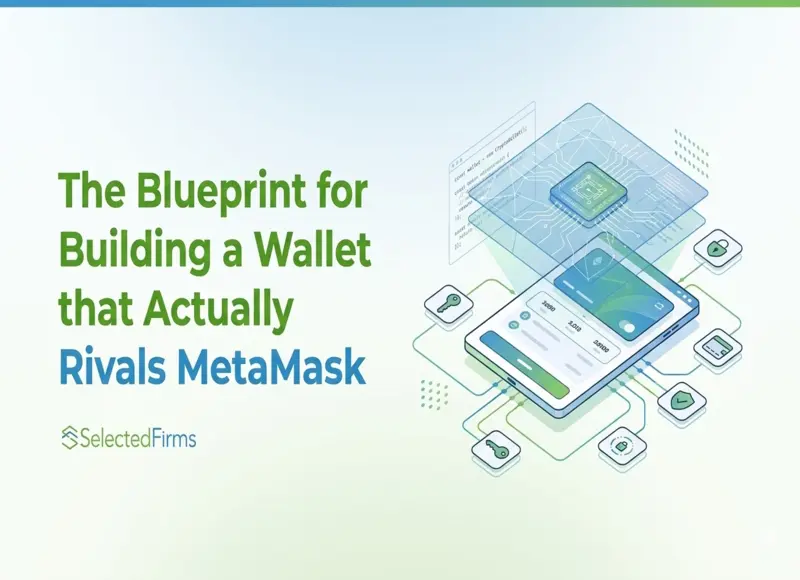
Everyone wants to be the next big gateway to the decentralized web. You see the numbers, and they are hard to ignore. In the first half of 2025 alone, stablecoin transfer volume shot past the $4 trillion mark. That is a massive amount of value moving through digital pipes. Most of that traffic goes through a handful of familiar doors, with MetaMask being the biggest one of all.
Building a wallet today is a bit like building a bank and a browser at the same time. You aren't just giving people a place to look at their coins. You are giving them the keys to a whole new economy. But let’s get one thing straight from the start.
A wallet is not a vault where coins sit and gather dust. It is more like a very smart remote control for the blockchain. If your remote control breaks, the TV is still there, but you can’t change the channel. That is exactly how crypto works. The assets stay on the network, while your app just holds the permission to move them.
Why does everyone point to MetaMask as the gold standard? It isn't because they have the flashiest UI. It is because they solved the "trust" problem early on. They made it feel okay to interact with weird, experimental websites. If you want to build something similar, you need to understand that reliability is your only real currency. If a user tries to swap tokens and the app hangs, they won't just get annoyed. They will panic. They will think their money is gone. Your job is to make sure that never happens.
Let’s look at what it really takes to pull this off. We are going to break down the layers, the logic, and the little mistakes that usually sink a project before it even launches.
Defining the MetaMask Standard: What Are We Actually Building?
Before you write a single line of code, you have to decide what your wallet represents. Is it a simple tool for beginners or a power-user extension? MetaMask succeeded by being "non-custodial." This means the user is the boss. They own the keys, they own the responsibility, and they own the risk.
In a non-custodial setup, your servers never see a private key. You are basically building a very fancy interface for local encryption. When a user creates an account, your app generates a seed phrase. That phrase is then turned into keys, and those keys are tucked away in the "secure storage" of the device.
If the user loses that phone and doesn't write down the phrase, the money is gone. You can’t help them. There is no "forgot password" button in the world of true Web3.
This model is powerful because it removes you, the developer, from the line of fire. You don't have to worry about a hacker stealing millions from your central database because you don't have a central database of funds. However, it makes the UX much harder. You have to teach people how to be their own bank without scaring them away.
The Layers of the Machine: Architecture That Scales
Think of your wallet as a house. If the foundation is shaky, the roof will eventually cave in. Most successful wallets use a layered approach to keep things organized.
1. The Key Management Layer
This is the heart of the operation. It handles entropy, which is just a fancy way of saying "randomness." If your randomness isn't random enough, a smart hacker can guess a user's keys. You’ll want to use industry standards like BIP-39 for seed phrases and BIP-44 for creating multiple accounts from one phrase. This layer must be isolated. It should do one job: keep the keys safe and use them to sign messages.
2. The Wallet Core
This is the brain. It knows how to build a transaction. It calculates the "nonce," which is a counter that prevents people from accidentally sending the same transaction twice. It also talks to the different "standards" like ERC-20 for tokens or ERC-721 for NFTs. Without a solid core, your wallet will feel sluggish and buggy.
3. The Network Layer
The blockchain is a noisy place. This layer manages your connections to "nodes" via RPC providers. If one provider goes down, your wallet should be smart enough to switch to another. It handles the "fetching" of balances and the "broadcasting" of signed transactions.
4. The dApp Connectivity Layer
This is what made MetaMask famous. It lets users talk to websites like Uniswap or OpenSea. For a browser extension, you "inject" a little bit of code into the website so it can ask the wallet for permission. For mobile, you’ll likely use WalletConnect. This is the most dangerous part of the app. You have to make sure a malicious website can’t trick the user into signing away all their assets.
Wallet Types: Choosing Your Path
Not all wallets are built the same way. While we are focusing on the MetaMask style, you should know the alternatives.
|
Wallet Type |
Who Holds the Keys? |
Security Level |
Best Use Case |
|---|---|---|---|
|
Non-Custodial |
The User |
High |
DeFi, Privacy-focused users |
|
Custodial |
The Service Provider |
Medium (Centralized) |
Beginners, Exchanges |
|
MPC (Multi-Party) |
Shared between User & Server |
Very High |
Institutional, High-value |
|
Hybrid |
Mixed Ownership |
Flexible |
Mainstream Fintech |
MPC wallets are becoming very popular lately. Instead of one big key, the key is split into pieces. One piece stays on the phone, one goes to a server, and maybe one goes to a recovery cloud. You need two out of three to do anything. This removes the "single point of failure" of a seed phrase. It is a bit more complex to build, but users love not having to write down 12 words on a piece of paper that their dog might eat.
Extra Insight: The "Simulation" Secret
One of the best things you can add to a wallet is a transaction simulator. Before the user hits "confirm," show them exactly what will happen. "You are sending 1 ETH and receiving 2500 USDC." This prevents "fat-finger" errors and protects people from phishing sites that try to empty their accounts with hidden commands.
The Technical Stack: What Tools Do You Need?
To build something this heavy, you need the right gear. If you are going the mobile route, React Native or Flutter are great because they let you use one codebase for both iPhone and Android. For the heavy lifting on the blockchain side, libraries like Ethers.js or Viem are the gold standard. They handle all the math and the "handshaking" with the network so you don't have to reinvent the wheel.
For the backend, you might still need a small server. Even though it's a non-custodial wallet, you’ll want to provide users with price charts, push notifications, and a fast history of their transactions. The blockchain is actually quite slow to search, so having a "middleware" that indexes the data makes the app feel much faster.
If you find this technical landscape a bit overwhelming, you aren't alone. Professional crypto wallet development services are often the bridge between a good idea and a secure, working product.
Security: Beyond Just Encryption
Security isn't a feature you add at the end. It is a mindset. You have to assume that every part of the environment is hostile.
- Biometrics: Use FaceID or Fingerprint to unlock the "vault" where the keys live.
- Secure Enclave: On modern phones, there is a dedicated chip for secrets. Use it.
- Audits: Never, ever launch without a third-party security firm looking at your code. They will find things you missed.
- Phishing Protection: Maintain a list of known "scam" websites and warn users if they try to connect to one.
Lifehack: The "Gas" Game
Gas fees are the biggest headache for users. If your wallet suggests a fee that is too low, the transaction gets stuck for hours. If it's too high, the user feels cheated. Building a custom "gas estimator" that looks at the last few blocks of the blockchain will make your users much happier than just using the default values from a provider.
Bringing It All Together
Building a wallet is a marathon, not a sprint. You start with the core security, move to the network integrations, and finally polish the UI until it shines. It takes a mix of deep cryptography knowledge and an obsession with user experience.


Head Of Digital Marketing
Recent Blogs

Elia Martell
5 Virtual Recruiting Support Operations for Tech and Healthcare Teams
-

09 Oct 2026
-

8 Min
-

477

Jane Hart
Why LinkedIn Campaign Optimization Requires More Than CPC and CTR
-
09 Oct 2026
-
8 Min
-
155
Jane Hart
How to Vet an Offshore SEO Partner: A Due-Diligence Checklist for Agencies and Brands
-
08 Oct 2026
-
8 Min
-
263
Jane Hart
Benchmarking GPU Providers: A Practical Guide to Comparing Cloud Compute Options
-
07 Oct 2026
-
6 Min
-
173
