Table of Contents
AI agents are transforming enterprise automation by enabling systems to plan, reason, and execute complex workflows, helping businesses reduce manual effort, improve decision-making, and scale operations more efficiently across interconnected environments
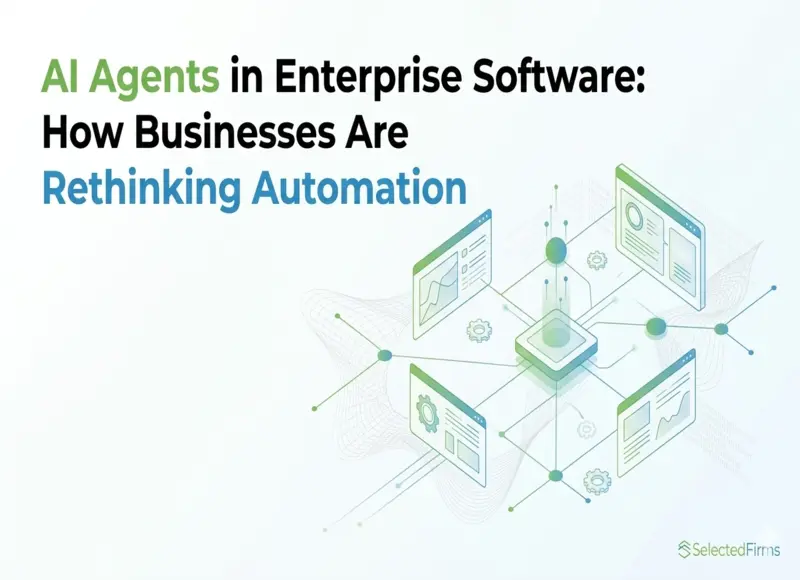
Artificial intelligence is moving beyond isolated tools and chatbot interfaces. Businesses today are increasingly focused on systems that can execute multi-step workflows, coordinate across software environments, and adapt decisions over time.
This shift has pushed the concept of AI agents into mainstream enterprise discussions. Rather than acting as assistants waiting for prompts, modern AI agents function as operational layers capable of planning, reasoning, and executing actions inside business ecosystems.
For companies evaluating technology partners or digital transformation strategies, understanding this transition is becoming essential.
Why Traditional Automation Is No Longer Enough
For years, organisations relied on rule-based automation to reduce repetitive work. While effective for predictable tasks, these systems struggle when workflows require context, decision-making, or adaptation.
Common limitations include:
- Inability to adjust when data changes
- Heavy dependence on manual oversight
- Poor interoperability across multiple systems
- Difficulty scaling complex workflows
As businesses grow, these constraints increase operational friction and slow execution speed.
AI agents address this gap by combining reasoning, memory, and tool orchestration. Instead of simply executing predefined rules, they evaluate outcomes and decide what actions to take next within approved boundaries.
What Makes AI Agents Different From Standard AI Tools
Many companies already use AI-powered features such as content generation, analytics assistants, or recommendation engines. However, these tools often operate in isolation.
AI agents introduce several new capabilities:
- Goal-driven execution rather than single-step responses
- Multi-tool coordination across APIs and enterprise software
- Continuous feedback loops that refine decisions over time
- Operational autonomy within defined governance frameworks
This allows organisations to automate not just tasks but complete workflows - from data gathering and analysis to execution and reporting.
Companies exploring this transition often look toward specialised AI agent development services to build systems that integrate securely with enterprise infrastructure and internal processes.
The Role of LLM Customization in Enterprise AI
A major challenge in enterprise adoption is that general-purpose AI models rarely understand domain-specific language, business logic, or compliance requirements.
Without adaptation, organisations face issues such as:
- inconsistent outputs
- hallucinated information
- weak alignment with internal processes
- low trust among operational teams
This is why customisation has become a core step in production AI deployments.
Approaches such as fine-tuning, retrieval-augmented generation (RAG), and instruction alignment allow companies to adapt models to their own data and terminology. Businesses investing in LLM customization typically achieve higher reliability and stronger adoption internally because outputs better reflect real operational context. LLM customization
AI Agents as an Operational Layer
One of the most important trends for 2026 is the shift from “AI tools” to “AI-enabled operations.”
Instead of adding standalone AI features, companies increasingly integrate intelligence directly into workflows such as:
- customer service orchestration
- internal knowledge management
- compliance monitoring
- reporting and analytics automation
- cross-system process execution
This approach allows organisations to preserve existing software investments while improving efficiency through incremental automation.
Industry platforms focused on enterprise AI transformation are positioning AI agents as long-term operational infrastructure rather than experimental technology. Nextigent AI
What Businesses Should Consider Before Adoption
Before deploying AI agents, decision-makers should evaluate several factors:
- Governance and Security
Agents must operate within clearly defined permissions and monitoring systems. - Integration Strategy
Successful adoption depends on connecting agents to real business tools and data sources. - Performance Observability
Teams need visibility into agent decisions, actions, and outcomes. - Scalability
Pilot projects should be designed with enterprise expansion in mind.
Companies that treat AI agents as strategic infrastructure - rather than short-term experimentation - tend to achieve more sustainable results.
Final Thoughts
AI agents represent a natural evolution of enterprise automation. As workflows become more complex and organisations demand faster execution, systems capable of reasoning and acting autonomously are becoming increasingly valuable.
For businesses evaluating digital transformation partners, the key question is no longer whether AI should be adopted, but how intelligently it can be integrated into existing operations.
The organisations that succeed will be those that combine strategic planning, customised intelligence, and scalable architecture - turning AI from a tool into a true operational advantage.

Head Of Digital Marketing at SelectedFirms
Recent Blogs
Software
Trends
Jane Hart
The Role of a Retail Software Development Company in Driving Omnichannel Growth
-

16 Mar 2026
-

8 Min
-

60


Isha Choksi
How to Choose a Professional Team Chat App for Streamlined Internal Communication
-
13 Mar 2026
-
5 Min
-
328