


Table of Contents
The $3B browser gaming market reveals how bypassing app store fees and owning distribution channels can significantly improve profit margins. By prioritizing direct-to-user access and organic growth, software firms and agencies can reduce dependency on co
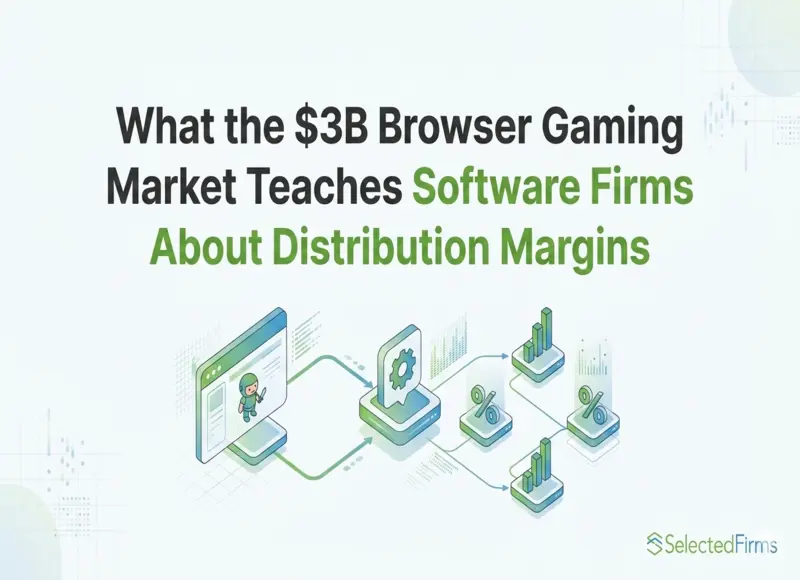
Every digital business eventually confronts the same structural problem: the platform you rely on for distribution takes a cut, controls your visibility, and can change the terms at any time. For software firms, agencies, and SaaS products, that intermediary is often an app store, a directory like SelectedFirms, Clutch, or Upwork, or a marketplace that charges for placement. The gaming industry ran this experiment at scale and found a way around it. The results are worth examining.
The 30% Tax That Redirects Developer Revenue
Steam, Apple's App Store, and Google Play each apply a standard 30% fee to developer transactions. That cut has remained largely unchanged for over a decade and compounds at scale. A studio earning $500,000 annually through an app store nets $350,000 before factoring in taxes, support costs, or reinvestment. Distribution and discovery are sold separately — and that second bill for visibility is where the real cost compounds.
A software agency dependent on a third-party directory faces a structurally similar problem: margin lost to placement fees, lead generation costs, or revenue share arrangements that don't diminish as the business grows. Browser gaming companies resolved this by building distribution as a core business asset rather than renting access to someone else's. The browser gaming market is projected to rise from $1.03 billion in 2021 to $3.09 billion by 2028, according to Google and Kantar data. That growth reflects a deliberate architectural choice: direct-to-user distribution without gatekeepers.
How the Model Works in Practice
Free game platform Poki is the most data-rich example of this approach. Co-founder Michiel van Amerongen outlined growth that reached 100 million monthly active users and 1 billion plays per month in June 2025, achieved without external funding and with a team that grew from 35 to 65 employees. Like an app store, Poki operates on a revenue-share model, but the mechanics are fundamentally different. App stores take their cut and then charge developers again for visibility through paid placement and promotional features. Poki handles ad sales on behalf of developers and provides distribution, discovery, and audience access as part of the same arrangement. There is no second bill for visibility. A game that performs well surfaces through the platform's own curation, not because the studio paid to be featured.
Critically, that audience of 100 million monthly users belongs to Poki. It is not rented from a search engine, a social platform, or an app store. Poki owns its channel, and because it does, the developers on it benefit from a stable, compounding audience that doesn't erode when external platform policies change or ad costs rise.
The Same Problem Looks Different in Software
For a digital agency listed on SelectedFirms, Clutch or Upwork, or a SaaS product dependent on the App Store for discovery, the structural problem is identical even if the numbers look different. Directory fees, marketplace commissions, and paid placement costs don't shrink as the business grows; they scale with it. An agency generating $2 million in annual revenue through a directory that charges 15% in lead fees or commissions is surrendering $300,000 before a single operational cost is accounted for. Unlike the 30% app store tax, that cost is largely invisible because it's baked into the cost of doing business rather than appearing as a line item. The browser gaming model makes it visible by contrast.
Three Principles That Transfer Outside Gaming
The browser gaming model doesn't translate wholesale to enterprise software or professional services. But the structural principles behind its success do.
Own the channel, not just the product. Poki built an audience of 100 million monthly users that comes directly to the platform, not through a third-party store, not through paid acquisition, and not through an algorithm it doesn't control. That owned channel is the foundation everything else is built on. Agencies and software development companies that rely exclusively on Clutch, Upwork, G2, or similar directories are renting access to an audience, not building one. When those platforms change their algorithms, raise listing fees, or deprioritise certain categories, the business has no fallback. The firms growing most efficiently are the ones treating direct search presence, content, and owned audience as infrastructure rather than optional marketing.
Organic reach compounds where paid spend does not. Because Poki owns its channel, games on the platform are discovered through curation, direct search, and sharing, not through paid placement. That reach compounds over time without a corresponding increase in cost. For a software firm, the equivalent is a content and SEO strategy that generates inbound leads independently of any directory or marketplace. The marginal cost of an additional lead through owned channels approaches zero at scale. The marginal cost through a directory does not.
Lower acquisition cost improves unit economics as you grow. Turkish indie studio Emolingo Games started as a two-person team and has grown to five full-time employees, averaging 800,000 daily gameplays across an eight-title catalog — built entirely on curation and organic reach, not marketing spend. The parallel for software firms is direct: a SaaS business spending $40,000 annually on directory placement that generates $200,000 in pipeline is effectively paying a 20% toll on growth — a cost that doesn't appear on the P&L but shows up in the unit economics. Every percentage point of revenue not surrendered to a marketplace is margin available for reinvestment, headcount, or profit. For firms considering whether to outsource or scale in-house, the same logic applies: where your costs sit structurally determines your ceiling.
The browser gaming market's trajectory over the past five years is a measurable case study in what direct-to-user distribution produces when the intermediary is removed. The gaming industry didn't stumble onto this model; it engineered it deliberately in response to the same margin pressure that most digital businesses accept as a fixed cost. It isn't.


Head Of Digital Marketing
Recent Blogs

Elia Martell
5 Virtual Recruiting Support Operations for Tech and Healthcare Teams
-

09 Oct 2026
-

8 Min
-

477
Jane Hart
Why LinkedIn Campaign Optimization Requires More Than CPC and CTR
-
09 Oct 2026
-
8 Min
-
155

Jane Hart
How to Vet an Offshore SEO Partner: A Due-Diligence Checklist for Agencies and Brands
-
08 Oct 2026
-
8 Min
-
263
Jane Hart
Benchmarking GPU Providers: A Practical Guide to Comparing Cloud Compute Options
-
07 Oct 2026
-
6 Min
-
173
