


Table of Contents
Agentic commerce shifts online shopping from human-led browsing to AI-driven execution, where autonomous agents handle discovery, comparison, and purchases, requiring retailers to adapt their data, infrastructure, and strategies to remain visible and comp
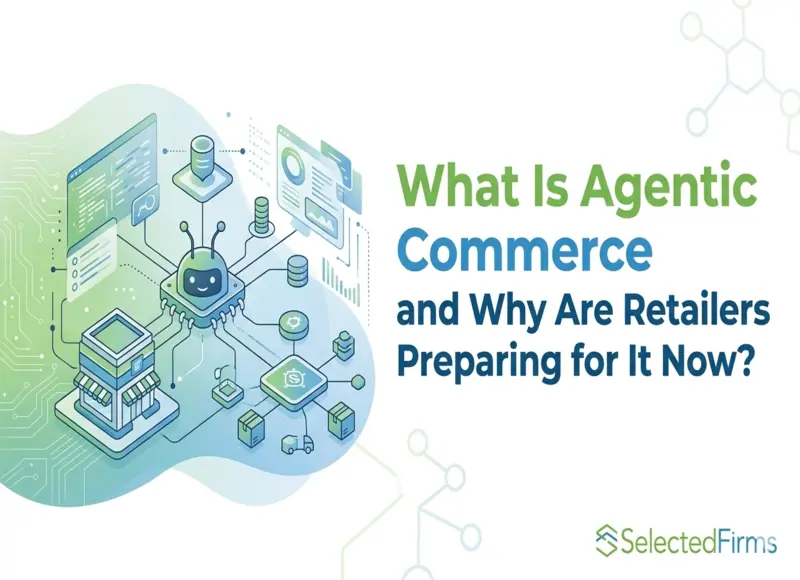
What is Agentic Commerce?
Agentic commerce describes the broader structural pivot from human-led navigation to AI-led execution for online buying. In conventional ecommerce, consumers must drive the navigation themselves typing search queries, opening browser tabs, comparing reviews, and entering payment details manually.
Agentic commerce seeks to delegate all this effort to a set of fully autonomous AI agents that can reason and plan across multiple systems in their interactions, helping discover, compare, evaluate, and even make a secure payment for a product.
This is the natural evolution as an operational layer beyond search-led and click-led ecommerce experiences. Historically, ecommerce transitioned from the merchant website era, where consumers typed in brand/product URLs, to the marketplace aggregation era, where platforms viewed it as their mission to collect infinite choice.
Today, the AI agent wants to supplant the marketplace screen as the personalized interface. Instead of consumers interacting with low-complexity product recommendation engines or sophisticated layouts of higher-complexity products, they delegate their goals to their assistants, who are then tasked with a firm price ceiling and functional goal. Options can be autonomously researched, vendors selected, and ultimately a firm product recommendation given.
From the perspective of individual retailers, this means their websites change in purpose: from primarily visual interfaces meant for humans to a machine-readable data supply chain that must interface with autonomous assistants. Achieving this level of readiness and discoverability is a multifaceted challenge. Some businesses invest in Agentic Commerce Services to improve visibility and readiness as commerce journeys become more AI-driven, ensuring their infrastructure is optimized for machine-led interactions.
How Agentic Commerce Alters the Shopping Journey
Search-Led Navigation Converts to Chat-Led Buying Journeys
Shopping journeys for ecommerce products currently require strong navigation and linear browsing actions. Users type in queries and filter through pages of search results before evaluating and considering various options. Agentic commerce shortens this by condensing it into the Ask -> Shortlist -> Action format.
Instead of ranking 20+ websites as links, an AI agent can consider a user's purchase history, inventory constraints, and preference inputs to make contextual, relevant shortlists of products. Discoverability thus evolves to be less webpage-first and more conversational and intent-driven. Natural language constraints can be added, like "Find me a vintage 1970s aesthetic jacket for my teenage self, costing <$100," and the agent then finds the optimal vendor and product without needing to visit any retailer's homepage.
What AI Shopping Agents Deliver to Consumers
In the early days, shoppers' usage firmly falls into research assistant capabilities. Consumers actively use AI to summarize tradeoffs, verify summarizations of aggregate reviews, and find the optimal combination of shipping and price. Over time, these behaviors start to resemble conditional execution, almost like limit order shopping.
The agent might then checkout the entire cart, but only when a certain product's price falls below a threshold or when the overall offer benefits from maximal cashback from the shopper's credit card. This transition to hands-off usage eliminates the need for continual monitoring and redefines the complex consumer interaction of product discovery as a well-defined intent that is delegated.
Why Agentic Commerce Matters for Retailers Now
Why Timing Matters
The rapid adoption of AI throughout the buying journey has now reached an inflection point in business significance. As of today, a growing share of consumers use conversational AI in the pre-shopping phases of the buying journey. As large language models and unified commerce protocols improve rapidly, the agentic capabilities market is expected to see aggressive growth from $5.2 billion in 2024 to an estimated $47 billion by 2030 (Statista)
What’s New in Retail and AI in the Past Year
Automated AI shopping assistants drive a substantial increase in retail traffic volumes, influencing where transactions occur during Cyber Week and other events. This growth demands that retailers quickly adapt, changing how discovery occurs, or they will be locked out.
Brands must pivot from traditional website UX/keyword SEO strategies, as waiting for this new ecosystem to fully emerge will create irreversible data debt, given that it takes multiple quarters to transition a brand's strategy to be fully AI agent-readable. Any holdout retailers risk invisibility from the autonomous agents that are increasingly driving discovery.
What Agentic Commerce Creates and Allows For
Better Consumer Experiences
Agentic commerce creates powerful levers for retailers to further reduce friction in product discovery and amplify personalized decisioning. Anticipated questions on a page can be added in the form of AI-driven responses rather than generic chat boxes. This allows brands to guide consumers through considered purchases of high-value products like skis or home furnishings with tailored responses for individual customers.
Agents also drive new opportunities for frictionless post-purchase behavior. In a rigid subscription use case, an AI agent can propose the ability to pause the delivery cadence for six months instead of canceling outright. This helps retain revenue and maintain brand affinity.
New Discoverability Growth Levers
Because AI assistants add more specificity and diversity to the constraints that users input over chat, the conversational transcripts generated also create powerful customer intent data. This can be used for "Value Mining" by retailers looking to expand with features, accessories, or permutations of their products that are hard to surface initially.
Additionally, agent-led discovery opens the door to novel incentive delivery models like "Direct Offers." Instead of display advertising with off-site clickthroughs, retailers can now advertise financial offers that are triggered in real-time during the AI reasoning session.
For example, if an agent determines a consumer wants to buy but is only held back by pricing, it might add a 20% discount plus free shipping offer to incentivize the purchase before the reasoning session ends.
What Agentic Commerce Poses as Risks
Data Quality and Trust Issues
Legacy ecommerce systems are broadly unprepared to handle AI-led interactions, exposing them to significant data quality vulnerabilities. When internal product catalogs are not properly structured and normalized, they experience "narrative drift" as independent AI agents capture web indexes, contradictory third-party reviews, and hallucinated claims from third-party category managers.
Marketing attribution also becomes a major contentious governance issue, as new agents intercept late-stage buying intents and claim last-click dominance in a way that resembles legacy coupon websites, which unfairly claim credit for guaranteed sales. This dynamic puts merchants at risk of paying repeated performance fees for existing customers they were already driving via loyalty programs.
Risk of Being Invisible to Agent-Led Discovery
The most immediate risk of the agentic commerce paradigm is that direct control over discovery is ceded. If early parts of the shopping journey move to third-party AI interfaces, then retailers become relegated to the fulfillment plumbing layer, with direct customer visibility lost.
This undercuts the ROI for centralized loyalty program initiatives and on-site personalization architecture. Significant risks arise for "Merchant of Record" disintermediation; if a brand is bypassed in the AI-led checkout process, they lose first-party data and post-purchase retention opt-in signals.
How Retailers Can Prepare for Agentic Commerce
To survive the agentic commerce transition, retailers must rapidly overhaul how discoverability infrastructure emerges, moving from Search Engine Optimization (SEO) to Generative Engine Optimization (GEO). They must improve data quality and consistency to ensure categorical information is conveyed properly to machine learning models.
It's common that 80% of compelling context around products like manufacturing heritage, technical specs, and sustainability claims exists in unstructured marketing content and must be normalized into structured datasets. Information architecture strategies must phrase data inputs to answer high-order shopper intent in natural language, as opposed to simply matching low-level keyword terms.
There needs to be a robust dual sourcing of data, with brands aligned from structured data inputs on the page all the way up to inventory pipelines that sync with global data exchange networks. Digging through external APIs, data feeds, and content systems, purchasing logic rules must be made explicit in a machine-readable way, capturing local inventory availability, shipping weights, and promotional bundle tiers.
Upgrading data maturity by auditing API endpoints, feeds, and integrations, leveraging concepts like digital transformation and retail technology, can help ensure their ecosystem is reachable by the autonomous AI interfaces that drive online commerce. Failing to influence the ecosystem this way creates implicit invisibility; if AI agents recommend products but automatically exclude domains that do not support them well, retailers must respond with comprehensive audits.
Where Agentic Commerce Creates Benefits for Retailers
Generic multi-SKU ecommerce brands and retailers selling commodity household essentials and functional lifestyle goods will likely see early benefits, as consumers are happy to delegate low-risk and low-value repetitive purchasing intents to autonomous software.
Because complex products and comparison-heavy categories will also benefit from this ecosystem transition, where dense specification overviews require heavy diffusion for shoppers to compare and contrast options, conversational AI agents become valuable to digest this info and summarize tradeoffs.
Broad marketplaces or destination brands with comprehensively large catalog sizes will benefit from acting on structured integrations. Early beneficiaries will be brands that leverage digital discovery, with highly defined parametric products that translate into clean and machine-interpretable logic to catch the AI-assisted high-intent traffic that emerges.


Head Of Digital Marketing
Recent Blogs


Elia Martell
5 Virtual Recruiting Support Operations for Tech and Healthcare Teams
-

09 Oct 2026
-

8 Min
-

477
Jane Hart
Why LinkedIn Campaign Optimization Requires More Than CPC and CTR
-
09 Oct 2026
-
8 Min
-
155

Jane Hart
How to Vet an Offshore SEO Partner: A Due-Diligence Checklist for Agencies and Brands
-
08 Oct 2026
-
8 Min
-
263
Jane Hart
Benchmarking GPU Providers: A Practical Guide to Comparing Cloud Compute Options
-
07 Oct 2026
-
6 Min
-
173
