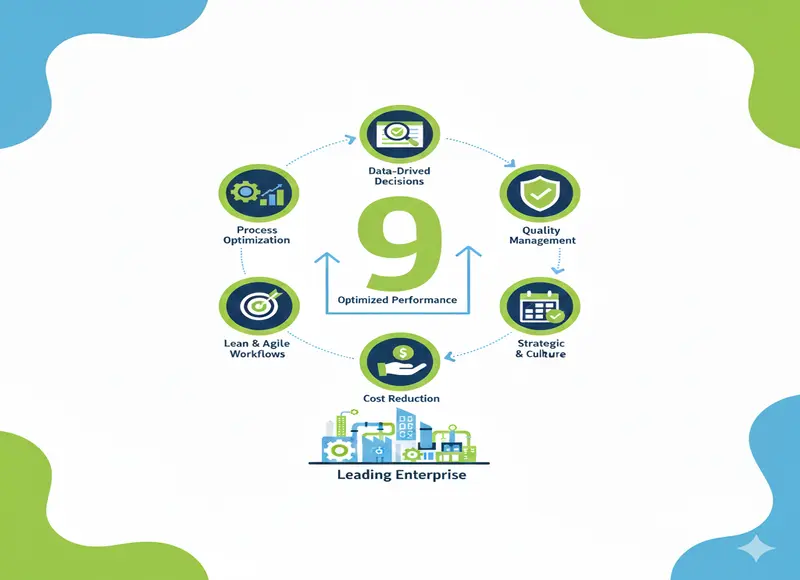
9 Operational Excellence Strategies: How Leading Enterprises Optimize Performance
-
Last Updated:

24 Dec 2025
-
Read Time:

6 Min Read
-
Written By:
 Elia Martell
-
18
Table of Contents
Operational excellence isn’t flashy, but it wins. Learn how nine proven strategies help leading enterprises reduce waste, align teams, improve flow, and turn everyday execution into a quiet, powerful driver of long-term performance.
‘Good advice is always certain to be ignored, but that is no reason not to give it.’ Agatha Christie was very good at reading people, and paradoxically, her work is also suited to the corporate world.
Operational excellence is simple in theory. The right things to do. Do them well. Continuously improve. But in real-life corporations, things go awry in execution, in priorities, or in following good advice through the day-to-day.
The exceptional companies aren’t perfect. They're disciplined. They stick to a few key strategies and deploy them across their organization, their teams, their systems, and their decisions.
Below are nine strategies that are usually employed by organizations that emphasize operations excellence in improving their performance.
1. Build a Strong Operational Core Around Inventory and Flow
For any business that involves physical commodities, the success of operations depends on inventory.
The choice of the inventory management solution has become a crucial aspect in any business or institution that deals with physical items, of which you can learn more on MRPeasy’s site. Inventory is the spinal cord of your business operations. If the data is stale or not accurate, everything else feels it. The sales team overpromises. The finance team loses sight. The warehouse ends up responding, not planning.
World-class teams see inventory management not as a boring back-office function, but rather a strategic underpinning.
They prioritize visibility. Understanding what is in inventory, where it is, and the rate of movement gives the organization or company confidence. This allows them to optimize reorder points, lead times, and safety stocks based not on intuition but on their demand.
2. Invest in Learning Systems That Actually Change Behavior
Operational excellence stems from people and not just processes.
Choosing the right Learning Management System is far more important than many leaders grasp. The market is saturated, and not all solutions result in real-world performance. These are solutions that simply exist for the storage of information without impacting how work is done. Others comply with regulations but never increase genuine capabilities.
The best companies are very specific about this. Learning platforms should be aligned with performance, rather than the completion of learning.
Kallidus’ learning management system helps organizations identify appropriate learning solutions through which they can quickly accelerate compliance and performance. It won’t be learning for the sake of learning. It will be learning that translates into better decisions being made quickly.
Effective organizations know, too, that learning is an ongoing process. They plan for learning that grows with the business, not for quick bursts of training.
Learning systems allow the achievement of success in work when learning occurs.
3. Standardize What Matters and Flex Where It Counts
Many individuals go wrong when they attempt to make everything standard.
Top-performing organizations are more selective. They standardize core processes that benefit from consistency, such as order fulfillment, quality checks, or financial close. This reduces variation and creates predictable outcomes.
But they also keep some room for maneuver on the edges. Teams that are closer to customers or suppliers can maneuver within some defined limits. This ensures a smooth flow without becoming too rigid.
It’s easiest to standardize when it’s well-documented, easily understood, and reviewed on a regular basis. If individuals understand the reasoning behind the process, then they will willingly cooperate.
4. Use Data to Guide Decisions, Not to Drown Teams
Data has the power, and it only works if you use it properly.
Best-run companies remain focused on what they measure and for what reason. They focus on a few key metrics linked to certain outcomes such as order fulfillment, lead time, inventory turns, and satisfaction.
The company also tries to make its data accessible. The dashboard is simple to use. The company shares definitions. The teams are satisfied with the numbers because they understand their derivation.
Some general principles always help:
- Capture trends rather than points in time
- Connect metrics to ownership and action
- Assess data regularly, not just when issues arise
When data supports decision-making instead of overwhelming individuals, there will be better performances.
5. Design Processes Around the Customer Experience
Operational excellence isn’t only about doing more with less with their own resources.
The best organizations plan the way they do business, considering the customer. This is because they ask themselves the question of how the way they do the work internally impacts delivery time and communication. Customer satisfaction may be vastly improved by small changes.
This mindset causes the approach to projects to change. They stop focusing on the efficiency of the department and seek to optimize the overall end-to-end process. The handoffs are minimized. The bottlenecks are fixed on a system-wide level.
Putting the focus on customers also reveals the trade-offs. When the impact of the delay or error is realized for the customers, the team sees the pressure to improve.
Some operations silently protect the customer experience every day.
6. Empower Teams With Clear Ownership and Accountability
Operational excellence is best achieved where everyone understands who is accountable for what.
The best teams articulate ownership for every level. Everyone knows what they own in terms of their processes, what they can decide, and when they should call in help from other sources. This eliminates delays and prevents issues from moving from one group to another.
Accountability is closely tied to trust. Executives provide guidance and support. Then they move away. There is encouragement to point out problems early on rather than just pushing them under the carpet.
This culture turns conversations from blame to improvement. Error becomes a signal, not a failure.
When you identify outcomes, the performance of your business improves.
7. Commit to Continuous Improvement as a Daily Habit
The best companies prioritize improvement. Small improvements are encouraged. Feedback cycles are rapid. A usual question among teams is ‘What can we do next time?’
Improvement happens most successfully when it’s simple. Having retrospectives, action items, and tracking progress helps to keep the momentum. Slowly but surely, the little steps lead to huge milestones.
It also helps in building resilience. Those organizations that always improve would adapt quickly in any change.
8. Align Operations With Clear Strategic Priorities
A common pitfall in pursuing excellence in operations is the loss of focus.
If everything is important, the team of workers cannot identify the important ones to handle first. Great organizations prioritize their operations within the context of a few strategic priorities.
This starts in the area of leadership. Specific goals are translated into specific aims on which teams can act. Is it a strategy for moving faster? OPS focuses on shortening lead times. Is it a strategy for preserving margins? Teams look at waste, rework, and inventory.
With clarity, it is easier to make trade-offs. The teams would know what to optimize for and what to move back to the list. This would reduce friction between different departments, eliminating frequent changes of direction frequently.
Effective organizations continually update priorities. Markets vary. Customer demands vary. The operational focus needs to respond.
9. Strengthen Cross-Functional Collaboration to Remove Bottlenecks
Great operations are not typically brought down by just one team.
More often, performance issues appear in the gaps between functions. Sales, operations, finance, and procurement may all perform well individually, yet struggle collectively.
World-class companies really prioritize cross-functional collaboration. They understand all parts of the end-to-end process and identify where their handoffs create bottlenecks or misunderstandings. Who owns what becomes easy to see, and they trade their individual metrics for common objectives.
It also involves a lot of cross-team conversation. It involves frequent check-ins to enable the identification of problems earlier. It also involves the use of shared dashboards to make sure that all people are looking at the same numbers. It also involves decision-making with the whole chain affected in mind.
This thinking also helps with problem-solving. When a team recognizes the impact of their endeavors on another team, the solutions will be more effective.
Effective collaboration can make a set of disparate operational functions a single system process.
Bringing It All Together
The most successful companies lock in strong functional fundamentals, such as inventory and learning. These companies optimize by standardizing well, managing their data, and designing their process thinking about their customers. These companies trust their employees and view improvement as a routine process, not a project approach.
Together, these efforts make performance optimization not reactive but rather a part of how everyone in the organization thinks and acts every day.
That’s what separates operationally excellent companies from the competition.

Marketing Manager
Recent Blogs