


Identity Verification Software: Features, Benefits, and Use Cases
-
Last Updated:

18 Feb 2026
-
Read Time:

6 Min Read
-
Written By:
 Elia Martell
-
1620
Table of Contents
An expert guide to identity verification technology, explaining how businesses use automated checks to enhance security, streamline onboarding, and scale with confidence.
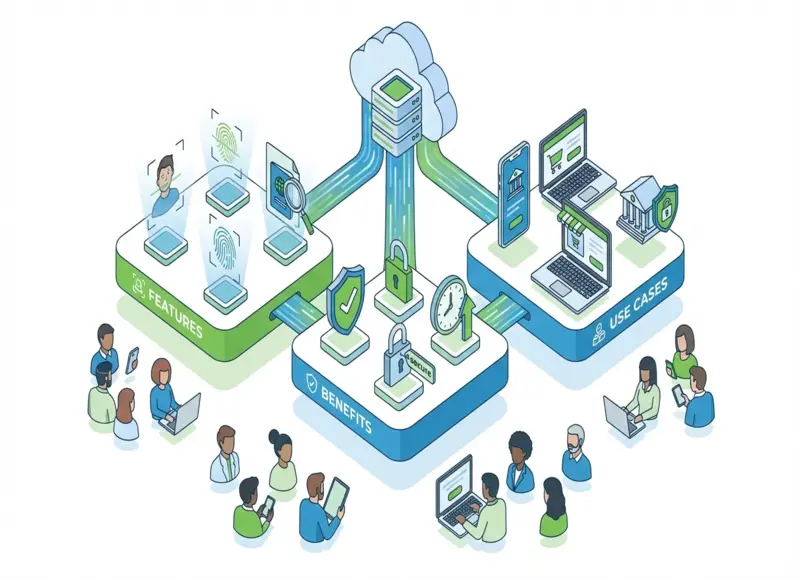
Digital business has removed geography from customer onboarding. A bank customer may never visit a branch. A crypto trader may register from another continent. A patient may consult a doctor without leaving home.
But while digital access has expanded, one question remains unchanged:
How do you know the person on the other side of the screen is real?
Identity verification software provides answers to that. It helps confirm identities when not physically present, reduces the exposure to fraud activities, and helps to comply with regulatory bodies without compromising user experience.
An era marked by high-end deepfake impersonations and forged quality documents has seen increased complexity of identity fraud. Automated identity verification is globally recognized today as one of the most secure layers for digital corporations.
What Is Identity Verification Software?
Identity verification software is a digital system designed to confirm that a person is who they claim to be. It does this by analyzing identity documents, comparing biometric data, and cross-checking trusted data sources.
At first glance, that may sound simple. In practice, it involves multiple technologies working together in real time.
It’s also important not to confuse identity verification with authentication.
Identity verification is the initial process of establishing trust in a person’s identity. Authentication happens later, when that verified user returns and needs to prove they are still the same individual.
Most modern verification workflows follow a similar structure:
- A user submits a photo or scan of a government-issued ID.
- The document is analyzed for authenticity.
- The user provides a selfie or short video.
- The system compares biometric data.
- Liveness checks confirm the presence of a real person.
- Risk signals are evaluated before a decision is made.
From a user’s perspective, the process takes seconds. Behind the scenes, it’s far more complex.
Core Features of Identity Verification Software
Robust Identity Validation Software does not rely on a single control, it leverages a combination of document inspection, biometric validation and fraud detection to reduce the risk of multiple points.
Document Authentication
The first step is verifying the identity document itself.
Advanced solutions examine:
- Machine Readable Zone (MRZ) data
- Document layout consistency
- Security features such as holograms or microtext
- Embedded RFID or NFC chip data (for ePassports and eIDs)
- Data integrity and expiration details
There are so many different identity document types that analyzing all of them poses quite a challenge. Really reliable means require large databases of templates and forensic-level means for differentiating genuine documents from surreptitiously modified and deliberately false documents.
RFID chip verification adds yet another layer of trust because the verification validates digitally protected data stored inside the document.
Biometric Face Matching
Once the document appears authentic, the next question is whether the person presenting it is the rightful owner.
Facial recognition technology performs a 1:1 comparison between:
- The portrait extracted from the ID document
- A live selfie or video captured during verification
Modern biometric engines assess hundreds of facial data points to produce a likeness score, which categorizes whether or not the two images match.
This operation requires as much precision as anything. Too much of it reduces legitimate users; too little fails to protect against fraud.
Liveness Detection and Anti-Spoofing
Fraudsters hardly think about stopping after they get hold of some data; they undoubtedly try very hard to trick technical systems with printed photos, film replays, silicone masks, or, most recently, deepfake videos.
Liveness detection ensures that the system is interacting with a real person physically present during the verification session.
There are two primary approaches:
- Active liveness prompts the user to perform small actions, such as turning their head or blinking.
- Passive liveness works in the background, analyzing depth, texture, and subtle behavioral cues without requiring user interaction.
Presentation attack detection (PAD) further strengthens defenses by identifying spoofing artifacts that are invisible to the human eye.
Database and Compliance Screening
For regulated industries, identity verification often extends beyond confirming authenticity.
Financial institutions, crypto platforms, and other regulated entities must screen users against:
- Sanctions lists
- Politically exposed persons (PEP) databases
- AML watchlists
- Internal fraud records
Automating these checks ensures consistent compliance and reduces the risk of regulatory penalties.
Risk-Based Decisioning
Not every identity verification attempt carries the same risk.
Sophisticated platforms apply risk scoring models that consider:
- Document anomalies
- Biometric confidence levels
- Device characteristics
- IP address and geolocation inconsistencies
- Behavioral indicators
This approach ensures that organizations can only scrutinize transactions when required, adjusting easily between user comfort and security.
Integration and Deployment Flexibility
From a technical standpoint, identity verification software must integrate smoothly into existing ecosystems.
Most enterprise solutions provide:
- Mobile SDKs
- Web-based verification flows
- REST APIs
- Cloud, on-premise, or hybrid deployment options
Deployment flexibility is particularly important for organizations operating in regions with strict data protection requirements.
Business Benefits of Identity Verification Software
The technical features are only part of the picture. The real value becomes clear when looking at business impact.
Reduced Fraud Exposure
Multi-layered identity checks significantly lower the risk of:
- Synthetic identity fraud
- Account takeover
- Identity theft
- Forged document abuse
By detecting inconsistencies early in the onboarding process, organizations can prevent financial losses before they occur.
Improved Regulatory Compliance
Compliance requirements are growing stricter across jurisdictions.
Identity Verification Software is a necessity for organizational functions that must be performed efficiently and legally trusted to comply with corporate requirements.
Automated functions moderate the rate of potential human error, potentially due to inherent oversights in manual review processes.
Faster Onboarding
Speed matters.
Complex, indefinite processes can bore users, driving off. Computerized verification of one's identity in less than sixty seconds can indeed improve conversion rates without compromising security whatsoever.
It essentially aids in digital-age revenue enhancement.
Operational Cost Savings
Manual document review teams are expensive and difficult to scale.
By automating identity checks, organizations can reduce staffing costs, minimize fraud-related losses, and lower chargeback rates. Over time, these efficiencies often outweigh implementation expenses.
Scalability for Global Growth
As companies expand internationally, they must verify identities from different countries, each with unique document formats.
Strong identity verification software supports global document coverage, multilingual interfaces, and high-volume processing, enabling businesses to scale confidently.
Common Use Cases Across Industries
Identity verification software supports a wide range of industries where trust is critical.
In banking and fintech, it enables remote account opening and loan applications while supporting AML compliance.
Cryptocurrency exchanges use it to meet regulatory requirements and prevent fraudulent account creation.
Online marketplaces verify sellers and freelancers to reduce scams and fake profiles.
Healthcare providers are using identity verification as a preventive measure to protect patient records as well as check insurance fraud.
Airline companies and border agencies check the biometric details of passengers to accelerate passenger processing and improve security.
Digital identity verification ensures contact with public services that are secure and are provided by the government.
Irrespective of the industry, the fraud-prevention goal remains the same: trading trust in a digital environment.
How to Choose the Right Identity Verification Software
Selecting a solution requires more than comparing feature lists.
Organizations should evaluate:
- The breadth and depth of document template coverage
- The accuracy of biometric algorithms
- The robustness of liveness detection
- Deployment flexibility
- Compliance certifications
- Vendor expertise in document forensics
Solutions built on forensic document examination expertise often provide stronger protection against sophisticated forgery techniques.
Conclusion
Identity fraud is evolving rapidly. Deepfakes are improving. Synthetic identities are harder to detect. Fraud networks are increasingly organized.
As a result, identity verification software must continue to evolve as well.
Artificial intelligence will play a growing role in fraud pattern detection. Biometric systems will become more resilient against deepfake manipulation. Decentralized identity models may reshape how digital identities are stored and reused.
What will not change is the need for reliable identity verification as the foundation of digital trust.

Marketing Manager
Recent Blogs

Elia Martell
5 Virtual Recruiting Support Operations for Tech and Healthcare Teams
-
09 Oct 2026
-
8 Min
-

631

Jane Hart
Why LinkedIn Campaign Optimization Requires More Than CPC and CTR
-
09 Oct 2026
-
8 Min
-
189

Jane Hart
How to Vet an Offshore SEO Partner: A Due-Diligence Checklist for Agencies and Brands
-
08 Oct 2026
-
8 Min
-
325

Jane Hart
Benchmarking GPU Providers: A Practical Guide to Comparing Cloud Compute Options
-
07 Oct 2026
-
6 Min
-
187
