


Why Execution Speed Matters More Than Creativity for Marketers
-
Last Updated:

10 Feb 2026
-
Read Time:

6 Min Read
-
Written By:
 Harshita Toplani
-
1609
Table of Contents
Trends don’t wait. Algorithms don’t either. In today’s digital world, execution speed beats creativity, and AI helps marketers move faster, publish sooner, and win attention before moments disappear online today.
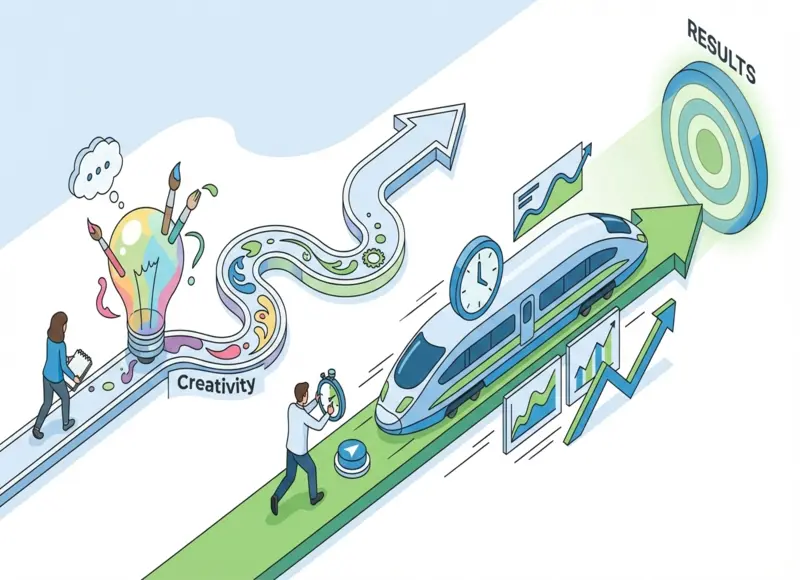
In the fast & furious world of social media, great ideas aren’t the big deal; instead, getting them live is. Markets move fast, algorithms move faster, and hesitation kills momentum. Execution speed is what turns creativity into real results before the moment passes.
How AI Helps Teams Keep Up With Platform Pace
Social media platforms now move faster than most marketing teams can react. Trends rise and fall within days, sometimes hours. Algorithms reward early signals, and late content rarely recovers—no matter how strong the idea is.
Today, marketers are no longer competing on ideas alone. They are competing on the digital world’s reaction time. The brands that win are not always the most creative, but the most responsive.
This shift explains why many strong campaigns fail to gain reach. The idea may be solid, the messaging clear, and the execution polished—but it arrives too late. By the time content is published, platform momentum has already passed.
AI tools matter in this environment because they compress execution time. They allow teams to move at platform speed without increasing workload, headcount, or burnout.
Platforms Now Reward Timing Before Quality
Modern social algorithms prioritize early engagement. Distribution decisions happen quickly, often within the first minutes or hours after posting.
Key signals include:
- Initial watch time
- Early interaction velocity
- Format alignment with current trends
Content quality still matters, but only after these signals are met. First impressions are fundamental in this game. A post that does not hit it off at the beginning seldom has a second chance. The setup plays into renderer that immediately publishes, tests, and adapts.
Speed is no longer a nice-to-have. It is built directly into how reach is allocated.
Why Manual Workflows Cannot Keep Up
Traditional content workflows assume stable timelines. Ideation, filming, editing, and approval often happen sequentially. This model worked when platforms moved slower—but it fails under rapid algorithm cycles.
By the time content is produced:
- The trend has shifted
- The format feels outdated
- The algorithm has moved on
Speed becomes the bottleneck, not creativity. Teams aren’t short on ideas—they’re trapped in processes designed for a slower internet.
Speed Lever 1: Pre-Built Trend Structures
Fast execution starts with format alignment
 .
.
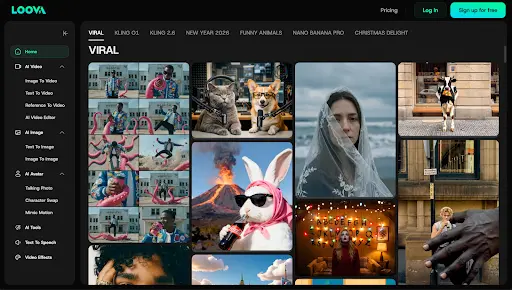
Trending templates reduce analysis time. Instead of reverse-engineering viral formats from scratch, marketers reuse structures already performing well. This removes guesswork and accelerates decision-making.
AI-powered template systems adapt to platform behavior continuously. Teams focus on message and positioning rather than mechanics and formatting.
Loova integrates trending templates that reflect current short-form patterns, allowing marketers to move directly from idea to execution. Less planning. Faster publishing. More relevance.
Speed Lever 2: Motion Without Production
Motion is one of the strongest engagement drivers on social platforms. However, filming motion is expensive, slow, and difficult to scale.

This is where mimic motion changes execution speed.
Mimic motion workflows capture movement from reference videos and apply it to characters or visuals automatically. Motion becomes reusable rather than recreated each time.
Instead of filming every variation, marketers reuse proven motion patterns. Production time drops significantly while consistency improves.
Platforms like Loova integrate mimic motion directly into video workflows. Movement no longer depends on on-camera performance, studio time, or repeated takes. Speed improves without sacrificing engagement.
Speed Lever 3: Automated Voice and Visual Adaptation
Beyond motion, voice and visuals also slow teams down.
Recording voiceovers requires setup and coordination. Visual adjustments require design cycles. Each step adds friction and delay.
Text-to-speech and AI image tools remove these bottlenecks. Scripts become narrated instantly. Visuals adapt across formats without manual resizing or redesign.
Automation shortens feedback loops. Teams can test more variations, faster, with less effort—turning iteration into a strength instead of a burden.
Why Speed Enables Better Decision-Making
Speed is not just about publishing faster. It improves learning.
Fast iteration allows teams to:
- Test multiple hooks
- Compare formats
- Identify winners early
Slow teams guess. Fast teams measure. AI tools lower the cost of experimentation, making data-driven decisions easier and more reliable. When iteration is cheap, insight increases.
Execution Speed Changes Team Dynamics
When workflows accelerate, roles shift.
Marketers spend less time producing and more time evaluating. Strategy replaces manual labor. Decision-making becomes proactive instead of reactive.
This shift improves morale. Teams feel in control of performance rather than constantly chasing deadlines. Speed reduces stress by removing urgency-driven firefighting.
AI Tools to Keep Marketers Ahead of Trends
Here are some of the leading AI tools helping teams move faster, streamline workflows, and adapt to real-time shifts in platform behaviour:
1. Trend Analysis & Insights
- TrendSpottr / Exploding Topics – Discover rising topics early so content aligns with emerging conversations.
- BuzzSumo – Surface trending content in your niche and analyse what’s resonating.
2. Content Creation & Copy
- ChatGPT / Jasper AI / Writesonic – Generate optimised captions, scripts, and hooks instantly.
- Copy.ai – Rapid ideation for taglines, CTAs, and multi-format messaging.
3. Visual Content & Design
- Canva AI – Auto-resize designs for every platform, generate ideas, and produce visuals fast.
- Adobe Firefly – AI-driven image generation and editing that eliminates repetitive tasks.
4. Video & Motion
- Descript – Edit video by editing text; removes transcription bottlenecks and slashes production time.
- RunwayML – AI video tools for background removal, motion tracking, and creative effects.
- Loova – (If you’re referencing earlier) Templates + mimic motion for quick video production.
5. Voice & Audio
- Speechify / ElevenLabs – Ultra-natural text-to-speech for instant voiceovers across languages and styles.
- Cleanvoice AI – Removes ums, pauses, and noise so audio edits become instant.
6. Workflow & Automation
- Zapier / Make (Integromat) – Connect tools and automate repetitive posting or tagging tasks.
- Notion AI / Asana AI – Smarter task generation, briefs, and project planning without friction.
7. Performance Monitoring
- LatelyAI – Analyses content performance and suggests better versions based on engagement patterns.
- Socialbakers / Sprout Social (AI modules) – Early trend signals and content optimisation insights.
Quick Benefits You Can Call Out
- Reduces manual production time — from hours to minutes
- Enables real-time iteration — test more hooks and formats
- Keeps content platform-aligned — faster discovery of trend waves
- Improves cross-format adaptability — one idea becomes many executions
Speed Is a Structural Advantage, Not a Talent Issue
Many teams blame slow execution on limited resources or lack of talent. In reality, workflow design is often the real constraint.
AI tools do not add creativity. They remove friction.
By compressing production steps, platforms like Loova allow teams to operate at platform speed without burnout. Execution speed becomes repeatable rather than exceptional.
Conclusion
In today's digital world, social platforms reward timing, alignment, and iteration.
Creativity remains important, but execution speed determines reach. Teams that move quickly capture attention. Teams that hesitate fall behind.
AI tools help marketers keep pace by removing production bottlenecks. Mimic motion eliminates filming delays. Templates reduce planning time. Automation shortens iteration cycles.
Winning on social media is no longer about having the best idea.
It’s about executing at the speed of the platform.

Web Content Writer
Recent Blogs


Elia Martell
5 Virtual Recruiting Support Operations for Tech and Healthcare Teams
-
09 Oct 2026
-
8 Min
-

614

Jane Hart
Why LinkedIn Campaign Optimization Requires More Than CPC and CTR
-
09 Oct 2026
-
8 Min
-
187

Jane Hart
How to Vet an Offshore SEO Partner: A Due-Diligence Checklist for Agencies and Brands
-
08 Oct 2026
-
8 Min
-
318

Jane Hart
Benchmarking GPU Providers: A Practical Guide to Comparing Cloud Compute Options
-
07 Oct 2026
-
6 Min
-
186
