


Best Web Search APIs for LLM Training Data Aggregation
-
Last Updated:

25 Dec 2025
-
Read Time:

5 Min Read
-
Written By:
 Elia Martell
-
5542
Table of Contents
Explore leading web search APIs for aggregating LLM training data at scale, offering high recall, semantic understanding, and structured outputs that support efficient data pipelines and improve the quality of large language model training.
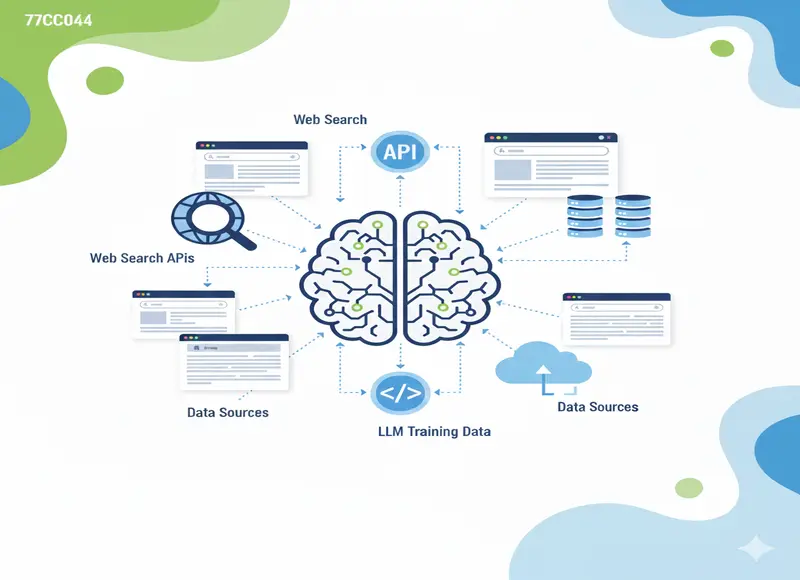
Building a powerful Large Language Model (LLM) requires deploying dedicated tools to create high-quality sets of data that can be used for training purposes. Instead of relying on traditional tools, developers should use web search APIs compatible with AI applications to extract, clean, and organize data.
AI-native solutions can be integrated into existing RAG pipelines and streamline obtaining accurate data saved in the right format. In this guide, we decided to test popular web search APIs available today to discover which are best suited for aggregating data for LLM training.
Key API Requirements for LLMs
When looking for a search API, developers should consider whether it is suitable for their specific needs and objectives. When testing AI-native APIs, we focused on the following criteria:
- Performance. Top-level APIs allow LLMs to achieve higher response speed and accuracy. They can be used for training purposes, as they empower LLMs to provide better replies in real-world situations.
- Customization. Good APIs are flexible, which allows developers to train AI models on specific datasets and adjust their performance to solve specialized tasks.
- Scalability. An API should be easy to scale, especially if a company expects that the demand for chatbots will be inconsistent. Top APIs can scale with ease, enabling them to handle an increased number of requests during peak times.
Moreover, it’s better to choose a web search API with an active community and a helpful technical support team. If a company has clients from different countries, it should find an API that supports the languages of its target audience.
Top APIs for LLM Data Aggregation
We have thoroughly tested popular search APIs and selected the list of the best options for those who are looking for AI-native solutions suitable for training enterprise-level LLMs. Here are the options AI developers should consider when selecting search APIs.
NewsCatcher
If you want to discover reliable search tools that deliver top-level performance comparable to that of a human data analyst, NewsCatcher`s Web Search API for AI is exactly what you need. This powerful tool excels at finding articles relevant to a query within seconds.
NewsCatcher facilitates gathering news data at scale. It is perfect for those who develop apps with market analysis tools, want to monitor client feedback on a particular brand, or need to keep track of news to predict potential supply chain disruptions. The API has impressive recall capabilities and saves structural data in a format that can be read by an LLM.
Exa
This search API will be especially useful for development teams tasked with building AI assistants. It easily integrates with RAG workflows and has advanced semantic search capabilities. When integrated with LLMs, Exa allows them to interpret inputs in a relevant context and ensure that a chatbot’s replies will be based on accurate information. This solution is different from traditional SERP APIs, as it does not focus on keywords. Instead, it grasps subtle nuances of meaning and considers how different ideas may be linked to each other.
SerpApi
This search tool facilitates scraping data that can be found on Google or with the help of other popular search engines. It’s compatible with many programming languages and allows AI developers to use no-code tools. SerpApi provides real-time access to search results and helps AI engineers save time and obtain accurate, structured data quickly. It was designed for scraping dynamic content and can solve CAPTCHA easily.
Tavily
Advanced LLMs need to use well-organized data that is easy to digest. It allows them to fine-tune their performance and process information faster. Tavily saves data in JSON format and works best when deployed together with an LLM during the process of generating outputs. It feeds an LLM with current, factual data, making it an invaluable part of a RAG process. Developers use Tavily to ensure that their AI models won’t rely on outdated information.
Brave Search API
Developers integrate this search API with RAG pipelines to ensure that an LLM will be able to collect real-time data. It allows them to make LLM responses more relevant to a query and avoid hallucinations. The search API has its own index and affordable pricing. Due to the support of the Model Context Protocol, it can significantly streamline agentic workflows and allow developers to build advanced training models with multi-step reasoning capabilities.
Brave Search API supports AI grounding, which ensures that an LLM will use only verifiable sources. However, some complex tasks may require making several API calls, making this solution less suitable for those who prioritize cost efficiency.
Perplexity AI API
The Perplexity AI API is designed for building AI systems that require grounded, citation-backed answers. It combines web search, semantic understanding, and reasoning into a single interface. When integrated with LLMs, it enables them to generate responses supported by verifiable sources, significantly reducing hallucinations.
This API is especially useful for research assistants, knowledge bots, and decision-support systems where transparency and trust are critical. Unlike traditional search APIs, Perplexity emphasizes answer synthesis with references, making it ideal for applications that need explainable outputs rather than raw document retrieval.
Bing Web Search API (Microsoft)
The Bing Web Search API provides enterprise-grade access to real-time web data through Microsoft’s global search infrastructure. It is widely used in production environments that demand reliability, freshness, and compliance.
For LLM-powered applications, Bing Web Search API acts as a strong grounding layer, supplying up-to-date information that can be injected into RAG pipelines. While it relies more on keyword-based retrieval than semantic reasoning, it excels in coverage, stability, and scale, making it a dependable choice for enterprise AI assistants and analytical tools.
Cohere Rerank & Search
Cohere Rerank & Search tools are designed to maximize retrieval quality in RAG systems. Instead of focusing solely on search, Cohere excels at reranking retrieved documents based on semantic relevance to a user query.
This capability dramatically improves LLM output quality by ensuring that only the most contextually relevant information is passed to the model. Cohere’s tools are commonly paired with other search APIs (such as Bing, Tavily, or Exa) and are especially effective in enterprise knowledge retrieval, customer support automation, and research-heavy AI workflows.
Conclusion
When evaluating web search APIs for LLM training data aggregation, it becomes clear that different tools serve different priorities. Some solutions excel at large-scale data collection, others focus on semantic understanding and RAG workflows, while certain APIs specialize in real-time access or structured SERP data. Choosing the right API ultimately depends on factors such as data freshness, scalability, semantic capabilities, cost efficiency, and how well the tool integrates into existing AI pipelines.

Marketing Manager
Recent Blogs
Elia Martell
5 Virtual Recruiting Support Operations for Tech and Healthcare Teams
-
09 Oct 2026
-
8 Min
-

627


Jane Hart
Why LinkedIn Campaign Optimization Requires More Than CPC and CTR
-
09 Oct 2026
-
8 Min
-
189

Jane Hart
How to Vet an Offshore SEO Partner: A Due-Diligence Checklist for Agencies and Brands
-
08 Oct 2026
-
8 Min
-
323

Jane Hart
Benchmarking GPU Providers: A Practical Guide to Comparing Cloud Compute Options
-
07 Oct 2026
-
6 Min
-
187
