


How to Choose the Right AI Agent Consulting Partner for Your Business
-
Last Updated:

31 Mar 2026
-
Read Time:

6 Min Read
-
Written By:
 Elia Martell
-
1195
Table of Contents
-
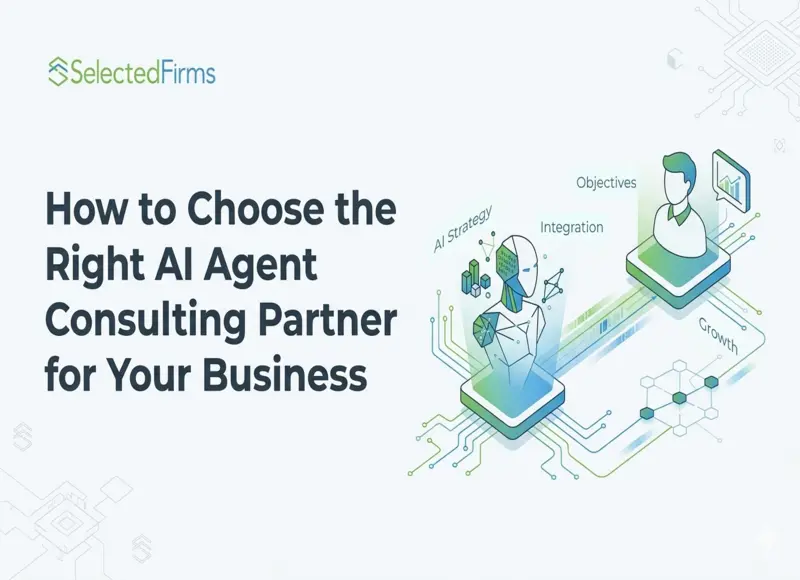
The enterprise is pivoting from chat tools to autonomous AI agents. Instead of a straightforward Q&A interface where a human does the thinking, an agentic interface takes a high-level command, then builds and executes an AI plan/workflow to deliver a completed output. Accordingly, 88% of senior execs plan to increase their overall AI budget to include these multi-step agents. (Source: PwC AI Agents Survey)
The hardest part of these projects isn't the agents themselves. The hardest part is organizational readiness, namely closely connecting workflows and adoption. This is why you want to pick a great deployment partner rather than get dazzled by a cool new demo. A good partner delivers great integration, security, and operational ROI.
If you're an enterprise that's ready to graduate beyond fragmented AI pilots, you want someone who deeply understands how to turn the unproven into the reliable on an everyday basis within your existing enterprise architecture. This transition is a key component of AI agents enterprise software automation.
What an AI Agents Consulting Partner Will Actually Do for You
Go Beyond Idea to Actual Workflows
A good partner will do more than just pick an LLM model. They'll bridge the gap between the technology world and the everyday operational world. Part of that is workflow discovery not via process workshops, but via AI-driven process mapping that asynchronously interviews stakeholders to figure out the "As Is" state without blocking folks. Then they'll help pick highly-specific workflows and set up an Analyze/Measure/Improve loop that captures failure modes and turns them into metrics, so the workflow is reliable over time.
Connect Your AI Agents to Business Ops
An AI agent is only useful if it can connect to your operational environment. You need to connect the "Brain" (LLM) with all the back-office tools that are in play. They'll help you securely connect all the legacy APIs, CRM databases, email/notifications, calendars, and more.
You can create:
- Analyst Agents: These analyze the shadow notes on CRM systems and find otherwise-hidden patterns.
- Action Agents: These automatically follow up with customers or update a Kanban board without humans needing to do anything.
What’s the Context Where AI Agents Consulting Makes Sense Now?
- People are stuck doing admin and coordination work: In many organizations, collaborative work such as email, messaging, calls, and meetings consumes a large share of the workweek, which is why workflow automation can have an outsized operational impact.
- Important follow-ups or tasks get lost: Fast lead response matters, and many companies still respond too slowly to inbound inquiries, which can hurt conversion and follow-up performance.
- Your systems don't integrate well with external providers: People end up needing external help because disjointed systems cause delays or blackouts. If you're stuck with manually managing access controls, then you'll experience frequent outages that take hours to coordinate and remediate because of all the fragmented systems.
Pick a Use Case BEFORE You Pick Your AI Agents Consulting Partner
- Pick 1–2 workflows that actually matter: List out one or two meaningful, high-frequency workflows that you want to improve first. A narrower starting point reduces the risk of building something impressive in theory but misaligned with day-to-day business needs. You want to be in the ROI sweet spot where it's interesting enough to be useful but not complex enough to take something like back-office task routing or lead follow-up.
- Enumerate all the systems the agent needs to interface with: Because of the lack of visibility into technical debt, seemingly simple ideas often hit walls because of integration dependencies with legacy systems. Make sure to list out all the internal legacy DBs, client communication portals, and calendaring/scheduling interfaces.
- Define the desired output/result for the use case BEFORE selecting the consulting services: You want to define a baseline starting point for the performance of the current manual system. You need to define a granular business-level problem, not just the tech-industry-level goal, so that you can understand the desired ending objectives before any funds are spent on services.
What You Want in an AI Agents Consulting Partner
"When evaluating providers, businesses should look beyond broad strategy decks and focus on whether the partner can actually turn AI into a working part of day-to-day operations. That is where specialized AI agent consulting becomes valuable."
- Business expertise, not tech jargon: You need a provider that understands the core business you operate in. When a consulting provider speaks in terms of decks and granular strategy above the core workflow integration but can't actually implement AI systems to specific day-to-day operational tasks, that's a problem.
- Integration/deployment capabilities: You want real bespoke integration capability with your custom architecture, specifically concerning hooking into 5–15 year old legacy platforms via API or middleware.
- Privacy/permissions/data-handling expertise: You want partners that can clearly explain how customer data is stored, retained, protected, and whether it is ever used for model training, since those policies vary by provider and product.
- Trusted/autonomous deployment with human-in-the-loop supervision: You want a gradual rollout of autonomy with very high oversight at the start and mandatory checkpoints for anything the agent attempts to do that is irreversible.
- Implementation/support/optimization over time: It’s not just for the launch. You want an ecosystem for implementation and support that includes operational audits, checkups, and stability over time.
Consulting Questions to Ask Before Hiring
- What are the ~25 workflows the provider has deployed? In initial discovery, focus on the production customer count rather than operational size or funding. You want to talk to ~3 customers in your industry regarding deployment times.
- How do you handle integrations and permissions? Ask the same complex questions in the RFP/demo and see if the responses detail how they limit system access and set identity-based oversight.
- What happens after the initial launch? How do they escalate when an agent hits an unpredicted edge case? Who owns the post-launch optimization, and how often is there a standard knowledge transfer?
- How do you measure success? You want the metrics to be more than just engineering delivery velocity; you want to measure "usage trust." If employees don't trust the agentic system, they will revert back to manual operational paradigms.
Red Flags for AI Agents Consulting
- Pushes tools rather than workflows: You can't automate bad logic. If a vendor is focused on rapid tech installation without auditing the underlying logic, they'll just speed up failures.
- Promises full autonomy with no explainability: Anything that's a "black box" causes immense operational risk. For example, an agent can misinterpret a technical command and execute a full power-cycle of the datacenter.
- Vague about security/oversight/support: Many organizations are still early in building the governance, oversight, and access controls needed for more autonomous AI systems. If a provider is vague about monitoring, escalation paths, or system access controls, that’s an automatic disqualifier.
- No measurable outcomes: If the vendor doesn't measure the scope of their pilot projects in your real proprietary environments and just leans on hype, they're a bad vendor.
Why Implementation Trumps Demos
Polished demos don’t discuss workflows. Highly controlled AI agent deployments on sales calls aren’t predictive of real-world resiliency. The “demo trap” is choosing a product based on a hand-picked demo rather than how it performs inside the unpredictability of a real organization. Current research predicts that by 2027, 40% of agentic AI projects will be canceled due to escalating costs, unclear business value, or inadequate risk controls.
Business outcomes are what matter, not novelty. The 10/20/70 rule on real business impacts is:
- 10% from algorithms
- 20% from data prep
- 70% from change management and process adaptation
Professional AI systems integration often uncovers legacy hurdles, and real deployment timelines are usually longer than early demos suggest because integration, permissions, testing, and change management take time. Execution is the key competitive advantage.
Next Steps
Pick 3–5 partners based on workflow fit, implementation capabilities, and long-term support. Pick a "1-use-case-execution" where it's "Spark but Scale" and try your best to pick vendors based on clarity, workflow process, and operational readiness not presentation. The one that executes on making AI into daily business operations is the winner.

Marketing Manager
Recent Blogs
Elia Martell
5 Virtual Recruiting Support Operations for Tech and Healthcare Teams
-
09 Oct 2026
-
8 Min
-

627

Jane Hart
Why LinkedIn Campaign Optimization Requires More Than CPC and CTR
-
09 Oct 2026
-
8 Min
-
189
Jane Hart
How to Vet an Offshore SEO Partner: A Due-Diligence Checklist for Agencies and Brands
-
08 Oct 2026
-
8 Min
-
323
Jane Hart
Benchmarking GPU Providers: A Practical Guide to Comparing Cloud Compute Options
-
07 Oct 2026
-
6 Min
-
187
