


Table of Contents
Choosing an Adobe Commerce agency isn’t just hiring developers—it’s shaping your ecommerce future. This guide helps you spot true experts, avoid costly missteps, and build a scalable, high-performing platform that grows with your business.
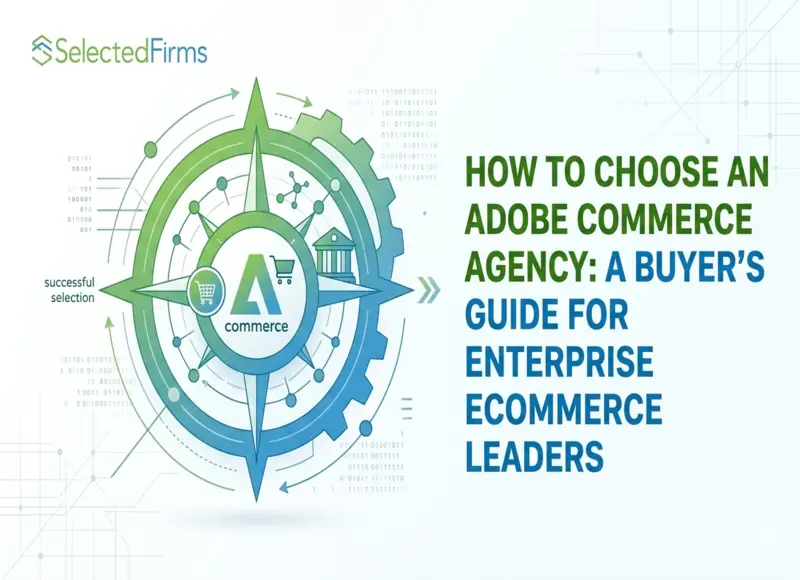
Adobe Commerce is not a platform you implement in a weekend. Licensing alone runs from tens of thousands to several hundred thousand dollars annually, and the implementation itself typically spans six to twelve months when done well. The platform rewards merchants who treat ecommerce as a strategic technology investment, and it punishes those who treat it as a website build.
Therefore, choosing the ideal Adobe Commerce partner is the most weighty and influential plan a commerce leader will mark as executed throughout the year past. A wrong partner misses deadlines and puts you in an architectural war for a timespan running up to three years, giving you integrations that break whenever something above them moves or tweaks, leaving the coding standards you would expect for a new developer with two months of learning before he can comfortably step in.
This guide walks through what to evaluate when selecting an Adobe Commerce partner, the red flags that indicate a poor fit, and how to structure the engagement for long-term success.
Why Adobe Commerce Demands Specialized Expertise
Adobe Commerce (formerly Magento Commerce) is an enterprise-grade platform that is intended for merchants with complex catalogs, diverse price rules, B2B workflows or multiple regions. The platform is strong because it gives you full access to the codebase, therefore ensuring full extensibility motivation. The power, however, works against you.
A generalist e-commerce developer will be able to put together a functional Magento store. On the other hand, the specialized Adobe Commerce team do understand the point at which it should use a plug-in, build a module, extend core functionality, or push some logic into a separate service layer. That is the difference between a build that functions under load and one that crashes during Black Friday.
Three areas separate specialists from generalists.
Architecture decisions. Those familiar with the intricacies of native B2B features and custom B2B logic know about the appropriateness of the Native catalog and the alternatives offered by PIMS, when Page Builder is needed to satisfy customer requirements, and when custom front-end development is essential, and how to configure multi-store systems, avoiding a maintenance headache.
Performance tuning. An Adobe Commerce site rarely tuned, and a fine-tuned one have a 3 to 5-second differential in page load time. Experts know their way around the various Varnish configurations, indexers, full-page caching optimization, correct deployment of static content, and the usual pitfalls concerning Adobe Commerce when it feels slow but should not really.
Integration fluency. Adobe Commerce rarely operates alone. It connects to ERPs like NetSuite, Microsoft Dynamics, SAP, and Oracle. It talks to CRMs, PIMs, OMS platforms, 3PL warehouses, tax engines, and fraud screening tools. Specialists have built these integrations before and know the patterns that scale versus the ones that break every time either system updates.
What to Look for in an Adobe Commerce Partner
Define which thing you really need before you narrow down the partners. A B2B manufacturer with 50,000 SKUs and customized price lists will require a very different partner than a DTC brand graduating from Shopify because they have grown too big for the system to handle the checkout process anymore.
Once you know what you need, evaluate partners against these criteria.
Adobe Solution Partner status. Adobe maintains a partner program with Bronze, Silver, Gold, and Platinum tiers. Higher tiers indicate more certified specialists, more documented case studies, and a longer track record. Platinum partners are rare and typically work on the largest implementations. A serious enterprise build should involve at least a Gold partner. A qualified adobe commerce agency will lead with their partner status and certifications during the initial conversation rather than burying it at the end of a pitch deck.
Certified developers on staff. Adobe offers formal certification paths for developers, solution specialists, and architects. Ask any agency how many certified Adobe Commerce developers they have on staff, not contracted or subcontracted. The answer tells you how much actual Adobe Commerce expertise lives inside the agency versus how much they outsource when work comes in.
Portfolio depth in your industry or model. B2B Adobe Commerce looks different from B2C. Multi-country implementations look different from single-region. Food and beverage has regulatory requirements that fashion does not. Ask for case studies that match your business model, not just your industry. A wholesale fashion brand needs a partner who has built B2B fashion implementations, not one who has done consumer fashion and B2B industrial separately.
References you can actually call. Case studies are marketing. References are truth. Ask for three client references and call all three. Ask what the agency did well, what they did poorly, how long the engagement was, whether they would hire the agency again, and what surprised them during the project. The answers tell you more than any pitch deck.
In-house product management. Top Adobe Commerce implementations do not just come from developers; they are created by product managers who translate business needs into technical specifications, handle scope, and guard the project from increasing feature creep without extending timelines. If the agency has no dedicated product management within the proposed team, you will end up doing that work by yourself.
Red Flags to Watch For
The agency cannot explain their architecture recommendations in plain English. If an architect cannot walk you through the proposed system design without reverting to jargon, they likely do not understand it well enough to defend it when changes are needed.
They agree to every request during the sales process. Agencies that say yes to every requirement before understanding the full picture will either miss the budget or cut corners later. Good partners push back when requirements are unclear or when a specific approach creates long-term debt.
They do not ask about your team, your stakeholders, or your existing technology. An Adobe Commerce build is an organizational project, not a technology project. Partners who do not ask about your internal team, your executive sponsor, your change management approach, and your existing tech stack do not understand how these projects actually succeed.
They propose custom development for functionality that exists natively. This is the most expensive pattern in the industry. Agencies with junior teams recommend custom builds because that is what they know how to do. The result is higher cost, longer timeline, and brittle functionality that native features would have handled reliably.
They cannot show you production code samples. Not screenshots, not case study images. Actual code. A serious partner will walk you through an anonymized module or integration they have built, explain the structure, and let you ask questions. If they cannot or will not, their code quality is likely not where it needs to be.
Scoping the Engagement
The biggest mistake ecommerce leaders make is asking for a full fixed-price proposal before the work is scoped properly. Adobe Commerce builds have too many variables for fixed pricing to work without either massive contingency buffers or scope reduction mid-project.
The best engagement structure follows three phases.
Phase 1: Discovery. A paid discovery engagement, typically two to six weeks, produces a documented architecture, detailed feature scope, integration specifications, a realistic timeline, and a fixed-price proposal for Phase 2. Discovery is not free, and you should be skeptical of any agency that offers extensive discovery work for free. Free discovery either gets charged back to you in inflated Phase 2 pricing or results in incomplete scoping that causes problems later.
Phase 2: Build. Fixed-price or time-and-materials implementation based on the Phase 1 deliverables. Six to twelve months is a realistic timeline for most enterprise implementations. Compressing that timeline rarely produces good results.
Phase 3: Support and optimization. Ongoing engagement for performance tuning, feature additions, platform upgrades, and bug fixes. The best agencies structure this as a retainer with clear SLAs, not ad-hoc hourly billing that creates friction every time something breaks.
Pricing Expectations
Enterprise Adobe Commerce implementations typically run between $150,000 and $750,000 depending on complexity, integration count, catalog size, and feature scope. Simple migrations from Magento Open Source to Adobe Commerce land on the lower end. Full B2B implementations with PIM, ERP, and CRM integrations, multi-country rollouts, and custom checkout experiences land on the higher end.
Anything under $100,000 for a full Adobe Commerce implementation should raise questions about what is being cut. Anything over $1,000,000 should raise questions about scope and whether a headless architecture or different platform would serve better.
Hourly rates for serious Adobe Commerce agencies range from $125 to $250 for senior developers and architects. Agencies billing under $100 per hour for senior roles are typically offshore teams with limited Adobe Commerce depth or junior teams padding their proposal with senior titles that do not reflect actual seniority.
Getting the Most From the Relationship
Once you have chosen a partner, the success of the engagement depends largely on how you manage it.
Assign an internal product owner with authority to make decisions without rounds of approval. Agencies cannot move faster than their client's decision cycle. If every question has to be escalated to a committee, the project will run long and the partner will lose focus.
Maintain one source of truth for requirements, decisions, and changes. Slack threads, email chains, and verbal agreements fall apart in a six-month engagement. A shared documentation workspace, a formal change request process, and weekly status reports with clear decisions keep everyone aligned.
Budget 10 to 20 percent of the implementation budget for post-launch work. The first 90 days after launch always surface issues, edge cases, and optimization opportunities. Agencies that disappear after launch are telling you what their approach is. Good partners plan for the stabilization period as part of the engagement.
Adobe Commerce is a long-term platform investment. The partner you choose will shape how that investment performs for years. Choose deliberately, scope carefully, and manage the engagement with the discipline the platform deserves.


Head Of Digital Marketing
Recent Blogs

Elia Martell
5 Virtual Recruiting Support Operations for Tech and Healthcare Teams
-

09 Oct 2026
-

8 Min
-

477
Jane Hart
Why LinkedIn Campaign Optimization Requires More Than CPC and CTR
-
09 Oct 2026
-
8 Min
-
155
Jane Hart
How to Vet an Offshore SEO Partner: A Due-Diligence Checklist for Agencies and Brands
-
08 Oct 2026
-
8 Min
-
263
Jane Hart
Benchmarking GPU Providers: A Practical Guide to Comparing Cloud Compute Options
-
07 Oct 2026
-
6 Min
-
173
